Two function g1(t) and g2(t) with correlation of 6 has average power of 4 and 5 respectively. The power of g1(t) + g2(t) is
-
9 -
21 -
3 -
15
An impulse function consist of
-
pure dc -
pure a.c -
entire frequency range with constant phase -
infinite bandwidth with linear phase vaariations
The ROC of sequence in the Z.T. of sequence x[n] = an ∪ [n] is
-
z > a -
z < a -
|z| > a -
|z| < a
In Laplace transform, multiplication by e-at in time domain becomes
-
translation by a in s domain -
translation by (-a) in s domain -
multiplication by e-as in s domain -
none of the above
Z transform is a non-linear operation.
-
True -
False
As per time displacement theorem in Laplace transformation, displacement in the time domain by T becomes
-
division by s in the s domain -
division by e-sT in the s domain -
multiplication by s in the s domain -
multiplication by e-sT in the s domain
The range of value "a" for which system will be stable. If impulse response of DT system is = an ∪[n]
-
a > 1 -
a < 1 -
1 < a < ∞ -
-1 < a < 1
The DTFT of x(n) = δ(n) will be
-
1 -
0 -
∞ -
not defined
The Laplace transform of f(t) is
-

-

-

-
none of the above
Energy density spectrum of x[n] = an∪[n] for -1 < a < + 1 is


Energy density spectrum of x[n] = an∪[n] for -1 < a < + 1 is
If 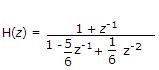 the poles of H(z) are at
-

-
z = 1 and z = 3 
-

-
z = -1 and z = -3
If the poles of H(z) are at
-
-
z = 1 and z = 3
-
-
z = -1 and z = -3
A rectangular pulse train s(t) is shown in figure is convolved with the signal cos2(4p x 103t). The convolved signal will be a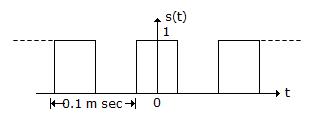
-
DC -
12 kHZ sinusoidal -
8 kHZ sinusoidal -
14 kHZ sinusoidal
Choose the function f(t), - ∞ < t < + ∞, for which a Fourier series cannot be defined
-
3 sin (25t) -
4 cos (20t + 3) + 2 sin (10t) -
exp - | t | sin 25 t -
1
A signal f(t) = cos 10pt + 3 cos 4pt is instantaneously sampled. The maximum allowable value of sampling interval Ts in sec is
-
1 / 4 sec -
1 / 8 sec -
1 / 8p sec -
1 / 10 sec
A signal f(t) = cos 10pt + 3 cos 4pt is instantaneously sampled. The maximum allowable value of sampling interval Ts in sec is
-
1 / 4 sec -
1 / 8 sec -
1 / 8p sec -
1 / 10 sec
If autocorrelation sequence is Rc(n) = 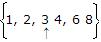 then what will be energy of sequence?
-
2 -
24 -
3 -
288
If autocorrelation sequence is Rc(n) = then what will be energy of sequence?
-
2 -
24 -
3 -
288
The range of value "a" for which system will be stable. If impulse response of DT system is = an ∪[n]
-
a > 1 -
a < 1 -
1 < a < ∞ -
-1 < a < 1
Auto correlation for t = 0 is equal to
-
average power S of waveform -
square of average power S of waveform -
half of average power S of waveform -
square root of average power S of waveform
Fourier transform of f(t) =
-
jω F(f) -
2pf F(f) -
F'(f) -
None
The range of value "a" for which system will be stable. If impulse response of DT system is = an ∪[n]
-
a > 1 -
a < 1 -
1 < a < ∞ -
-1 < a < 1
The DTFT of x(n) = δ(n) will be
-
1 -
0 -
∞ -
not defined
A voltage wave containingthird harmonic is applied to a scries R-L circuit. The percentage third harmonic content in the current wave will be
-
more than 10% -
10% or less than 10% -
less than 10% -
10% or more or less
If f(t) ↔ F(jω), and f(t) is real, then 


The Laplace transform of f(t) is
-
-
-
-
none of the above
The Laplace transform of f(t) is
-
-
-
-
none of the above
If the poles of H(z) are at
-
-
z = 1 and z = 3
-
-
z = -1 and z = -3
Choose the function f(t), - ∞ < t < + ∞, for which a Fourier series cannot be defined
-
3 sin (25t) -
4 cos (20t + 3) + 2 sin (10t) -
exp - | t | sin 25 t -
1
A signal f(t) = cos 10pt + 3 cos 4pt is instantaneously sampled. The maximum allowable value of sampling interval Ts in sec is
-
1 / 4 sec -
1 / 8 sec -
1 / 8p sec -
1 / 10 sec
If v(t) is a time varying voltage,  is
is
-
initial current -
initial voltage -
initial charge -
initial flux leakages
In the given figure 15.6 shows a series, R - C circuit fed by a current source i(t). There is an initial voltage v0. across the capacitor. The system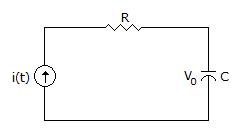
-
is linear -
is non linear -
may be linear or non linear -
is linear only if v0 is zero
The DTFT of x(n) = δ(n) will be
-
1 -
0 -
∞ -
not defined
If f(t) ↔ F(jω), and f(t) is real, then
The solution of state equations using Laplace transform is
-
x(t) = φ(t) x(0) + L-1 [φ(s) Bu(s)] 
-
x(t) = φ(s) x(0) + L-1 [φ(s) Bu(s)]
-
x(t) = eAt X(0) +  eA(t-t) Bu(t)dt
 -
Both (a) and (b)
If a signal g(t) has energy E, then the energy of the signal g(2t) is equal to ...
-
E/2 -
E/4 -
E -
2E
If f(k) ↔ F(z), then kn fk ↔
-
[F(z)]n 

-

-
[F(z)]1/n
-

The Laplace transform of f(t) is
-
-
-
-
none of the above
The period of the function cos  is
is
-

-
8s 
-
4s
-

If £[f(t)] = F(s), then £[f(t - T)] =
-
est F(s) 

-
e-st F(s)
-

-

If autocorrelation sequence is Rc(n) = then what will be energy of sequence?
-
2 -
24 -
3 -
288
If v(t) is a time varying voltage, is
-
initial current -
initial voltage -
initial charge -
initial flux leakages
If f(t) ↔ F(jω), and f(t) is real, then
The solution of state equations using Laplace transform is
-
x(t) = φ(t) x(0) + L-1 [φ(s) Bu(s)]
-
x(t) = φ(s) x(0) + L-1 [φ(s) Bu(s)]
-
x(t) = eAt X(0) + eA(t-t) Bu(t)dt -
Both (a) and (b)
The impulse response h[n] of a linear time invariant system is given as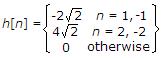
If the input to the above system is the sequence ejpn/4, then the output is
-
42 ejpn/4 -
42 e- jpn/4 -
4epn/4 -
-4epn/4
If f(k) ↔ F(z), then kn fk ↔
-
[F(z)]n
-
-
[F(z)]1/n
-
The period of the function cos is
-
-
8s
-
4s
-
The period of the function cos is
-
-
8s
-
4s
-
Auto correlation for t = 0 is equal to
-
average power S of waveform -
square of average power S of waveform -
half of average power S of waveform -
square root of average power S of waveform