Q.1.
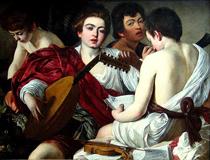
was painted by Caravaggio in 1595 and is now in the collection of the Metropolitan Museum. It is an allegorical painting rather than a true to life picture, as can be seen by the inclusion of which figure in the top left hand corner?
-
0%
A devil
-
0%
Apollo
-
0%
An angel
-
0%
Cupid
Q.2.
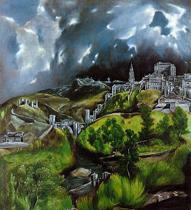
Painted by El Greco circa 1597, this dramatic landscape is a view of which Spanish city?
-
0%
Toledo
-
0%
Madrid
-
0%
Seville
-
0%
Barcelona
Q.3.
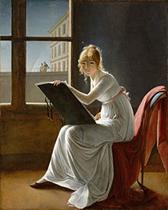
Once ascribed to Jacques-Louis David, this is now thought to be a self portrait by which 19th century French artist?
-
0%
Angelina Jolie
-
0%
Marie Denise Villers
-
0%
Brigitte Bardot
-
0%
Anne Marie Escoffier
Q.4.
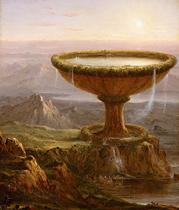
What is the title of this 1833 fantasy painting by the British-American artist, Thomas Cole?
-
0%
The Giant's Chalice
-
0%
World in Miniature
-
0%
The Titan's Goblet
-
0%
Insignificance of Man
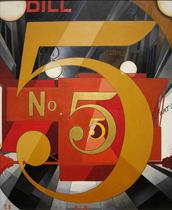
Q.5.
An appropriate choice of subject for question number 5, Charles Demuth's 1928 work is inspired by what?
-
0%
By a song
-
0%
By a film
-
0%
By a poem
-
0%
By an advert
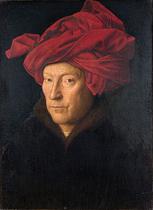
Q.6.
Possibly a self portrait, this 1433 painting by the Dutch artist Jan van Eyck can be found in the National Gallery. It is called simply , but what other name has it been given?
-
0%
Portrait of a Man in a Turban
-
0%
Portrait of the Artist
-
0%
Portrait of an Old Man
-
0%
Portrait of van Eyck
Q.7.
What is the name of this 1811 piece created by German artist Caspar David Friedrich, which unites Christian ideas with a winter scene?

-
0%
Christmas Tree
-
0%
Holy Tree
-
0%
Christmas landscape
-
0%
Winter Landscape
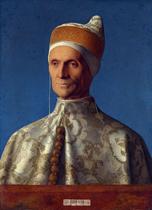
Q.8.
This portrait of Leonardo Loredan was painted in 1501 by the Venician painter Giovanni Bellini. Who exactly was Leonardo Loredan?
-
0%
He was the Pope
-
0%
He was the elected leader of Venice
-
0%
He was a Cardinal
-
0%
He was the King of Florence
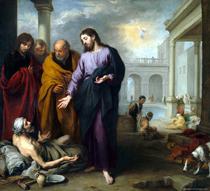
Q.9.
This painting, , was created around 1670 by the Spanish artist Bartolomé Esteban Murillo. It was one of a series of works representing what?
-
0%
The seven pillars of wisdom
-
0%
The seven acts of charity
-
0%
The seven days of the week
-
0%
The seven deadly sins
Q.10.
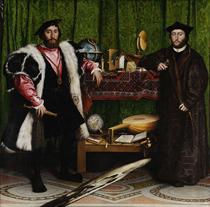
This Hans Holbein work, , has a distorted skull in a central position at the foot of the painting. The distortion is deliberate. Holbein has used an anamorphic perspective which can only be seen clearly when viewed from the correct angle (in this case, from below and slightly to the right). In what year was this painting made?
-
0%
1533
-
0%
1633
-
0%
1733
-
0%
1833