Q.1.
Use of baffles in shell and tube Heat exchangers increases pressure drop.
- a) True
- b) False
Q.2.
In how many ways can we classify Shell and Tube heat exchangers on the basis of flow patterns?
- a) 1
- b) 2
- c) 3
- d) 4
Q.3.
Which of the following has the maximum Log mean temperature difference for a Shell and tube Heat Exchanger?
- a) Counter-flow
- b) Parallel Flow
- c) Cross Flow
- d) Split Flow
Q.4.
What are the types of baffles exist for a shell and tube heat exchanger?
- a) Cross baffle, Split baffle and segmental baffle
- b) Counter baffle, doughnut baffle and Cross baffle
- c) Orifice baffle, segmental baffle and doughnut baffle
- d) Orifice baffle, segmental baffle and Counter baffle
Q.5.
Which one of the following is not a type of baffle for heat transfer in shell and tube HE?
- a) Segmental
- b) Orifice
- c) Doughnut
- d) Divided
Q.6.
What are the types of pitch arrangements are available for the baffles to be used in Shell and Tube HE?
- a) Square pitch and Rectangular pitch
- b) Square pitch and Triangular pitch
- c) Rectangular pitch and Hexagonal pitch
- d) Hexagonal pitch & Triangular pitch
Q.7.
When phase change occurs in one of the fluids, it is preferred to be kept at the shell side.
- a) True
- b) False
Q.8.
Which one of the following fluid cannot be placed in the shell side?
- a) Condensing Vapour
- b) Fluid with very high temperature
- c) Fluid with very high pressure
- d) Fluid with high viscosity
Q.9.
Which one of the following fluid cannot be placed in the tube side?
- a) Fouling Fluid
- b) Cooling liquid
- c) Corrosive fluid
- d) Highly viscous
Q.10.
When the fluid is very viscous, we can __________
- a) Keep it in shell side
- b) Keep it in tube side
- c) Keep it in any side
- d) Not use it
Q.11.
To calculate the temperature difference in a Shell and tube heat exchanger, we use _____
- a) LMTD
- b) Mean temperature difference
- c) Median of the temperature difference
- d) Square mean of the temperature difference
Q.12.
Recognize the type of pitch given the figure below.
- a) Square pitch
- b) Triangular pitch
- c) Rotated Square pitch
- d) Hexagonal pitch
Q.13.
Recognize the type of pitch given the figure below.
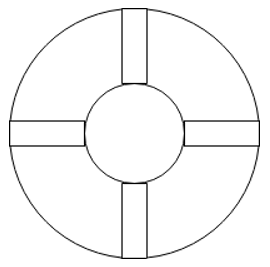
- a) Square pitch
- b) Triangular pitch
- c) Rotated Square pitch
- d) Hexagonal pitch
Q.14.
Recognize the type of pitch given the figure below.
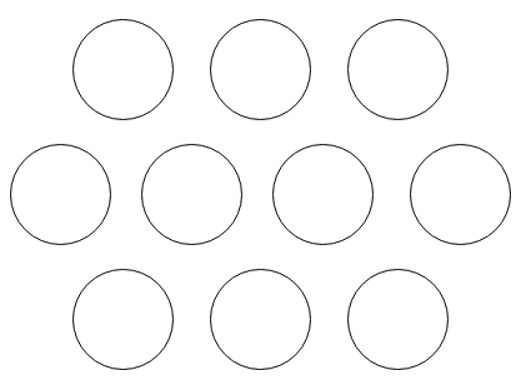
- a) Square pitch
- b) Triangular pitch
- c) Rotated Square pitch
- d) Hexagonal pitch