Q.1.
A point is moving at the end of the link rotating with constant angular velocity ω, what will be the value of tangential component of acceleration?
- a) 0
- b) ω2R
- c) Infinite
- d) ω2R/2
Q.2.
The tangential component of acceleration is maximum when the link rotates with a constant angular velocity.
- a) True
- b) False
Q.3.
A point is moving at the end of the link rotating with constant angular velocity ω, what will be the value of radial component of acceleration?
- a) 0
- b) ω2R
- c) Infinite
- d) ω2R/2
Q.4.
In a slider crank mechanism, the crank rotates with a constant angular velocity ofrpm, Length of crank is 150mm, and the length of the connecting rod is 600mm. Determine linear velocity of the midpoint of the connecting rod in m/s. Crank angle =from IDC.
- a) 4.1
- b) 4.4
- c) 4.8
- d) 5.2
Q.5.
In a slider crank mechanism, the crank rotates with a constant angular velocity ofrpm, Length of crank is 150mm, and the length of the connecting rod is 600mm. Determine acceleration of the midpoint of the connecting rod in m/sCrank angle =from IDC.
- a) 117
- b) 144
- c) 148
- d) 252
Q.6.
What will be the shape of the velocity diagram of the slider crank mechanism if there are three links including the slider.
- a) Triangle
- b) Parallelogram
- c) Square
- d) Trapezium
Q.7.
If the normal component of the acceleration is doubled, what will be the effect on the radial component?
- a) Doubled
- b) Halved
- c) Remains same
- d) Becomes 4 times
Q.8.
If the body is not rotating with a constant angular velocity then there are both radial and tangential component of acceleration.
- a) True
- b) False
Q.9.
In the given figure, the direction of radial velocity vector and angular velocity is given what will be the direction of coriolis force?
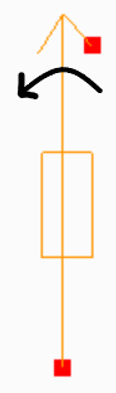
- a) Along the radial velocity vector
- b) Opposite to radial velocity vector
- c) Perpendicular to radial velocity vector towards right
- d) Perpendicular to radial velocity vector towards left
Q.10.
Coriolis component of acceleration exists when there is relative motion between two points from the ground frame.
- a) True
- b) False
Q.11.
Calculate the coriolis component of acceleration in m/s2 from the following data:
- a) 24
- b) 12
- c) 36
- d) 6
Q.12.
Which component of acceleration is parallel to the given link?
- a) Radial
- b) Tangential
- c) Coriolis
- d) Pseudo
Q.13.
Which of the following mechanism will have coriolis component?
- a) Quick return motion mechanisms
- b) Slider crank mechanism
- c) Four bar chains
- d) Gnome engine
Q.14.
Which component of acceleration is parallel to the velocity of given link?
- a) Radial
- b) Tangential
- c) Coriolis
- d) Pseudo