Q.1.
Which of the following instruments is used to draw ellipses?
- a) Elliptical trammels
- b) Slotted lever and crank
- c) Gnome engine
- d) Oldham’s coupling
Q.2.
Elliptical trammels are used to convert reciprocating motion into rotary motion.
- a) True
- b) False
Q.3.
How inversion is obtained in an elliptical trammel?
- a) Fixing the slotted plate
- b) Fixing the sliders
- c) Fixing the turning pairs
- d) Fixing the pin
Q.4.
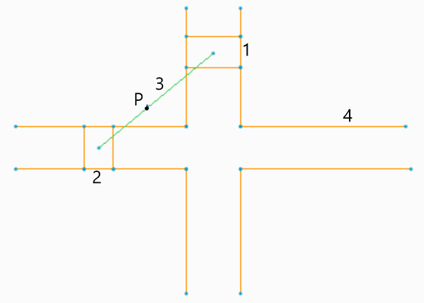
In the given figure, 1 and 2 are sliders, 3 is a bar and 4 is a fixed slotted plate, identify the mechanism.
- d) Gnome engine
- a) Elliptical trammel
- b) Scotch yoke mechanism
- c) Oldham’s coupling
Q.5.
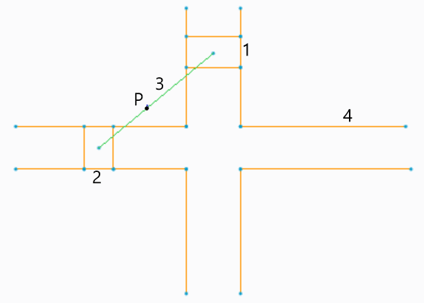
In the given figure if P is not the midpoint of the line connecting 1 andwhat is the locus of P?
- b) Straight line
- c) Parabola
- d) Rectangular hyperbola
- a) Ellipse
Q.6.
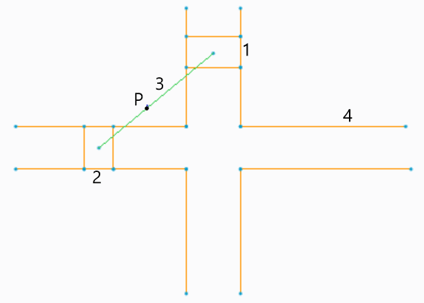
In the given figure if P is the midpoint of the line connecting 1 andwhat is the locus of P?
- a) Ellipse
- b) Circle
- c) Parabola
- d) Rectangular hyperbola
Q.7.
Which of the mechanism is used to convert rotary motion into a reciprocating motion?
- a) Elliptical trammel
- b) Scotch yoke mechanism
- c) Oldham’s coupling
- d) Gnome engine
Q.8.
In Scotch yoke mechanism, the crank is fixed in order to obtain the inversion.
- a) True
- b) False
Q.9.
Which of the following mechanism is used for connecting two parallel shafts whose axes are at a small distance apart?
- a) Elliptical trammel
- b) Scotch yoke mechanism
- c) Oldham’s coupling
- d) Gnome engine
Q.10.
Which of the following link is fixed to obtain inversion in Oldham’s coupling?
- a) Driving shaft
- b) Flange
- c) Supporting frame
- d) Driven shaft
Q.11.
How many turning pairs are there in a double slider crank chain?
- a) 1
- b) 2
- c) 3
- d) 4
Q.12.
A double slider crank chain has one pair of each sliding and turning pairs.
- a) True
- b) False
Q.13.
How many sliding pairs are there in a double slider crank chain?
- a) 1
- b) 2
- c) 3
- d) 4
Q.14.
In which of the following mechanisms inversion is obtained by fixing the cylinder?
- a) Pendulum pump
- b) Gnome engine
- c) Double slider crank chain
- d) Oscillating cylinder
Q.15.
Which of the following is not an inversion of double slider crank chain?
- a) Elliptical trammels
- b) Scotch yoke mechanism
- c) Oldham’s coupling
- d) Gnome engine