Q.1.
Which one of the following, is not a method of introducing imperfections in metals?
- a) Heating
- b) Processing
- c) Alloying
- d) Crystallization
Q.2.
Which one is a point defect?
- a) Dislocation
- b) Vacancy
- c) Grain boundary
- d) Void
Q.3.
Which point defect is known as equilibrium defect?
- a) Void
- b) Dislocation
- c) Interstitial
- d) Vacancy
Q.4.
Identify the defect for the below diagram.
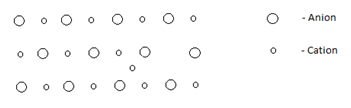
- a) Frankel
- b) Schottky
- c) Interstitialcy
- d) Vacancy
Q.5.
Identify the defect for the below diagram.
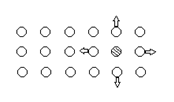
- a) Interstitial
- b) Substitutional
- c) Interstitialcy
- d) Schottky
Q.6.
Substitutional atoms are generally close in size (approximately 15%) to the parent metal atoms.
- a) True
- b) False
Q.7.
Which one is not an example of interstitial impurity?
- a) Carbon in iron
- b) Zinc in brass
- c) Hydrogen in Palladium
- d) Nitrogen in iron
Q.8.
If the atom is transferred to an interstitial position instead of the surface, then this defect is known as _____
- a) Interstitial
- b) Frankel
- c) Schottky
- d) Vacancy
Q.9.
In interstitial defect, the atoms surrounding the defect are in the state of tension.
- a) True
- b) False
Q.10.
For copper, the ratio between interstitial formation enthalpy and the energy required to create a vacancy is _____________
- a) 3:1
- b) 2:1
- c) 1:1
- d) 1:2
Q.11.
Match the following:
i) Oxidation of copper a) Frankel
ii) Neutron irradiation causes b) vacancy
iii) GaAs (anti site defect) c) interstitialcy
iv) Steel (C in Fe) d) interstitial
- a) i-b, ii-d, iii-a, iv-c
- b) i-b, ii-c, iii-a, iv-d
- c) i-c, ii-b, iii-a, iv-d
- d) i-d, ii-c, iii-a, iv-b
Q.12.
Which alloy system shows complete solubility?
- a) Cd-Mg
- b) Cu-Zn
- c) Fe-Ni
- d) Cu-Sn