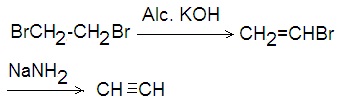
Q.1.
Reaction between acetone and methylmagnesium chloride followed by hydrolysis will give : ... [NEET 2020]
-
38%
a) Tert. butyl alcohol
-
34%
b) Isobutyl alcohol
-
22%
c) Isopropyl alcohol
-
6%
d) Sec. butyl alcohol
Q.2.
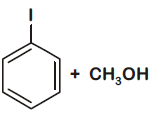
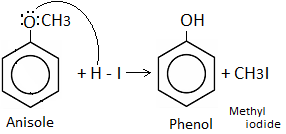
Anisole on cleavage with HI gives.... [NEET 2020]
-
18%
a)
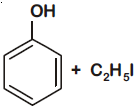
-
27%
b)
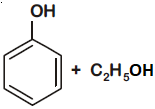
-
41%
c)
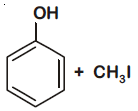
-
14%
d)
Explanation
Q.3.
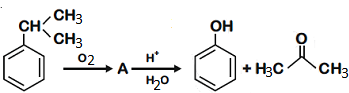
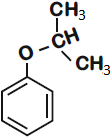
tion Q3) The structure of intermediate A in the following reaction, is .... [NEET 2019]
-
19%
a)
-
47%
b)
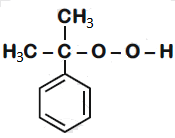
-
19%
c)
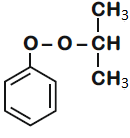
-
15%
d)
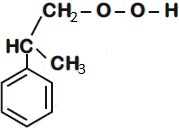
Q.4.
The compound that is most difficult to protonate is :
-
18%
a)
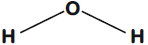
-
23%
b)
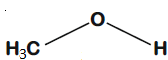
-
46%
c)
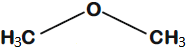
-
13%
d)
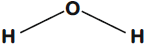
Q.5.
The compound A on treatment with Na gives B, and with PCl5 gives C. B and C react together to give diethyl ether. A, B and C are in the order .... [ NEET 2018]
-
17%
a) C2H5Cl, C2H6, C2H5OH
-
39%
b) C2H5OH, C2H5Cl, C2H5ONa
-
20%
c) C2H5OH, C2H6, C2H5Cl
-
23%
d) C2H5OH, C2H5ONa, C2H5Cl
Q.6.
tion Q6) In the reaction the electrophile involved is .... .. [NEET 2018]
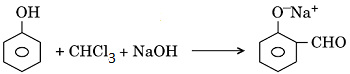
-
19%
a) dichloromethyl anion
-
23%
b) formyl cation
-
29%
c) dichloromethyl cation
-
29%
d) dichlorocarbene ( :CCl2)
Q.7.
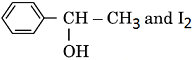
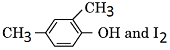
Compound A, C8H10O, is found to react with NaOI (produced by reacting Y with NaOH) and yields a yellow precipitate with characteristic smell. A and Y are respectively .... ...[NEET 2018]
-
28%
a)
-
29%
b)

-
23%
c)

-
20%
d)
Q.8.
Which of the following is added to chloroform to slow down its aerial oxidation in presence of light? [ AFMC 2008]
-
33%
a) Carbonyl chloride
-
31%
b) Ethyl alcohol
-
21%
c) Sodium hydroxide
-
15%
d) Nitric acid
Q.9.
Which of the following has the maximum viscosity .. [ AFMC 2003]
-
36%
a) Glycol
-
26%
b) Ethanol
-
26%
c) Water
-
11%
d) Acetone
Q.10.
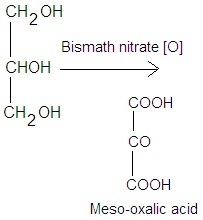
Glycerol on oxidation with bismuth nitrate produces. [ AFMC 1999]
-
24%
a) oxalic acid
-
31%
b) glyceric acid
-
26%
c) glyoxalic acid
-
20%
d) meso oxalic acid
Explanation
Q.11.
The catalyst used in the preparation of an alkyl chloride by the action of dry HCl on the alcohol is [ AFMC 2008]
-
30%
a) anhydrous AlCl3
-
22%
b) FeCl3
-
36%
c) anhydrous ZnCl2
-
12%
d) Cu
Q.12.
Alkyl halides react with dialkyl copper reagents to give [ AIEEE 2005]
-
18%
a) alkenyl halides
-
30%
b) alkanes
-
39%
c) alkyl copper halides
-
13%
d) alkenes
Q.13.
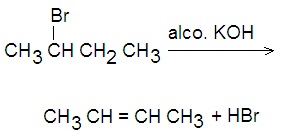
Elimination of bromine from 2-bromobutane results in the formation of [ AIEEE 2005]
-
21%
a) Predominantly 2-butyne
-
25%
b) Predominantly 1-butene
-
33%
c) Predominantly 2-butene
-
21%
d) equimolar mixture of 1 and 2-butene
Explanation
Q.14.
ion Q12) Arrange following phenols in order of their increasing acidity { AFMC 2011]
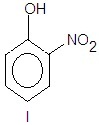
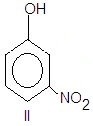
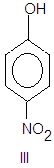
-
14%
a) I > III > II
-
34%
b) I > II > III
-
33%
c) III > I > II
-
19%
d) III > II > II
Q.15.
Chlorobenzene can be prepared by reacting aniline with [ IIT 1984]
-
21%
a) hydrochloric acid
-
18%
b) cuprous chloride
-
39%
c) chlorine in presence of anhydrous aluminium chloride
-
22%
d) nitrous acid followed by heating cuprous chloride
Q.16.
The reaction of toluene with chlorine in presence of ferric chloride gives predominantly ..[ IIT 1986]
-
17%
a) benzoyl chloride
-
20%
b) m-chlorotoluene
-
27%
c) benzyl chloride
-
35%
d) o- and p- chlorotolunene
Q.17.
The reaction conditions leading to the best yield of C2H5Cl are .. [IIT 1986]
-
27%
a) C2H6(excess) + Cl2 → ( in presence of uv light )
-
23%
b) C2H6 + Cl2 → ( at room temperature , dark)
-
24%
c) C2H6(excess) + Cl2( excess) → ( in presence of uv light
-
26%
d) C2H6 + Cl2(excess) → ( In presence of uv light)
Q.18.
n-propyl bromide on treatment with ethanolic potassium hydroxide produces.. [ IIT 19987]
-
21%
a) Propane
-
37%
b) Propene
-
21%
c) Propyne
-
21%
d) Propanol
Q.19.
The number of structural and configurational isomers of a bromo compound, C5 H9Br, formed by the addition of HBr to 2-pentyne respectively are [ IIT 1988]
-
12%
a) 1 and 2
-
50%
b) 2 and 4
-
30%
c) 4 and 2
-
8%
d) 2 and 1
Q.20.
1-Chlorobutane on reaction with alcoholic potash gives [ IIT 19991]
-
23%
a) 1-butene
-
29%
b) 1-butanol
-
36%
c) 2-butene
-
12%
d) 2-butanol
Q.21.
The chief reaction product of reaction between n-butane and bromine at 130°C is ..[ IIT 1995]
-
31%
a)
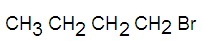
-
30%
b)
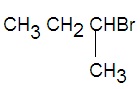
-
27%
c)
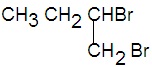
-
12%
d)
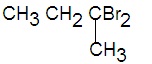
Q.22.
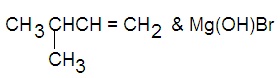
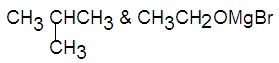
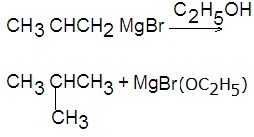
Iso butyl magnesium bromide with dry ether and ethyl alcohol gives [ IIT 1995]
-
22%
a)

-
39%
b)
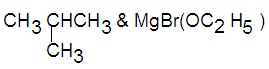
-
29%
c)
-
10%
d)
Explanation
Q.23.
During debromination of meso-2,3-dibromobutane, the major compound formed is .. [ IIT 1997]
-
15%
a) n -butane
-
25%
b) 1-butene
-
39%
c) cis-2-butene
-
22%
d) trans-2-butene
Q.24.
(CH3)3CMgCl on reaction with D2O produces ..[ IIT 1997]
-
22%
a) (CH3)3CD
-
28%
b) (CH3)3OD
-
30%
c) (CD3)3CD
-
20%
d) (CD3)3OD
Q.25.
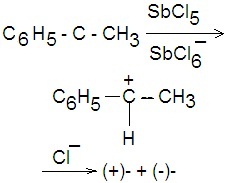
A solution of (+) -2-chloro-2-phenylethane in toluene racemises slowly in the presence of small amount of SbCl5 due to the formation of [ IIT 1999]
-
34%
a) carbanion
-
18%
b) carbebe
-
26%
c) free-radical
-
22%
d) carbocation
Explanation
Q.26.
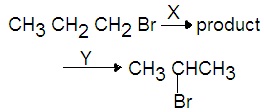
ion Q23) Identify the set of reagent/ reaction conditions 'X' and 'Y' in the following set of transformations [ IIT 2002]
-
19%
a) X= dilute aqueous NaOH, 20°; Y = HBr/acetic acid 20°
-
37%
b) X = Concentrated alcoholic NaOH, 80° ; Y = HBr/acetic acid 20°
-
27%
c) X= dilute aqueous NaOH, 20°; Y = Br2/CHCl3, 0°
-
17%
d) X = Concentrated alcoholic NaOH, 80° ;Y = Br2/CHCl3, 0°
Q.27.
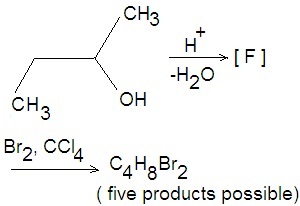
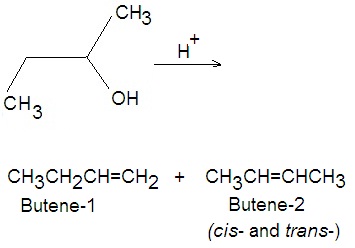
ion Q25) How many structures for F are possible? [ IIT 2003]
-
17%
a) 2
-
38%
b) 5
-
31%
c) 6
-
13%
d) 3
Explanation
Q.28.
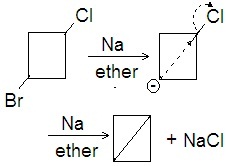
What would be the product formed when 1-bromo-3-chlorocyclobutane reacts with two equivalents of metallic sodium in ether? [ IIT 2005]
-
23%
a)

-
33%
b)

-
20%
c)

-
24%
d)

Explanation
Q.29.
When phenyl magnesium bromide reacts with tert-butanol, the product would be ..[ IIT 2005]
-
16%
a) Benzene
-
24%
b) Phenol
-
33%
c) tert-butylbenzene
-
27%
d) tert-butyl phenyl ether
Q.30.
ion Q28) The reagent(s) for the following conversion ..[IIT 2007]
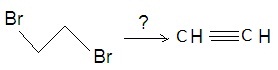
-
24%
a) alcoholic KOH
-
35%
b) alcoholic KOH followed by NaNH2
-
24%
c) aqueous KOH followed by NaNH2
-
17%
d) Zn/CH3OH
Explanation