Q.1.
The toxicity order for CH3OH, C2H5OH and C3H7OH is ... ...
-
32%
a) C2H5OH < CH3OH < C3H7OH
-
21%
b) C3H7OH < C2H5OH < CH3OH
-
32%
c) C2H5OH < C3H7OH < CH3OH
-
16%
d) CH3OH < CH3OH < C3H7OH
Q.2.
The compound which does not react with sodium is
-
18%
a) CH3- O - CH3
-
47%
b) C2H5OH
-
18%
c) CH3CHOHCH3
-
18%
d) CH3COOH
Q.3.
When acetyl chloride is reduced with LiAlH4, the product formed is ... ......
-
53%
a) acetaldehyde
-
20%
b) acetone
-
20%
c) methyl alcohol
-
7%
d) ethyl alcohol
Explanation

Q.4.
Association of alcohol molecules takes place because of .... ....
-
27%
a) ionic bond
-
33%
b) hydrogen bond
-
7%
c) electrovalent bond
-
33%
d) covalent bond
Q.5.
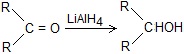
On reduction with LiAlH4, a ketone yields .... ....
-
27%
a) primary alcohol
-
55%
b) secondary alcohol
-
9%
c) tertiary alcohol
-
9%
d) all of these
Explanation
Q.6.
23g of sodium reacts with CH3OH to give ..... .....
-
25%
a) 1 mole of O2
-
25%
b) ½ mole of H2
-
42%
c) 1 mole of H2
-
8%
d) none of these
Q.7.
Glycol reacts with PCl3 and gives ethylene dichloride. What will be the product, if it reacts with P+I2
-
30%
a) Ethylene
-
40%
b) Ethylene iodide
-
30%
c) Ethylene iodohydrin
-
0%
d) None of these
Q.8.
The reaction given below is called C2H5OH + SOCl2 → C2H5Cl + SO2 + HCl
-
38%
a) Hunsdicker's reaction
-
25%
b) Wurts reaction
-
12%
c) Karasch effect
-
25%
d) Darzen's reaction
Q.9.
on Q310) Identify (X) in the reaction ... ..

-
50%
a) CH3 - CH2 - CH2OH
-
0%
b) CH3 - O- CH3
-
50%
c) C2H5CHO
-
0%
d) CH3COOH
Q.10.
The major organic product in the reaction CH3 - O - CH(CH3)2 + HI → product is
-
12%
a) CH3OC(CH3)2
-
38%
b) CH3I + (CH3)2CHOH
-
38%
c) CH3OH + (CH3)2CHI
-
12%
d) ICH2PCH(CH3)2
Q.11.
Dialkyl sulphide are known as .... ...
-
50%
a) mercaptan
-
12%
b) thioester
-
25%
c) sulphonal
-
12%
d) thioethers
Q.12.
Scientific aspect of fermentation was first studied by ... ..
-
67%
a) Pasteur
-
0%
b) Bose
-
0%
c) Buchner
-
33%
d) Liebig
Q.13.
On boiling with concentrated hydrobromic acid phenyl ethyl ether yields
-
0%
a) phenol and ethane
-
33%
b) bromobenzene and ethanol
-
50%
c) bromobenzene and ethane
-
17%
d) phenol and ethyl bromide
Q.14.
Assertion: C2H5I is more reactive than C2H5Cl Reason: I is less electronegative than Cl
-
25%
a) Both Assertion and Reason are true and Reason is the correct explanation of Assertion
-
62%
b) The Assertion and Reason are true but Reason is not correct explanation of Assertion
-
0%
c) Assertion is true but, Reason is false
-
12%
d) Assertion is false but, Reason is true
Q.15.
Which of the following undergoes dehydration most readily?
-
12%
a) 1-phenyl-1-butanol
-
12%
b) 1-phenyl-2-butanol
-
62%
c) 2-phenyl-2-butanol
-
12%
d) 2-phenyl-1-butanol
Q.16.
han One Correct Answer Q317) The general formula(s) of monohydric alcohol is/are
-
14%
a) CnH2nO
-
57%
b) CnH2n+1OH
-
0%
c) CnH2n+2O
-
29%
d) CnH2n+4O
Q.17.
Glycerol catches fire on mixing with .... ....
-
0%
a) KMnO4
-
57%
b) K2Cr2O7
-
14%
c) HNO3
-
29%
d) none of these
Q.18.
In the reaction, the products formed are (CH3)2CH2.CH2.O.CH2CH3 + HI →
-
29%
a) (CH3)2CH.CH2 + CH3CH2OH
-
43%
b) (CH3)2CHCH2OH + C2H5I
-
0%
c) (CH3)2CH.CH2I + CH3CH2OH
-
29%
d) (CH3)2 CH.CH2OH + C2H6
Q.19.
During alcoholic fermentation inorganic slats like ammonium sulphate or ammonium phosphate are added ....
-
0%
a) which produce desirable enzymes
-
29%
b) Which act as food for ferment cells
-
43%
c) to decrease the freezing point of solution
-
29%
d) which prevents the growth of undesirable bacteria
Q.20.
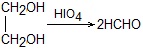
HOH2C.CH2OH on heating with periodic acid gives
-
17%
a) 2 HCHO
-
0%
b) 2CO2
-
33%
c) 2HCOOH
-
50%
d) HCHO
Explanation
Q.21.
The -OH group of methyl alcohol cannot be replaced by chlorine by the action of ... ....
-
0%
a) HCl
-
14%
b) PCl3
-
57%
c) PCl5
-
29%
d) Chlorine
Q.22.
The boiling point of ethyl alcohol is much higher than that of dimethyl ether and C2H5SH, though both have same molar mass. the reason for this si ... ...
-
17%
a) ethyl alcohol shows hydrogen bonding
-
50%
b) dipole moment of ethyl alcohol is less
-
33%
c) methyl groups are attached to oxygen in ether
-
0%
d) ether is insoluble in water
Q.23.
The prospective fuel 'gashol' is a mixture of ... ....
-
0%
a) radioactive substances
-
20%
b) petrol and ethanol
-
0%
c) petrol and phenol
-
80%
d) gaseous hydrocarbons and heavy water
Q.24.
In CH3CH2OH the bond which most readily undergoes heterolytic cleavage during its reaction with CH3COOH/H2SO4 is ....
-
33%
a) C - C
-
33%
b) C - O
-
33%
c) O- H
-
0%
d) C - H
Explanation

Q.25.
Diethyl ether absorbs oxygen to form .... .....
-
0%
a) ether peroxide
-
20%
b) acetic acid
-
80%
c) red coloured sweet smelling compound
-
0%
d) ether suboxide
Q.26.
To obtain unsaturated alcohol from unsaturated aldehydes the following reagent is used for reduction
-
0%
a) Na amalgam/H2O
-
20%
b) Dil.H2SO4
-
60%
c) LiAH4
-
20%
d) Zn/HCl
Q.27.
Structure of diethyl ether can be confirmed by .... ...
-
0%
a) Kolbe's synthesis
-
50%
b) Williomson's synthesis
-
33%
c) Wurtz's synthesis
-
17%
d) Frankland's synthesis
Q.28.
han One Correct Answer Q329) Which of the following compounds is/are easily oxidised by K2Cr2O7 and H2SO4?
-
29%
a) CH3CH2OH
-
57%
b) (CH3)2CHOH
-
0%
c) CH3CHO
-
14%
d) (CH3)3COH
Q.29.
f methanol vapour is passed over heated copper at 300°C
-
12%
a) dehydration
-
50%
b) oxidation
-
25%
c) hydrogenation
-
12%
d) dehydrogenation
Q.30.
A compound with molecular formula C4H10O3 is converted by the action of acetyl chloride to a compound with molar massThe original compound has ... ...
-
12%
a) one OH group
-
75%
b) two OH groups
-
0%
c) three OH groups
-
12%
d) no OH group