Q.1.
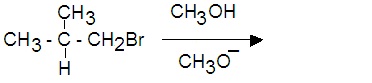
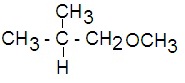
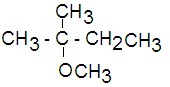
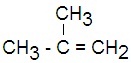
ion Q92) The major product formed in the following reaction [AIIMS 2005]
-
38%
a)
-
33%
b)
-
17%
c)
-
12%
d)
Explanation
Q.2.
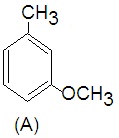
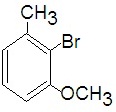
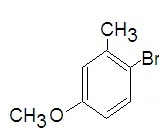
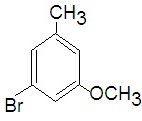
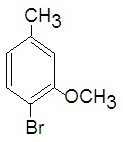
ion Q93) The major product obtained on the monobromination ( with Br2/FeBr3) of the following compound A is [ AIIMS 2006]
-
29%
a)
-
33%
b)
-
14%
c)
-
24%
d)
Q.3.
Which of the following compounds has the highest boiling point? [ AIIMS 2006]
-
5%
a) CH3CH2CH2Cl
-
16%
b) CH3CH2CH2CH2Cl
-
42%
c) CH3CH(CH3)CH2Cl
-
37%
d) (CH3)3CCl
Q.4.
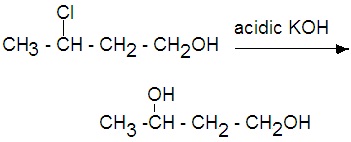
The major product formed in the following reaction CH3CH(Cl)CH2-CH2OH + aq.KOH → is : [ AIIMS 2006]
-
20%
a) CH3CH = CHCH2OH
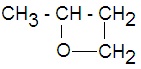
-
33%
b) CH2 = CHCH2OH
-
20%
c)
-
27%
d) CH3CH(OH)CH2CH2OH
Explanation
Q.5.
CH3OC2H5 and (CH3)3C-OCH3 are treated with Hydroiodic acid. The fragments obtained after reactions are [ AIIMS 2007]
-
23%
a) CH3I + HOC2H5 ; (CH3)3Cl+HOCH3
-
31%
b) CHO + C2C2H5I ; (CH3)3Cl+HOCH3
-
23%
c) CHO + C2C2H5I ; (CH3)3COH + CH3I
-
23%
d) CH3I + HOC2H5 ; CH3I + (CH3)3COH
Q.6.
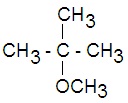
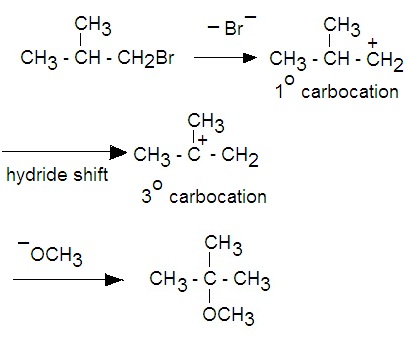
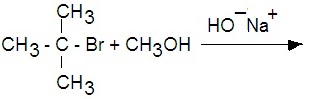
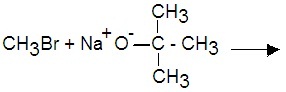
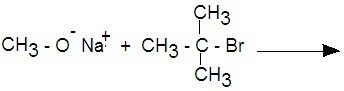
In which of the following reactions the product obtained is t-butyl methyl ether? [ AIIMS 2008]
-
23%
a)

-
62%
b)
-
15%
c)
-
0%
d)
Q.7.
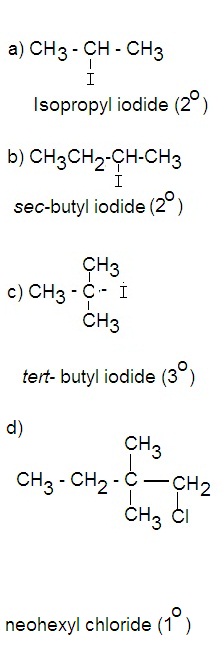
Which of the following is primary halide? [ AIIMS 2008]
-
21%
a) iso-propyl iodide
-
14%
b) secondary butyl iodide
-
29%
c) tertiary butyl bromide
-
36%
d) Neohexyl chloride
Explanation
Q.8.
An organic compound X on treatment with pyridinium chlorochromate in dichloromethane gives compound Y. Compound Y reacts with I2 and alkali to form triiodomethane. The compound X is [ AIIMS 2008]
-
23%
a) C2H5OH
-
31%
b) CH3CHO
-
38%
c) CH3COCH3
-
8%
d) CH3COOH
Explanation

Q.9.
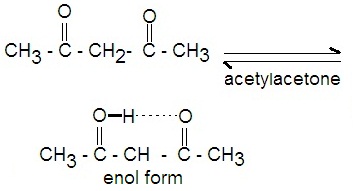
Maximum enol content is in [AIIMS 2008]
-
7%
a)

-
64%
b)
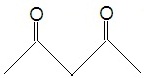
-
7%
c)

-
21%
d)
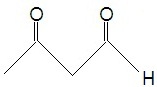
Explanation
Q.10.
The formation of diethyl ether ethanol is based on [ AIIMS 2009]
-
36%
a) Dehydrogenation reaction
-
14%
b) Hydrogenation reaction
-
36%
c) Dehydration reaction
-
14%
d) Hetrolytic fission reaction
Q.11.
Chloropicrin is obtained by the reaction of [ AIIMS 2010]
-
15%
a) steam on carbon tetrachloride
-
31%
b) nitric acid on chlorobenzene
-
23%
c) chlorine on picric acid
-
31%
d) nitric acid on chloroform
Q.12.
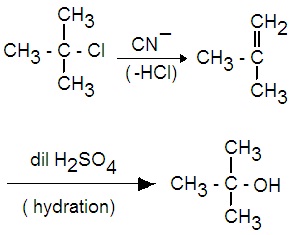
on Q103) compound B is [ AIIMS 2011]

-
31%
a) (CH3)3CCOOH
-
31%
b) (CH3)3COH
-
23%
c) (CH3)3COC(CH3)3
-
15%
d) All the three
Explanation
Q.13.
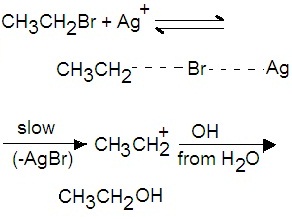
Ethanol can be prepared more easily by which reaction? [ AIIMS 2011] i) CH3CH2Br + H2O → CH3CH2OH ii) CH3CH2Br + Ag2O ( in boiling water) → CH3CH2OH
-
17%
a) by (i) reaction
-
8%
b) by (ii) reaction
-
58%
c) Both reactions proceed at same rate
-
17%
d) by none
Explanation
Q.14.
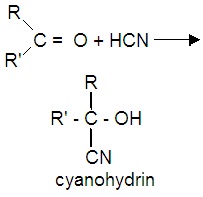
THe formation of cyanohydrin from a ketone is an example of [ IIT 1998]
-
17%
a) Electrophilic addition
-
25%
b) Nucleophilic addition
-
33%
c) Nucleophilic substitution
-
25%
d) Electrophilic substitution
Explanation
Q.15.
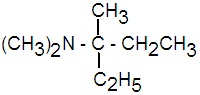
on Q106) IUPAC Name of the compound
-
17%
a) 3-N,N-dimethylamino-3-methylpentane
-
25%
b) 3-N,N-dimethylpentanammine
-
42%
c) 3-N,N-dimethyl-3-aminopentane
-
17%
d) 3,3-Dimethylamino-3-methylpentane
Q.16.
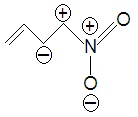
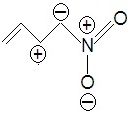
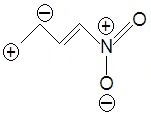
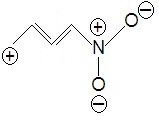
Among the following, the least stable resonance structure is [ IIT 2007]
-
25%
a)
-
50%
b)
-
17%
c)
-
8%
d)
Q.17.
The correct stability order of the following resonance structure is [ IIT 2009] I) H2C = N + = N- II) H2C+ - N = N- III) H2C- - N+ ≡ N IV) H2C- = N+
-
8%
a) (I) > (II) > (IV) > (III)
-
25%
b) (I) > (III) > (II) > (IV)
-
50%
c) (II) > (I) > (III) > (IV)
-
17%
d) (III) > (I) > (IV) > (II)
Q.18.
Grignard reagent is not prepared in aqueous medium but prepared in ether medium because
-
33%
a) The reagent is highly reactive in ether
-
17%
b) The reagent does not react with water
-
17%
c) The reagent becomes iactive in water
-
33%
d) The reagent reacts with water
Q.19.
SN1 reaction of alkyl halides leads to
-
31%
a) retention of configuration
-
38%
b) racemisation
-
23%
c) inversion of configuration
-
8%
d) none of these
Q.20.
A mixture of two organic compounds was treated with sodium metal in ether solution. iso-butane was obtained as a product. The two chlorine compounds are
-
33%
a) methyl chloride and propyl chloride
-
8%
b) methyl chloride and ethyl chloride
-
33%
c) isopropyl chloride and methyl chloride
-
25%
d) isopropyl chloride and ethyl chloride
Q.21.
Among the following, the molecule with highest dipole momentum is [ IIT 2003] Answer: (a)
-
25%
a) CH3Cl
-
8%
b) CH2Cl2
-
33%
c) CHCl3
-
33%
d) CCl4
Q.22.
Which of the following is the example of SN2 reaction?
-
25%
a) CH3Br + OH- → CH3OH + Br-
-
33%
b) CH3CH(Br)CH3 + OH - → CH3CH(OH)CH3 + Br-
-
17%
c) CH3CH2OH → CH2 = CH2
-
25%
d) (CH3)2C(Br)CH3 + OH- → (CH3)2C(OH)CH3 + Br-
Q.23.
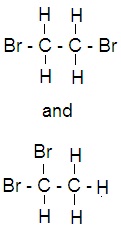
The molecular formula of saturated compound is C2H4Br2 the formula permit the existence of two ...
-
25%
a) functional isomers
-
50%
b) position isomers
-
25%
c) optical isomers
-
0%
d) cis - trans isomers
Explanation
Q.24.
A compound which does not give iodoform test on treatment with alkali and iodine is [ Roorkee 1993]
-
8%
a) Ethanol
-
17%
b) Acetone
-
50%
c) Diethyl ketone
-
25%
d) Isopropyl alcohol
Q.25.
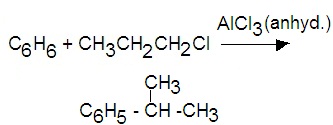
Benzene reacts with n-propyl chloride in the presence of anhydrous AlCl3 to give [ CBSE-PMT 1993]
-
23%
a) 3-propyl-1-chlorobenzene
-
23%
b) n-propylbenzene
-
15%
c) no reaction
-
38%
d) isopropylbenzene
Explanation
Q.26.
When wine is kept in air, it becomes sour due to .... ... [ Chandigarh CET 1998]
-
23%
a) Bacteria
-
54%
b) Oxidation of C2H5OH into CH3COOH
-
0%
c) Virus
-
23%
d) Formic acid
Q.27.
In glycerine .... ....
-
8%
a) One primary -OH group is present
-
38%
b) One tertiary -OH group is present
-
23%
c) Two secondary -OH groups are present
-
31%
d) One secondary -OH group is present
Q.28.
Absolute ethyl alcohol can be converted to diethyl ether by heating it to 410K in the presence of .... ... [ Bihar CEE 1992]
-
25%
a) Dil. H2SO4
-
0%
b) Dil. HCl
-
42%
c) Conce. H2SO4
-
33%
d) Conc. CH3COOH
Q.29.
Scientific study of fermentation was first made by ,,, ,,, [ MP CET 1994]
-
42%
a) Buchner
-
33%
b) Liebig
-
8%
c) Biot
-
17%
d) Pasture
Q.30.
An organic compound A reacts with methyl magnesium iodide to form an addition product which on hydrolysis forms the coumpound B, Compound B gives blue colour salt in Victor Meyer's test. The compounds A and B respectively are .... ... [ Tamil Nadu CET 2002]
-
18%
a) Acetaldehyde, t-butyl alcohol
-
36%
b) Acetaldehyde, ethyl alcohol
-
36%
c) Acetaldehyde, iso-propyl alcohol
-
9%
d) Acetone, iso-propyl alcohol