Q.1.
Excess of glycol when dehydrated gives ... ..
-
33%
a) ethylene oxide
-
46%
b) 1,4 dioxan
-
12%
c) ethanol
-
8%
d) acrolein
Explanation

Q.2.
C2H5OH can be differentiated from CH3OH by ... ... [ MPCET 1994]
-
5%
a) Reaction with HCl
-
37%
b) Reaction with NH3
-
37%
c) Iodoform test
-
21%
d) Solubility in water
Q.3.
Propanon is the product obtained by dehydrogenation of ... .... [ KCET CET 2001]
-
44%
a) 2-Propanol
-
6%
b) 1-Propanol
-
33%
c) Iso- butyl alcohol
-
17%
d) Propanethiol
Q.4.
An organic compound (A) reacts with sodium metal and forms (B). On heating with conc. H2SO4 (A) gives diethyl ether. (A) and (b) are respectively .... ...
-
44%
a) C2H5OH and C2H5ONa
-
31%
b) C3H7OH and CH3ONa
-
19%
c) CH3OH and CH3ONa
-
6%
d) C4H9OH and C4H9ONa
Q.5.
Which is more acidic? ... .. [ Orissa JEE 2004]
-
6%
a) o-Cresol
-
59%
b) p-Nitrophenol
-
35%
c) Phenol
-
0%
d) m-Cresol
Q.6.
Phenol is more acidic than cyclohexanol because
-
33%
a) Benzene ring exhibits resonance
-
33%
b) Cyclohexane ring shows resonance
-
22%
c) Phenol is poor in hydrogen
-
11%
d) Cyclohexanol is rich in hydrogen
Q.7.
Which of the following is most volatile?
-
29%
a) o-Nitrophenol
-
24%
b) p-Nitrophenol
-
18%
c) m-Nitrophenol
-
29%
d) All of the above
Q.8.
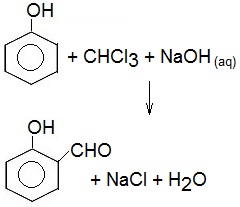
What is the major product obtained when phenol is treated with chloroform and aqueous alkali?
-
7%
a)
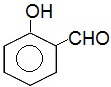
-
40%
b)
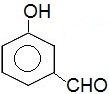
-
33%
c)
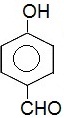
-
20%
d)
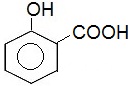
Explanation
Q.9.
Which of the following compounds is obtained on passing ethanol vapours on heated Al2O3? ... ..[ MPPET 2001]
-
31%
a) Ethyl ether
-
38%
b) Acetone
-
15%
c) Ethane
-
15%
d) Ethanol
Q.10.
Which of the following can not prepared using Willamson's synthesis?
-
15%
a) Methoxybenzene
-
54%
b) Benzyl-p-nitrophenyl ether
-
0%
c) Methyl-tert-butyl ether
-
31%
d) Di-tert-butyl ether
Q.11.
tert- Butyl methyl ether on heating with HI gives a mixture of ... ....
-
45%
a) tert- Butyl alcohol and methyl iodide
-
9%
b) tert- Butyl iodide and methanol
-
27%
c) iso- Butylene and methyl iodide
-
18%
d) iso- Butylene and methanol
Explanation

Q.12.
Which cannot be produced by acidic dehydration of alcohols?
-
8%
a) Ether
-
58%
b) Aldehyde
-
17%
c) Alkyl hydrogen sulphate
-
17%
d) Alkene
Q.13.
Which of the following does not give yellow ppt. with I2/NaOH? ... ...[ MPPET 1996]
-
18%
a) C2H5OH
-
9%
b) CH3CHO
-
27%
c) CH3COCH3
-
45%
d) HCHO
Q.14.
Baeyer's reagent .... ..... [ MPCET 1994]
-
50%
a) Alkaline KMnO4
-
17%
b) Ammonical AgNO3
-
17%
c) Ammonical CuSO4
-
17%
d) CaSO4/Ca(OH)2
Q.15.
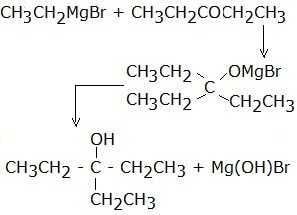
To prepare 3-ethylpentan-3-ol, the reagents needed are .... [ Chd. CET 1998]
-
44%
a) CH3CH2MgBr + CH3COCH2CH3
-
22%
b) CH3MgBr + CH3CH2CH2COCH2CH3
-
22%
c) CH3CH2MgBr + CH3CH2COCH2CH3
-
11%
d) CH3CH2CH2MgBr + CH3COCH2CH3
Explanation
Q.16.
Conversion of ethyl alcohol into acetaldehyde is an example of ... .... [ Punjab CET 1997]
-
20%
a) Reduction
-
30%
b) Molecular rearrangement
-
30%
c) Hydrolysis
-
20%
d) Oxidation
Q.17.
The reaction between alcohol and carboxylic acids is called ... ..[ Pub CET 1994]
-
67%
a) Esterification
-
0%
b) Hydrolysis
-
11%
c) Saponification
-
22%
d) Hydrogenation
Q.18.
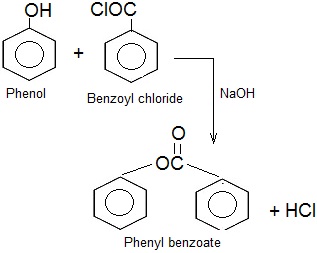
The reaction of aromatic acyl chloride and phenol in the presence of a base NaOH or pyridine is called ... ....[ AFMC 1998]
-
44%
a) Kolbe's reaction
-
11%
b) Perkin's reaction
-
22%
c) Sandmeyer's reaction
-
22%
d) Schotten Baumann reaction
Explanation
Q.19.
Ethylene may be obtained by the treatment of concentrated H2SO4 and X at 160-170°C. X is ... ... [ MPPET 2001]
-
11%
a) C2H5OH
-
22%
b) CH3OH
-
33%
c) C3H7OH
-
33%
d) (CH3)2CHCH2OH
Q.20.
Which of the following process is employed to convert alkyl halide into alcohol?
-
25%
a) Addition
-
38%
b) Substitution
-
25%
c) Dehydrohalogenation
-
12%
d) Molecular rearrangement
Q.21.
The order of reactivity of halogen acids for reaction with C2H5OH is ... ... [ MPPET 1996]
-
12%
a) HCl > HBr > HI
-
25%
b) HI > HBr > HCl
-
38%
c) HBr > HI > HCl
-
25%
d) HBr > HCl > HI
Q.22.
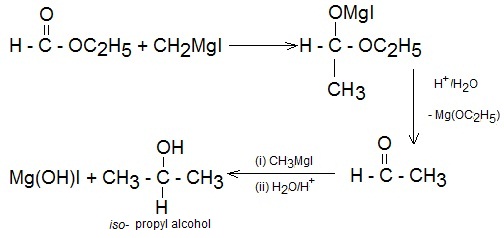
Which of the following combinations can be used to synthesize iso- propyl alcohol? [ karnataka CET 2004]
-
14%
a) CH3MgI nad CH3COCH3
-
43%
b) CH3MgI and C2H5OH
-
29%
c) CH3MgI and CH3COOC2H5
-
14%
d) CH3MgI and HCOOC2H5
Explanation
Q.23.
Which bond of ethyl alcohol undergoes cleavage reaction with sodamide? ... .. [ IIT 1988]
-
25%
a) C - C
-
25%
b) C - O
-
12%
c) C - H
-
38%
d) O - H
Q.24.
Which of the following reagents will convert propanoic acid to propan-1-ol?
-
12%
a) KMnO4
-
25%
b) MnO2
-
25%
c) Cr2O3
-
38%
d) LiAlH4
Q.25.
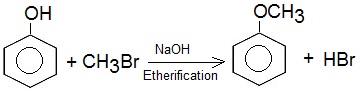
Anisole is product obtained from phenol by the reaction known as ....
-
12%
a) Coupling
-
12%
b) Etherification
-
50%
c) Oxidation
-
25%
d) Esterification
Explanation
Q.26.
A compound is soluble in conc. H2SOit does not decolourise bromine in CCl4 but is oxidised by chromic anhydride in aqueous sulphuric acid within two seconds, turning orange solution to blue green, then opaque. The original solution contains
-
25%
a) A secondary alcohol
-
50%
b) An alkene
-
25%
c) An ether
-
0%
d) A primary alcohol
Q.27.
Which statement is not correct about alcohols?
-
25%
a) Ethyl alcohol is heavier than water
-
0%
b) Ethyl alcohol evaporates more quickly
-
38%
c) Alcohol with less number of carbon atoms is more soluble in water than alcohol with more number of carbon atoms
-
38%
d) Alcohol produces H2 by reaction with sodium metal
Q.28.
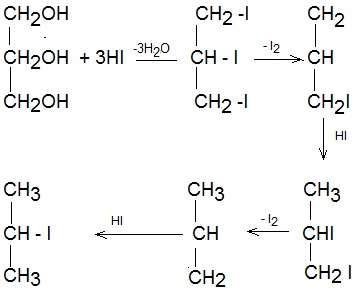
Which of the following is not formed when glycerol reacts with HI? ... ... [ DEC 1994]
-
29%
a) CH2 = CH - CH2I
-
43%
b) CH2OH - CHI - CH2OH
-
0%
c) CH3 - CH = CH2
-
29%
d) CH3 - CHI - CH3
Explanation
Q.29.
Ethyl alcohol can be used for preparation of which of the following? ... .. [ Punjab CET 1994]
-
25%
a) Ethyl acetate
-
38%
b) Ethylene
-
12%
c) Acetic acid
-
25%
d) All of these
Q.30.
Ethylene reacts with 1% cold alkaline KMnO4 to give ... ... [ Haryana CEET 1998]
-
11%
a) Oxalic acid
-
22%
b) Acetone
-
44%
c) Ethylene glycol
-
22%
d) Formaldehyde