Q.1.
On oxidation, an alcohol gives an aldehyde having the same number of carbon atoms as that of alcohol. The alcohol is ... ....
-
47%
a) 1° alcohol
-
29%
b) 2° alcohol
-
6%
c) 3° alcohol
-
18%
d) none of these
Q.2.
The starting material for the preparation of CH3I in one step reaction is
-
57%
a) CH3OH
-
29%
b) C2H5OH
-
7%
c) CH3CHO
-
7%
d) CH3COCH3
Q.3.
Vinyl carbinol is ... ...
-
45%
a) CH3C(OH) = CH2

-
9%
b) HOH2C - CH = CH2
-
36%
c) CH3 - CH = CH - OH
-
9%
d)
Q.4.
Glycol is prepared industrially by the following reactions
-
27%
a)
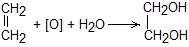
-
36%
b)

-
18%
c)
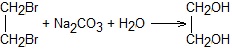
-
18%
d) none of the above
Q.5.
A neutral compound gives red colour with ceric ammonium nitrate. It suggests that the compound has .... ....
-
22%
a) ketone group
-
22%
b) aldehyde group
-
33%
c) ether
-
22%
d) alcoholic group
Q.6.
Lucas reactant produces cloudiness immediately with
-
0%
a) n-butanol
-
50%
b) isopropanol
-
10%
c) n-propanol
-
40%
d) tertiary butanol
Q.7.
on Q247) Y is

-
0%
a) CH2OH - CH2OH
-
14%
b) CH3OH
-
57%
c) CH3CH2OH
-
29%
d) CH2OH - CH2OH
Q.8.
Alcohol is not used in making
-
43%
a) benzene
-
14%
b) acetaldehyde
-
29%
c) chloroform
-
14%
d) chloral
Q.9.
han One Correct Answers Q249) Neutral ferric chloride gives violet colour with
-
57%
a) phenol
-
0%
b) cresol
-
29%
c) catechol
-
14%
d) none of these
Q.10.
CH3COOH reacts rapidly with .... ..
-
0%
a) (CH3)2CHOH
-
43%
b) CH3CH2OH
-
29%
c) (CH3)3COH
-
29%
d) all of these
Explanation

Q.11.
Which could not be obtained from wood?
-
17%
a) CH3OH
-
33%
b) C2H5OH
-
17%
c) Wood tar
-
33%
d) Wood charcoal
Q.12.
Ether in contact with air for a long time from peroxides. The presnce of peroxide in ether can be tested by adding Fe+2 ion in it and then adding ... ...
-
17%
a) KI
-
33%
b) SnCl2
-
17%
c) HgCl2
-
33%
d) KCNS
Q.13.
For drying ether, sodium metal can be used, but it cannot be used for drying ethyl alcohol because .... ..
-
20%
a) ether reacts easily with Na
-
40%
b) Na is very reactive
-
40%
c) ethyl alcohol reacts with sodium metal
-
0%
d) none of the above
Q.14.
han One Correct Answer Q254)Phenol is less acidic than
-
0%
a) acetic acid
-
0%
b) p-methoxyphenol
-
100%
c) p-nitrophenol
-
0%
d) ethanol
Q.15.
Which alcohol is most acidic?
-
17%
a) Ethanol
-
17%
b) Methanol
-
17%
c) Isopropyl alcohol
-
50%
d) t-butyl alcohol
Q.16.
C2H5OH cannot be dried by anhydrous CaCl2, because .... ...
-
0%
a) C2H5OH is soluble in water
-
25%
b) C2H5OH reacts with CaCl2
-
50%
c) CaCl2 is soluble in water
-
25%
d) none of the above
Q.17.
An organic compound dissolved in dry benzene evolved hydrogen on treatment with sodium. It is ... ....
-
0%
a) a ketone
-
50%
b) an alcohol
-
50%
c) a tertiary amine
-
0%
d) an aldehyde
Explanation

Q.18.
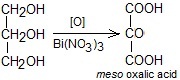
Glycerol on oxidation with bismuth nitrate mainly gives ....
-
40%
a) mesoxalic acid
-
20%
b) oxalic acid
-
20%
c) tartronic acid
-
20%
d) glycerinc acid
Explanation
Q.19.
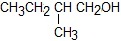
How many isomers of C5H11OH will be primary alcohols?
-
33%
a) 2
-
0%
b) 3
-
0%
c) 4
-
67%
d) 5
Explanation
Q.20.
Alcoholic fermentation by starch or sugar is brought about bt ... ...
-
20%
a) Sodium bicarbonate
-
40%
b) yeast
-
20%
c) CO2
-
20%
d) phosphates
Q.21.
Which of the following statement is incorrect?
-
33%
a) Urease is an enzyme
-
33%
b) Enzymes can catalyse any reaction
-
0%
c) Enzymes are in colloidal state
-
33%
d) Enzymes are catalyst
Q.22.
An aldehyde on treatment with Zn/HCl yields
-
20%
a) 1° alcohol
-
20%
b) 2° alcohol
-
40%
c) 3° alcohol
-
20%
d) none of these
Q.23.
A compound X with molecular formula C3H8O can be oxidised to a compound Y with the molecular formula C3H6O2 . X is most likely to be
-
33%
a) Ketone
-
67%
b) Primary alcohol
-
0%
c) aldehyde
-
0%
d) secondary alcohol
Q.24.
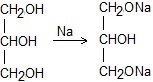
Glycerol on reacting with sodium gives .... ....
-
50%
a) monosodium glycerollate
-
0%
b) disodium glycerollate
-
0%
c) trisodium glycerollate
-
50%
d) none of the above
Explanation
Q.25.
Chlorex which is good solvent for aromatic impurities is .... ...
-
0%
a) dichlorodiethyl ether
-
0%
b) dichlorodimethyl ether
-
50%
c) monochloro ether
-
50%
d) diethyl ether
Q.26.
On boiling with conc. hydrobromic acid, phenyl ethyl ether will yield
-
55%
a) bromobenzene and ethane
-
18%
b) bromobenzene and ethanol
-
9%
c) phenol and ethane
-
18%
d) phenol and ethyl bromide
Q.27.
When an ether is treated with P2S5 we get ... ...
-
20%
c) thio-alcohol
-
40%
a) thio-ether
-
40%
b) thio-ester
-
0%
d) thio-aldehyde
Q.28.
Which will not form yellow precipitate on heating with an alkaline solution of iodine?
-
20%
a) CH3OH
-
40%
b) CH3CH2OH
-
20%
c) CH3CH2CHOHCH3
-
20%
d) CH3CH2CHOHCH3
Q.29.
Tertiary alcohol is obtained when Grignard reagent reacts with .... ...
-
0%
a) Butanone
-
33%
b) Propanone
-
67%
c) acetone
-
0%
d) all of the above
Explanation

Q.30.
Ethyl alcohol reacts with HCl but not with HCN because
-
14%
a) C2H5OH is weak base and HCN is weak base
-
29%
b) HCl is strong acid and C2H5OH is weak base
-
29%
c) C2H5OH is strong acid and HCN is weak acid
-
29%
d) C2H5OH is weak acid and HCN is strong acid