Q.1.
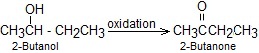
A substance C4H10O yields on oxidation compound C4H8O which gives an oxime and a positive iodoform test. The original substance on treatment with conc. H2SO4 gives C4HThe structure of the compound is
-
33%
a) CH3CH2 - O - CH2CH3
-
11%
b) (CH3)3COH
-
56%
c) CH3CH(OH)CH2CH3
-
0%
d) CH3CH2CH2CH2OH
Explanation

Q.2.
han One Correct Answer Q212) Which will react with acetone to give a product containing >C=N, linkage?
-
0%
a) (CH3)3N
-
20%
b) C6H5NHNH2
-
40%
c) NH2CONHNH2
-
40%
d) C6H5NHC6H5
Q.3.
The reagent with which both aldehydes and ketones react is ... ... [ IIT 1981]
-
0%
a) Gehling solution
-
29%
b) Grignard's reagent
-
43%
c) Schiff's reagent
-
29%
d) Tollen's reagent
Q.4.
Silver mirror is a test for
-
14%
a) Aldehyde
-
57%
b) Thioalcohols
-
29%
c) Acids
-
0%
d) Ethar
Q.5.
C6H5CHO + HCN → C6H5CH(CN)OH. The product would be
-
0%
a) meso compound
-
20%
b) optically active
-
60%
c) racemate
-
20%
d) mixture of diastereomers
Q.6.
Formaldehyde can be distinguished from acetaldehyde by
-
0%
a) Ammoniacal AgNO3
-
20%
b) Ammonia
-
60%
c) Fehling's solution
-
20%
d) Schiff's reagent
Q.7.
han One Correct Answers Q217) Which is/are isomer(s)?
-
0%
a) Propionic acid and ethyl acetate
-
25%
b) Propionaldehyde and acetone
-
50%
c) Urea and ammonium cyanate
-
25%
d) Xylenes
Q.8.
Catalyst SnCl2/HCl is used in
-
0%
a) Cannizzaro reaction
-
50%
b) Clemmensen reduction
-
25%
c) Rosenmnd's reaction
-
25%
d) Stephen's reaction
Explanation

Q.9.
Between p-nitrophenol and salicylaldehyde, solubility in base is
-
0%
a) equal in nature
-
25%
b) higher for salicylaldehyde
-
25%
c) almost nil in both cases
-
50%
d) higher in p-nitrophenol
Q.10.
At room temperature formaldehyde is
-
50%
a) liquid
-
0%
b) solid
-
0%
c) gas
-
50%
d) none of these
Q.11.
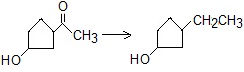
on Q221) The appropriate reagent for transformation
-
33%
a) Zn(Hg), HCl
-
67%
b) NH2NH2, OH-
-
0%
c) H2/Ni
-
0%
d) NaBH4
Q.12.
Ketones are less reactive than aldehydes because
-
0%
a) of electromeric effect
-
33%
b) of steric hindrance to the attacking reagent
-
33%
c) C=O group is less polar in ketones
-
33%
d) none of the above
Explanation

Q.13.
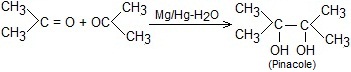
Pinacole is
-
33%
a) 3-methyl butan-2-ol
-
0%
b) 2,3-dimethyl-2,3-butandiol
-
67%
c) 3,3-dimethyl-2-propanone
-
0%
d) none of the above
Explanation
Q.14.
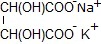
Fehling solution is a mixture of two solutions. While one solution contains CuSO4, the other contains
-
67%
a)
-
0%
b)

-
33%
c)

-
0%
d)

Q.15.
on Q225) The above reaction is known as

-
33%
a) Beckmann rearrangement
-
0%
b) Benzilic acid rearangement
-
33%
c) Benzoin condensation
-
33%
d) Aldol condensation
Explanation

Q.16.
han One Correct Answer Q226) Which of the following do not undergo base-catalysed aldol condensation?
-
0%
a) p-methylbenzaldehyde
-
0%
b) 2-methylpropionaldehyde
-
67%
c) 2,2-dimethylpropionaldehyde
-
33%
d) Benzaldehyde
Q.17.
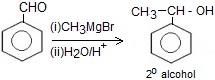
Which of the following products is formed when benzaldhyde is treated with CH3MgBr and the addition product so obtained is subjected to acid hydrolysis? ... ..[ HArryana EET 2000 ]
-
33%
a) Secondary alcohol
-
33%
b) Primary alcohol
-
33%
c) phenol
-
0%
d) tert- butyl alcohol
Explanation
Q.18.
The reagent(s) which can be used to distinguish acetophenone from benzophenone is (are)
-
0%
a) Aqueous solution of NaHSO3
-
33%
b) Benedict reagent
-
0%
c) 2, 4 -dinitrophenyl hydrazine
-
67%
d) I2 and Na2CO3
Q.19.
Paraldehyde is used as a
-
33%
a) saporific
-
0%
b) poison
-
33%
c) polymer
-
33%
d) dye
Q.20.
Which of the following alcohol cannot be produced by treatment of aldehydes or ketones with NaBH4 or LiAlH4? [ Punjab CET 1990]
-
0%
a) 1_propanol
-
0%
b) 2-Propanol
-
33%
c) 2-Methyl-2-Propanol
-
67%
d) Ethanol
Q.21.
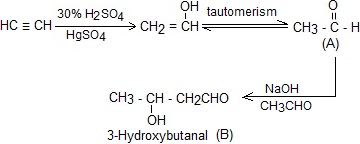
on Q231) Predict the product 'B' in the sequence of reaction

-
0%
a) CH3COOH
-
33%
b) CH3CHO
-
33%
c) CH3COONa
-
33%
d) CH3CH(OH)CH2CHO
Explanation
Q.22.
Paraldehyde is
-
0%
a) a trimer of formaldehyde
-
67%
b) a trimer of acetaldehyde
-
0%
c) a hexamer of formaldehyde
-
33%
d) a hexamer of acetaldehyde
Explanation

Q.23.
han One Correct Answer Q233) The silver mirror with Tollens reagent is formed by
-
33%
a) acetone
-
33%
b) ethanal
-
0%
c) ethyl acetate
-
33%
d) glucose
Q.24.
Partial oxidation of methane gives
-
0%
a) HCOOH
-
33%
b) H2O and CO2
-
0%
c) HCHO
-
67%
d) CO and H2O
Q.25.
Cyanohydrin of which of the following forms lactic acid?
-
0%
a) CH3CH2CHO
-
0%
b) CH3CHO
-
33%
c) CH3COCH3
-
67%
d) HCHO
Explanation

Q.26.
The increasing order of the rate of HCN addition to compounds A to D is A) HCHO B) CH3COCH3 C) PhCOCH3 D) PhCOPh ... ...[ AIEEE 2006]
-
0%
a) A < B < C < D
-
0%
b) D < B < C < A
-
50%
c) D < C < B < A
-
50%
d) C < D < B < A
Explanation

Q.27.
Aliphatic aldehydes react with Fehling's solution to give red ppt. but benzaldehyde does not produce red ppt with Fehling's solution because
-
0%
a) of bulky ring, -CHO is hinderer
-
33%
b) of resonance, oxidation of benzaldehyde is difficult
-
0%
c) - CHO is present in cyclic structure
-
67%
d) of all the above
Q.28.
on Q238) the product X is

-
33%
a) CH3OH + CH3OH
-
33%
b) CH2OH - COO-
-
0%
c) CH3OH + HCOOH
-
33%
d) OOC - COO-
Q.29.
The decreasing order of solubility of methanal (A), propanaldehyde (B), benzaldehyde (C) and acetophenone (D)
-
0%
a) A > B > C > D
-
0%
b) D > C > D > A
-
67%
c) D > A > B > C
-
33%
d) B > A > C > D
Q.30.
Propanal on treatment with dilute sodium hydroxide forms
-
33%
a) CH3CH2COONa
-
0%
b) CH3CH2CH2CH2CH2CHO
-
33%
c) CH3CH2CH(OH)CH(CH3)CHO
-
33%
d) CH3CH2CH(OH)CH2CH2CHO
Explanation
