Q.1.
the energy of hydrogen atom in nth orbit is En then the energy in the nth orbit of a single ionised helium atom will be.. [ CBSE-PMT 2001]
-
41%
a) 4En
-
25%
b) En /4
-
24%
c)2En
-
10%
d)En / 2
Q.2.
The ionization energy of the electron in the hydrogen atom in its ground state is 13.6 eV. The atoms are excited to higher energy levels to emitt radiations of 6 wavelengths. Maximum wave length of emitted radiation corresponds to the transition between... [ CBSE-PMT 2009]
-
21%
a) n=3 to n=1 satates
-
36%
b) n=2 to n=1 states
-
37%
c) n=4 to n=3 states
-
6%
d) n=3 to n=2 states
Q.3.
In which of the following systems will the radius of the first orbit (n=1) be minimum? [ CBSE-PMT 2003]
-
34%
a)Hydrogen atom
-
45%
b) Doubly ionized lithium
-
17%
c)Singly ionized helium
-
4%
d)Deuterium atom
Q.4.
Ionization potential of hydrogen atom is 13.6eV. Hydrogen atoms in the ground state are excited by monochromatic radiation of photon energy 12.1eV. According to Bohr's theory, the spectral lines emitted by hydrogen will be.. [ CBSE-PMT 2006]
-
27%
a) three
-
34%
b) four
-
27%
c)one
-
12%
d)two
Q.5.
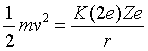
An alpha nucleus of energy ½ m v2 bombards a heavy nuclear target of charge Ze. Then the distance of closest approach for the alpha nucleus will be proportional to .. [ CBSE-PMT 2010]
-
23%
a) 1 / Ze
-
20%
b) v2
-
36%
c)1/m
-
21%
d)1/v4
Explanation

Q.6.
Which source is associated with a line emission spectrum? [ CBSE-PMT 1993]
-
12%
a) Electric fire
-
55%
b) Neon street sign
-
22%
c) Red traffic light
-
11%
d) sun
Q.7.
An electron in the hydrogen atom jumps from excited state n to the ground state. The wave length so emitted illuminates a photosenseitive material having work function 2.75eV. If the stopping potential of the photoelectron is 10V, the value of n is .. [ CBSE-PMT 2011]
-
14%
a)3
-
64%
b) 4
-
14%
c)5
-
8%
d)2
Q.8.
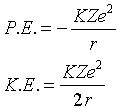
When a hydrogen atom is raised from ground state to an excited state.. [ CBSE-PMT 1995]
-
20%
a) P.E. decrases and KE increases
-
59%
b) P.E. increases and K.E. decreases
-
16%
c)both K.E. and P.E. decreases
-
4%
d)absorption spectrum
Explanation
Q.9.
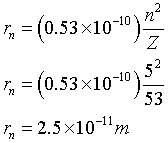
What is the rdius of iodine atom ( At.No 53, mass number 126)...[CBSE-PMT 1988]
-
45%
a) 2.5×10⁻¹¹ m
-
32%
b) 2.5×10⁻⁹ m
-
19%
c)7×10⁻⁹ m
-
4%
d)7 × 10⁻⁶ m
Explanation
Q.10.
The ionisation energy of hydrogen atom is 13.6 eV, the ionisation energy of helium atom would be .. [ CBSE-PMT 1988]
-
26%
a) 13.6 eV
-
37%
b) 27.2 eV
-
7%
c) 6.8 eV
-
30%
d) 54.4 eV
Q.11.
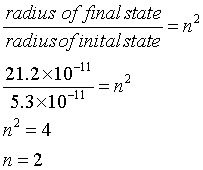
The radius of hydrogen atom in its ground state is 5.3×10⁻¹¹ m. After collision with an electron it is found o have a radius of 21.2×10⁻¹¹ m. What is the principal quantum number n of the final state of the atom.. [ CBSE-PMT 1994]
-
29%
a) n=4
-
48%
b) n=2
-
17%
c)n=16
-
6%
d)n=3
Explanation
Q.12.
Curi is a unit of .. [ CBSE-PMT 1989]
-
12%
a) energy of gamma ray
-
14%
b) half-life
-
67%
c)radioactivity
-
8%
d)intensity of gamma-rays
Q.13.
Fusion reaction takes place at high temperature because ... [ CBSE-PMT 2011]
-
25%
a) nuclei break up at high temperature
-
11%
b) atoms get ionisec at high temperature
-
52%
c)kinetic energy is high enough to overcome the coulomb repulsion between nuclei
-
11%
d)molecules break up at high temperature
Q.14.
Which of the following statement is true for nuclear forces?... [ CBSE-PMT 1990]
-
10%
a) they obey the inverse square law of distance
-
20%
b) they obey the inverse third power law of distance
-
45%
c) they are short range forces
-
25%
d) they are equal in strength to electromagnetic forces
Q.15.
Heavy water is used a moderator in a nuclear reactor. The function of the moderator is .. [ CBSE-PMT 1994]
-
12%
a)to control energy released in the reactor
-
29%
b) to absorb neutrons and stop chain reaction
-
28%
c)to cool the reactor
-
31%
d)to slow down the neutrons to thermal energies
Q.16.
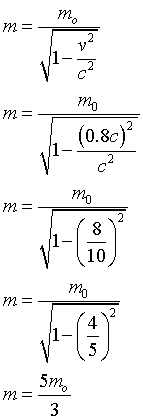
An electron with ( rest mass mo) moves with a speed of 0.8c. Its mass when it moves with this speed is .. [ CBSE-PMT 1991]
-
17%
a) mo
-
28%
b) mo /6
-
42%
c)5mo /3
-
13%
d)3mo /5
Explanation
Q.17.
Fission of nuclei is possible because the binding energy per nucleon is them .. [ CBSE-PMT 2005]
-
16%
a)increases with mass number at low mass number
-
22%
b) decreases with mass number at lower mass number
-
29%
c)increases with mass number at high mass number
-
33%
d)decreases with mass number at high mass number
Q.18.
The binding energy per nucleon in deuterium and helium nuclei are 1.1 MeV and 7.0 MeV respectively. When two deuterium nuclei fuse to form a helium nucleus the energy released in the fusion is .. [ CBSE-PMT 2010]
-
12%
a) 30.2 MeV
-
46%
b) 23.6MeV
-
25%
c) 2.2MeV
-
17%
d) 28.0MeV
Q.19.
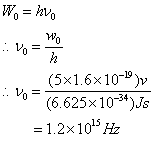
2) The work function of a metallic substance is 5 eV. The threshold frequency is approximately{AFMC 2009}
-
15%
a) 1.6 × 10 7 Hz
-
31%
b) 8.68 × 10 15 Hz
-
21%
c) 9.68 × 10 17 Hz
-
33%
d) 1.2 × 10 15 Hz
Explanation
Q.20.
The half life of a radio active isotopes 'X' is 50 years. It decays to another element 'Y' which is stable. the two elements 'X' and 'Y' were found to be in the ratio of 1:15 in a sample of a given rock. the age of the rock was estimated to be.. [ CBSE-PMT 2011]
-
21%
a)150 years
-
42%
b) 200 years
-
25%
c)250 years
-
12%
d)100 years
Explanation

Q.21.
Two nuclei have their mass numbers in the ratio of 1:The ratio of their nuclear densities would be .. [ CBSE-PMT 2008]
-
18%
a) 1:3
-
18%
b) 3:1
-
22%
c)31/3 : 1
-
41%
d)1:1
Q.22.
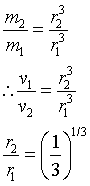
A nucleus ruptures into two nuclear parts, which nave their veloity ratio equal to 2:What will be the ratio of their nuclear size ( nuclear radius)?.. [CBSE-PMT 1996]
-
21%
a) 21/3 : 1
-
43%
b) 1:21/3
-
21%
c)31/2 : 1
-
15%
d)1: 31/2
Explanation

Q.23.
Two radioactive nucleous P and Q in a given sample decay into a stable nucleus R. At time t=0, number of P species are 4No and that of Q are No. Half life of P is 1 mintes where as that of Q is 2 minutes. Initially there are no nuclei of R present in the sample. When number of nuclei of P and Q are equal, the number of nuclei of R present in the sample would be.. [ CBSE-PMT 2011]
-
16%
a) 3No
-
47%
b) (9/2)No
-
24%
c) (5/2) No
-
13%
d) 2No
Q.24.
The activity of radioactive sample is measured as No counts per minutes at t=0 and No/e counts per minute at t=5 minutes. The time ( in munutes) at which the activity reduces to half its value is .. [ CBSE-PMT 2010]
-
19%
a)loge(2/5)
-
33%
b) 5 / loge2
-
14%
c)5 log102
-
35%
d)5 loge2
Q.25.
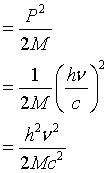
A radioactive nucleus of mass M emits a photon of frequency ν and the nucleus recoils. The recoil energy will be.. [ CBSE-PMT 2011]
-
8%
a) Mc2 - hν
-
51%
b) h2 ν2 / 2Mc2
-
33%
c)zero
-
8%
d)hν
Explanation
Q.26.
The mass number of a nucleus is .. [ CBSE-PMT 2003]
-
24%
a) sometimes less than and some times more than its atomic number
-
10%
b) always less than its atomic number
-
30%
c)always more than its atomic number
-
36%
d)sometimes equal to its atomic number
Q.27.
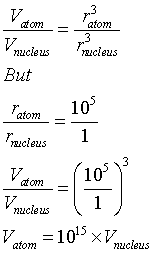
The voume occupied by an atom is greater than the volume of the nucleus by a factor of about.. [ CBSE-PMT 2003]
-
50%
a) 1015
-
28%
b) 10
-
12%
c) 105
-
10%
d) 1010
Explanation
Q.28.
For a nuclear fusion process, the sitable nuclei are.. [ CBSE-PMT 2002]
-
14%
a)any nuclei
-
18%
b) heavy nuclei
-
40%
c)light nuclei
-
28%
d)nuclei lying in the middle of the periodic table
Q.29.
It is possible to understand nuclear fission on te basis of the .. [ CBSE-PMT 2000]
-
28%
a) liquid drop model of the nucleus
-
26%
b) meson theory of the nuclear forces
-
28%
c)proton-proton cycle
-
19%
d)independent particle model of the nucleus
Q.30.
After 1 α and 2β emissions.. [ CBSE-PMT 1999]
-
48%
a) mass number reduced by 4
-
10%
b) mass number reduced by 5
-
25%
c)mass number reduced by 6
-
17%
d)mass number increased by 4