Q.1.
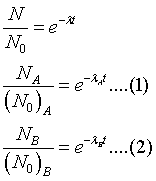
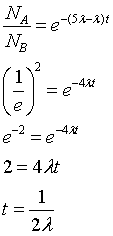
two radioactive substabce A and B have decay constant5λ and λ respectively. At t=0 they have same number of nuclei. the ratio of number of nuclei of A to those of B will be (1/e)2 after time interval .. [ CBSE-PMT 2007]
-
30%
a) 1/4λ
-
25%
b) 2λ
-
42%
c) 1/2λ
-
4%
d) λ / 4
Explanation

Q.2.
Which one of the following is stable ? [ AFMC 1997]
-
5%
a) positron
-
77%
b) proton
-
9%
c)electron
-
9%
d)neutron
Q.3.
Intensity of X-rays depends upon the number of ----- . [ AFMC 2000]
-
14%
a) positron
-
24%
b) neutrons
-
16%
c)protons
-
46%
d)electrons
Q.4.
Which of the following statement is not correct ? [ AFMC 1999]
-
54%
a)Infra-red photons have more energy than photons of visible light
-
14%
b)Infra-red rays are invisiable but can cast shadows like visiable light
-
20%
c)Photographic plates are sensitive to ultraviolet rays
-
11%
d) Photographic plates are sensitive to infra-red rays.
Q.5.
Bohr`s theroy was modified by ------- . [ AFMC 2003]
-
35%
a) Rutherford and Soddy
-
56%
b) Planck
-
6%
c) Hund
-
3%
d) Sommerfield
Q.6.
)Atoms having different atomic number as well as different mass number but having same number of neutrons. --- [AFMC 2003]
-
17%
a)isotopes
-
17%
b) isobars
-
60%
c)isotones
-
6%
d)isodiaphers
Q.7.
) The intensive property among the following is [ AFMC 2003]
-
23%
a) energy
-
3%
b) volume
-
16%
c)entropy
-
58%
d)temperature
Q.8.
) the total energy of electron is 3.555 MeV. If its potential energy is zero, then its kinetic energy is ---- . [ AFMC 2000}
-
74%
a)3.555 MeV
-
6%
b) 3.5 MeV
-
12%
c)3.545 MeV
-
9%
d)3.045 Mev
Q.9.
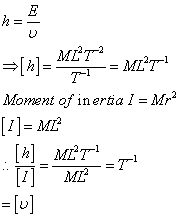
) The ratio of dimensions of Plank`s constant and that of the moment of interia is the dimension of ---- . [ AFMC 2007]
-
41%
a) frenqucy
-
7%
b) velocity
-
52%
c) angular momentum
-
0%
d) time
Explanation
Q.10.
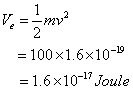
) Kinetic energy of an electron accelerated in a potential difference of 100 V is{AFMC 1999}
-
28%
a)

-
14%
b) 1.6 ×10 -29 J
-
10%
c)1.6 × 10²¹ J
-
48%
d)1.6 × 10⁻¹⁷ J
Explanation
Q.11.
) Photoelectric effect shows{AFMC 2003}
-
7%
a) wave nature of electrons
-
53%
b) particle nature of light
-
37%
c) both (a) and ( b)
-
3%
d)none of the above
Q.12.
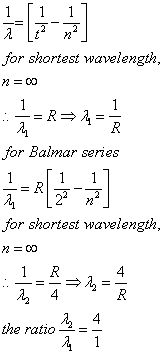
) What is the ratio of the shortest wavelength of the Balmer series to the shortest wave length of the Lyman serises?{AFMC 2011}
-
41%
a)4 : 1
-
34%
b) 4 : 3
-
19%
c)4 : 9
-
6%
d)5 : 9
Explanation
Q.13.
) Fraction of tritium left after 150 years ( half life of tritium is 12.5 years) is{AFMC 2011}
-
11%
a) 1 / 1024
-
22%
b) 1 / 2048
-
59%
c) 1 / 4096
-
7%
d) 1 / 8192
Explanation

Q.14.
In the nuclear reaction , there is conservation of{AFMC 2000}
-
16%
a)momentum
-
8%
b) mass
-
8%
c)energy
-
68%
d)all of these
Q.15.
) Rutherford's alpha particle experiment show that the atoms have{AFMC 2011}
-
33%
a) electron
-
11%
b) neutrons
-
52%
c) nucleus
-
4%
d) proton
Q.16.
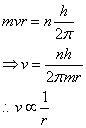
3) The velocity of an electron in the inner most orbit of an atom will be{AFMC 2002}
-
86%
a)highest
-
7%
b) lowest
-
4%
c)mean
-
4%
d)zero
Explanation
Q.17.
4) Which of the following is most unstable ?{AFMC 2005}
-
21%
a) Electron
-
4%
b) Proton
-
54%
c)Neutron
-
21%
d)alpha - particle
Q.18.
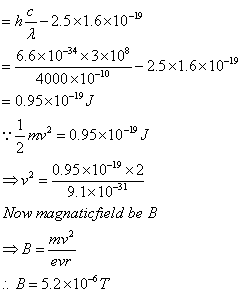
5) The strength of the transverse magnetic field required to bend all photoelectrons within a circle of radius 50 cm when light of wavelength 4000A is incident on barium emitter is ( work function of barium is 2.5eV){AFMC 2004}
-
50%
a) 5.2× 10 -6 T
-
25%
b) 4 × 10 -4 T
-
11%
c)4.0 × 10 -6 T
-
14%
d)5.2× 10 -4 T
Explanation
Q.19.
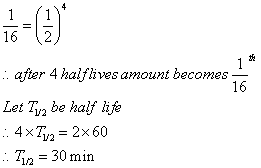
6) After 2 hrs, 1/16 th of intial amount of certain radioactive isotope remains undecayd. The half life time of isotope is{AFMC 2005}
-
18%
a) 15 min
-
75%
b) 30 min
-
4%
c) 45 min
-
4%
d) 60 min
Explanation
Q.20.
7) If the energy of a hydrogen atom in nth orbit is En. then energy in nth orbit of a singly ionized helium atom will be{AFMC 2007}
-
65%
a)4 En
-
4%
b) En/4
-
17%
c)2 En
-
13%
d) En/2
Q.21.
8) What is not released in nuclear disintegration?{AFMC 2009}
-
57%
a) Electrons
-
9%
b) Protons
-
22%
c)Helium nucleus
-
13%
d)gama rays
Q.22.
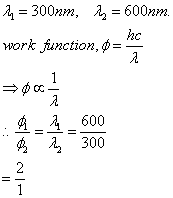
9) When light of wavelength 300nm falls on a photoelectic emitter, photoelectrons are liberated. For another emitter, light of wavelength 600nm is sufficient for liberating photoelectrons. The ratio of the work function of the two emitters is{AFMC 2008}+
-
17%
a) 1 : 2
-
58%
b) 2 : 1
-
12%
c)4 : 1
-
12%
d) 1 : 4
Explanation
Q.23.
) Photoelectric effect shows{AFMC 2003}
-
9%
a) wave nature of electron
-
78%
b) particle nature of light
-
4%
c) both (a) and (b)
-
9%
d) none of these
Q.24.
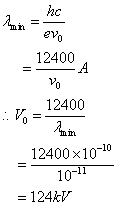
) Hard X-rays for the study of fractures in bones should have a minimum wavelength of 10-11 m. The accelrating voltage for electrons in X-ray machin should be{AFMC 2006}
-
57%
a)< 124 kV
-
4%
b) > 124 kV
-
26%
c)between 60 kV and 70 kV
-
13%
d)=100 kV
Explanation
Q.25.
) Alpha particles are [ AFMC 2003]
-
64%
a) ionised helium atom
-
12%
b) hydrogen atom
-
4%
c)neutral atom
-
20%
d)all of these
Q.26.
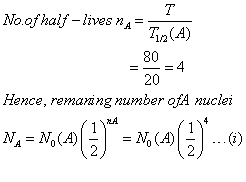
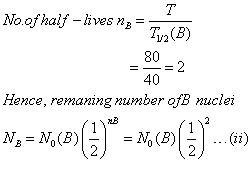
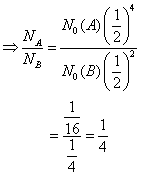
) Half lives of two radioactive substances A and B are respectively 20 min and 40 min. Intially, the samples of A and B have equal number of nuclei. After 80 min the ratio of remaining number of A and B nuclei is [ AFMC 2006]
-
17%
a) 1 : 16
-
13%
b) 4 : 1
-
65%
c)1 : 4
-
4%
d)1 : 1
Explanation
Q.27.
) In which of the the following system will be radius of the first orbit (n=1) be minimum? [ AFMC 2007]
-
12%
a) Deuterium atom
-
4%
b) hydrogen atom
-
79%
c) Doubly ionized lithium
-
4%
d) Singly ionised helium
Q.28.
) The fussion of 235 U can be triggered by the absorption of a slow netron by a nucleus. Similarily, a slow proton can also be used.This statment is [ AFMC 2007]
-
21%
a)correct
-
50%
b) wrong
-
17%
c)information is insufficient
-
12%
d)none of the above.
Q.29.
) Activity of radio active sample decreases to (1/3)rd of its original value in 3 days. Then in 9 days its actvity will become [ AFMC 2008]
-
54%
a) (1/27) of the original value
-
21%
b) (1/9) of the original value
-
17%
c)(1/18) of the original value
-
8%
d)(1/3) of the original value
Q.30.
) A free neutron decays spontaneously into [ AFMC 2008]
-
71%
a) a proton, an electron and anti neutrino
-
4%
b) a proton, an electron and a neutrino
-
0%
c)a proton and electron
-
25%
d)a proton, and electron, a neutrino and an anti-neutrino
Explanation
