Q.1.
With reference to the diagram, choose the wrong statement:
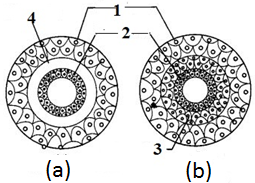
-
32%
a) Part labelled (3) represents undifferentiated Mesoglea in triploblastic animals.
-
39%
b) Adamsia is an example of an animal with germinal layers arranged as (b)
-
18%
c) Part (4) forms coelom in coelomates.
-
11%
d) The three germ layers are formed during the gastrula of embryonic development.
Q.2.
Free swimming ciliated of Liver Fluke is
-
21%
a) Redia
-
34%
b) Miracidium
-
32%
c) Metacercaria
-
13%
d) Cercaria
Q.3.
Echinoderms are heartless, brainless, headless, yet from evolutionary point of view, they have been placed on the top of the invertebrate phyla because of
-
25%
a) Power of reproduction
-
34%
b) Power of regeneration
-
19%
c) Presence of enterocoel
-
22%
d) Exclusively marine habitat
Q.4.
Haemoglobin is found dissolved in blood plasma of
-
39%
a) Earthworm
-
18%
b) Cockroach
-
21%
c) Rabbit
-
21%
d) Frog
Q.5.
Maximum number of economically important species is in the class
-
28%
a) Crustacea
-
34%
b) Insecta
-
16%
c) Chilopoda
-
22%
d) Diplopoda
Q.6.
Comb plates of ctenophores posses
-
46%
a) Cilia for locomotion
-
23%
b) Cilia for filter feeding
-
19%
c) Teeth for crushing
-
12%
d) Teeth for filtering
Q.7.
Aplysia belongs to the class
-
46%
a) Amphineura
-
29%
b) Gastropoda
-
21%
c) Bivalvia
-
4%
d) Cephalopoda
Q.8.
Pearl producing Indian species is
-
29%
a) Pennatula
-
42%
b) Pinctada vulgaris
-
25%
c) Ostrea indica
-
4%
d) Ostrea vulgaris
Q.9.
Match the following:
| Column I | Column II |
| a Thesocytes | 1 Sponging fibres |
| b Gemmules | 2 Food storing cells |
| c Osculum | 3 Involved in reproduction |
| d Spicules | 4 Collar cells |
| - - - - | 5 Water exists the Spongocoel through this structure |
-
4%
a) a →1 , b →2 ,c →3 ,d → 4
-
43%
b) a →3 , b →1 ,c →4 ,d → 5
-
22%
c) a →2 , b →3 ,c →4 ,d → 1
-
30%
d) a →2 , b →3 ,c →5 ,d → 1
Q.10.
Ascaris lumbricoides is commonly called
-
44%
a) Roundworm
-
24%
b) Hookworm
-
16%
c) Seat worm
-
16%
d) Pinworm
Q.11.
The pigment haemocyanin is found in
-
35%
a) Mollusca
-
30%
b) Annelida
-
30%
c) Echinodermata
-
5%
d) Chordata
Q.12.
Which one spreads through food contamination?
-
20%
a) Taenia
-
20%
b) Schistosoma
-
40%
c) Ascris
-
20%
d) Facsciola
Q.13.
The nitrogeneous metabolic waste in Hydra is mostly
-
40%
a) Ammonia and is removed from whole surface of body
-
30%
b) Ureas and is removed from whole surface of body
-
25%
c) Urea and is removed mainly by tentavles
-
5%
d) Uric acid and is removed from whole surface of body
Q.14.
Hydra can digest all types of food except
-
11%
a) Proteins
-
33%
b) Fats
-
39%
c) Starches
-
17%
d) All of the above
Q.15.
Neopilina is a connecting link between
-
33%
a) Arthropoda and Mollusca
-
39%
b) Annelida and Mollusca
-
22%
c) Mollusca and Echinodermata
-
6%
d) Mollusca and Helminthes
Q.16.
Which of the following animal has nervous system but no brain?
-
27%
a) Earthworm
-
20%
b) Amoeba
-
33%
c) Hydra
-
20%
d) Periplaneta
Q.17.
Sea hare is
-
44%
a) Aplysia
-
19%
b) Sepia
-
38%
c) Pila
-
0%
d) Teredo
Q.18.
Excretory organs in echinoderms are
-
33%
a) Coxal glands
-
27%
b) Green glands
-
20%
c) Malpighian tubules
-
20%
d) No specialized organ
Q.19.
In Fasiola hepatica, germination of capsule produces
-
38%
a) Miracidium
-
31%
b) Sporocyst
-
15%
c) Redia
-
15%
d) Cercaria
Q.20.
Miracidium of Liver Fluke is
-
42%
a) Free swimming
-
8%
b) Creeping
-
33%
c) Nonmotile
-
17%
d) Free floating
Q.21.
The body of Hydra is
-
25%
a) Naked
-
25%
b) Covered by perisarc
-
25%
c) Covered with thin cuticle
-
25%
d) Surrounded by thick cuticle
Q.22.
In cephalopod Sepia
-
21%
a) Shell is absent
-
43%
b) Inner shell is found
-
29%
c) A folded shell is found
-
7%
d) Outer shell is found
Q.23.
Which of the following belongs to class Insecta?
-
0%
a) Julus
-
31%
b) Silverfish
-
19%
c) Lobsters
-
50%
d) Prawn
Q.24.
An animal that absorbs its nutrients from the host body directly through their body surface:
-
27%
a) Hirudinaria
-
27%
b) Taenia
-
33%
c) Ascaris
-
13%
d) Neries.
Q.25.
In which of the following groups, all animals are diploblastic:
-
15%
a) Limulus, Neries, Taenia.
-
23%
b) Meandrina, Laccifer, Sycon
-
38%
c) Ctenoplana, Aplysia, Pleurobranchia
-
23%
d) Coenoplana, Aurelia, Pennatula
Q.26.
Mesoglea of hydra is:
-
36%
a) Acellular and can be crossed by interstitial cells.
-
9%
b) ellular and cannot be crossed by interstitial cells.
-
45%
c) Cellular and contains mesenchyme cells
-
9%
d) Cellular and give rise to germ cells
Q.27.
Special mode of feeding by radula is found in
-
17%
a) Sea mouse
-
17%
b) Earthworm
-
67%
c) Molluscs
-
0%
d) Sea snake
Q.28.
Lung Fluke is
-
30%
a) Hymenolepis nana
-
50%
b) Paragonimus westermani
-
0%
c) Schistosoma haematobium
-
20%
d) Echinococcus granulosus
Q.29.
The metallic ion contained in the blood of mollusca is
-
27%
a) Iron
-
18%
b) Copper
-
27%
c) Magnesium
-
27%
d) Zinc
Q.30.
Peripatus is a connecting link between
-
31%
a) Annelida and Arthropoda
-
31%
b) Annelida and Mollusca
-
23%
c) Mollusca and Arthropoda
-
15%
d) Coelenterata and Platyhelminthes