Q.1.
In silkworm, silk is the product of
-
33%
a) Salivary glands of larvae
-
22%
b) Cuticle of the adult
-
36%
c) Cuticle of the larva
-
9%
d) Salivary gland of the adult
Q.2.
Pseudocoelom develops from
-
12%
a) Blastopore lip
-
35%
b) Archenteron
-
32%
c) Embryonic mesoderm
-
21%
d) Blastocoel
Q.3.
A phylum with triploblastic acoelomate animal is
-
29%
a) Platyhelminthes
-
23%
b) Aschelminthes
-
26%
c) Annelida
-
23%
d) Arthropoda
Q.4.
Many molluscs have a water-testing organ present in the mantle cavity. This is called
-
14%
a) Statocyst
-
46%
b) Osphradium
-
25%
c) Tentaculocyst
-
14%
d) Amphid
Q.5.
Choanocytes are present in ….. of Leucosolenia
-
4%
a) Incurrent canals
-
39%
b) Radial canals
-
22%
c) Excurrent canals
-
35%
d) Spongocoel
Q.6.
In hemichordates the dorsal nerve cord is
-
30%
a) Absent
-
13%
b) Restricted to tongue region
-
26%
c) Present throughout
-
30%
d) Restricted to collar region
Q.7.
Which of the following is not a mollusca?
-
29%
a) Octopus
-
29%
b) Sea squirt
-
19%
c) Sea squid
-
24%
d) Nautilus
Q.8.
Pupa occurs in the life cycle of
-
17%
a) Grasshopper
-
17%
b) Cockroach
-
22%
c) Silverfish
-
43%
d) Butterfly
Q.9.
In leech, hirudin is secreted by
-
0%
a) Crop
-
25%
b) Pharynx
-
45%
c) Salivary glands
-
30%
d) Haemocoel
Q.10.
Match the following
| Column I( Locomotory Organ) | Column II ( Phylum) |
| A. Pseudopodia | p. Mollusca |
| B. Parapodia | q. Chondrichthyes |
| C. Muscular feet | r. Protozoa |
| E. Fins | s. Annelida |
-
5%
a) A- s, B- r , C-q, D-p
-
50%
b) A- r, B- s , C-p, D-q
-
35%
c) A- r, B- p , C-s, D-q
-
10%
d) A- p, B- r , C-s, D-q
Q.11.
Body having a meshwork of cells, internal cavities lined with food filtering flagellated cells and indirect development are the characteristics of phylum:
-
30%
a) Coelenterata
-
30%
b) Porifera
-
30%
c) Mollusca
-
10%
d) Protozoa.
Q.12.
Find out the mismatch:
-
10%
a) Sponges – Cellular level
-
43%
b) Coelenterates – Tissue level
-
24%
c) Platyhelminthes – Organ level
-
24%
d) Mollusca - Organ level
Q.13.
Spongilla is commonly called:
-
15%
a) Glass rope sponge
-
20%
b) Bath sponge
-
30%
c) Venus flower basket
-
35%
d) Fresh water sponge
Q.14.
A bilateral larva transforms to radial adult in
-
14%
a) Aurelia
-
27%
b) Hydra
-
32%
c) Sea urchin
-
27%
d) Sea anemone
Q.15.
In which of the animals rectum passes through pericardium?
-
16%
a) Unio
-
32%
b) Pila
-
21%
c) Sepia
-
32%
d) All
Q.16.
Amongst coelenterates, Hydra is one of the smallest
-
25%
a) Medusa
-
35%
b) Polyp
-
25%
c) Gastrozooid
-
15%
d) Gonozoid
Q.17.
Which molluscan group is primarily used in pearl production
-
6%
a) Pelecypoda
-
44%
b) Monoplacophora
-
33%
c) Cephalopoda
-
17%
d) Gastropoda
Q.18.
Triploblastic unsegmented, acoelomate, exhibiting bilateral symmetry and reproduction both asexually and sexually and asexually, with parasitic forms belong to phylum
-
28%
a) Porifera
-
28%
b) Platyhelminthes
-
28%
c) Annelida
-
17%
d) Ctenophora
Q.19.
Which of the following traits is not characteristic of echinoderms
-
11%
a) Water vascular system
-
44%
b) Trochophore larva
-
28%
c) Tube feet
-
17%
d) Enterocoel
Q.20.
For class cephalopoda which of the following statement is incorrect:
-
41%
a) Head distinct and large with well developed eyes, foot as tentacles with siphon
-
24%
b) Dioecious and direct development.
-
12%
c) Shell external, internal or absent
-
24%
d) Marine and sedentary
Q.21.
Level of structural organization found in Hydra and Jelly fish is
-
5%
a) Cellular
-
21%
b) Acellular
-
53%
c) Tissue
-
21%
d) Organ-system
Q.22.
Stomatochord is found in
-
17%
a) Balanoglossus
-
33%
b) Herdmania
-
33%
c) Pyrosoma
-
17%
d) Amphioxus
Q.23.
Choose the correct combination
-
24%
a) Annelida and Porifera – Phyla
-
6%
b) Oligochaete and Arthropoda – Phyla
-
65%
c) Mollusca and Hydrozoa – Classes
-
6%
d) Aves and Chordata - Classes
Q.24.
Match the following:
| Column I | Column II |
| Statocysts | (a) Radiating plates |
| Radula | (b) Respiratory function |
| 3.Gills | (c) Organ of balance |
| Cnidoblast | (d) Anchorage, defence |
| - - - - | (e) Organ of feeding |
| - - - - | (f) Organ of locomotion |
-
19%
a) 1 →d ,2 →a ,3 →c ,4 →f ,
-
25%
b) 1 →c ,2 →e ,3 →b ,4 →d
-
50%
c) 1 →d ,2 →e ,3 →f ,4 →f
-
6%
d) 1 →b ,2 →c ,3 →e ,4 →d
Q.25.
Match the following:
| Column I | Column II |
| a Physalia | 1 Liver fluke |
| b Taenia | 2 Sycon |
| c Fasciola | 3 Tapeworm |
| d Scypha | 4 Portuguese man of war |
-
6%
a) a →2 ,b →1 ,c →3 ,d →4
-
25%
b) a →4 ,b →3 ,c →1 ,d →2
-
50%
c) a →1 ,b →3 ,c →2 ,d →4
-
19%
d) a →1 ,b →2 ,c →3 ,d →4
Q.26.
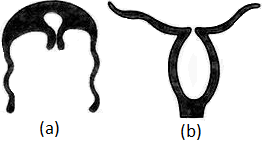
The diagram given below represents the two basic body forms of cnidarians (i) (a) represents polyp and (b) represents medusa. (ii) Polyp is sessile and cylindrical form while medusa is umbrella shaped and free swimming. (iii) Hydra and Adamsia represent poly form while Aurelia represents medusa form. (iv) Those cnidarians in which (b) body form is present alone belong to class Scyphozoa. (v) Obelia can show both (a) and (b) in their life cycle.
-
13%
a) (ii), (iii) and (iv) are false.
-
33%
b) (i) and (iv) are false.
-
27%
c) (i), (iii), (iv) are false
-
27%
d) Only (i) is false
Q.27.
atch list I with list II and select the correct answer with the help of answer code
| List I (genus,phylum) | List II( Larcastage) |
| A. Aurelia | Parenchymula |
| B. Sponge | Ephyra |
| C. Mollusca | Trochopore |
| D. Plychaeta | 4.Veliger |
-
0%
a) A- 1, B- 2, C – 3, D – 4
-
43%
b) A- 2, B- 3, C – 4, D – 1
-
29%
c) A- 3, B- 4, C – 1, D – 2
-
29%
d) A- 2, B- 1, C – 4, D – 3
Q.28.
The infective stage of Ascaris is
-
24%
a) Fertilized egg
-
24%
b) Embryonated egg
-
12%
c) Rhabditoid larva
-
41%
d) Adults Ascaris
Q.29.
The germinal layers of Limulus consist of:
-
13%
a) Ectoderm, Mesoderm and Endoderm
-
27%
b) Ectoderm and mesoderm
-
27%
c) Endoderm and Mesoderm
-
33%
d) Endoderm and Ectoderm
Q.30.
Read the following statements: (i) Polyp is sessile and cylindrical form like Adamsia. (ii) Medusa is umbrella shaped and free-living like Aurelia. (iii) Polyp produces medusa sexually and medusa forms the polyp asexually in Obelia. (iv) Metagenesis is seen in jelly fish.
-
12%
a) (i), (iv)
-
31%
b) (i), (iii)
-
19%
c) (ii), (iii)
-
38%
d) (iii), (iv)