Q.1.
Sponges are characterised by
-
28%
a) Absence of organs and tissues
-
20%
b) Presence of tissues but absence of organs
-
32%
c) Presence of both tissues and organs but absence of organ system
-
20%
d) Absence of cells
Q.2.
Which is not an insect?
-
39%
a) Housefly
-
36%
b) Spider
-
12%
c) Cockroach
-
12%
d) Mosquito
Q.3.
In Arthropoda, head and thorax are often fused to form cephalothorax, but in which one of the following classes, is the body divided into head, thorax and abdomen
-
43%
a) Insecta
-
23%
b) Crustacean
-
27%
c) Myriapoda
-
7%
d) Arachnida and Crustacean
Q.4.
In sponges, various types of body cell obtained nourishment from
-
36%
a) Choanocytes
-
14%
b) Trophocytes
-
14%
c) Collenocytes
-
36%
d) Both (b) and(c)
Q.5.
In which of the animals the heart does not have the left and right auricles?
-
30%
a) Cartilaginous and bony fish
-
30%
b) Frogs and toads
-
35%
c) Lizards and snakes
-
4%
d) Crocodiles and alligators
Q.6.
Which of the following phylum is being described here by the given statement: (i) They are bilaterally symmetrical, triploblastic, segmented and coelomate animals. (ii) Their body consists of head, thorax and abdomen and have joined appendages. (iii) Circulation is of open type. (iv) Excretion takes place through Malpighian tubules.
-
40%
a) Annelida
-
20%
b) Mollusca
-
35%
c) Arthropoda
-
5%
d) Cnidaria
Q.7.
he three germ layers namely ectoderm, endoderm and mesoderm are found in
-
40%
a) All the chordates only
-
15%
b) All the chordates except the protochordates
-
40%
c) All the chordates and higher invertebrates
-
5%
d) Higher chordates and higher invertebrates
Q.8.
Identify the figures a –d and select the correct option:
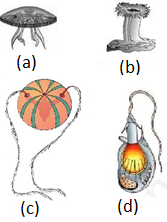
-
22%
a) a – Adamsia, b – Aurelia, c – Pleurobranchia, d-Cnidoblast
-
33%
b) a – Aurelia, b – Adamsia, c – Pleurobranchia, d – Cnidoblast
-
28%
c) a – Aurelia, b – Adamsia, c – Obelia, d – Cnidobla
-
17%
d) a – Adamsia, b – Aurelia, c – Obelia, d – Cnidoblast.
Q.9.
Find out the mismatch:
-
33%
a) Pterophyllum – Tortoise
-
13%
b) Clarius – Magur
-
33%
c) Labeo – Rohu
-
20%
d) Hippocampus – Sea horse
Q.10.
Find out the mismatch:
-
25%
a) Ascidia – Urochordata.
-
42%
b) Doliolum – Tunicata
-
17%
c) Branchiostoma - Cephalochordata
-
17%
d) Salpa – Vertebrata.
Q.11.
Which of the following statements is/are true about notochord? (i) Stiff and flexible rod of tissues. (ii) Lying ventral to nerve chord. (iii) Lying dorsal to nerve chord. (iv) Notochord is absent in non-chordates. (v) Notochord is the common character of all invertebrates.
-
10%
a) (i), (iii) and (v) are correct.
-
40%
b) (i), (iii) and (iv) are correct.
-
30%
c) (i), (ii) and (iv) are correct
-
20%
d) (ii), (iv) and (v) are correct.
Q.12.
Identify the following animals and their classes to which they belong:
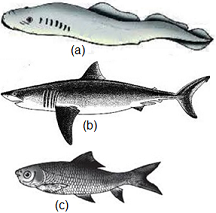
-
30%
a) a-Petromyzon-Gnathostomata, b-Scoliodon-Osteichthys, c-Trygon-Chondrichthys
-
20%
b) a-Petromyzon-Cyclostomata, b-Pristis-Chondrichthys, c-Labeo-Osteichthys
-
30%
c) a-Myxine-Agnatha, b-Caracharadon-Chondrichthys, c- Betta-Osteichthys
-
20%
d) a-Petromyzon-Cyclostomata, b- Scoliodon- Chondrichthys, c-Catla-Osteichthys
Q.13.
Mention the position of heart in chordates and non-chordates?
-
25%
a) Chordates have ventral heart and non-Chordates have dorsal heart.
-
38%
b) Non-chordates have ventral heart and Chordates have dorsal heart
-
25%
c) Both chordates and non-chordates have dorsal heart.
-
12%
d) Both chordates and non-chordates have ventral heart
Q.14.
Identify the correct option regarding the animal given in figure:
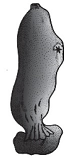
-
14%
a) They belong to class Cephalochordata.
-
57%
b) Notochord is present from head to tail and they are known as ‘Blue print of chordates’
-
14%
c) They are also called tunicates
-
14%
d) They have 6-15 pairs of gill slits.
Q.15.
Choose the incorrect statement regarding vertebrates.
-
14%
a) They possess notochord during the embryonic period.
-
57%
b) The notochord is replaced by bony vertebral column in all species.
-
0%
c) They possess two, three or four chambered ventral heart.
-
29%
d) They possess kidneys and paired appendages.
Q.16.
Which of the following is not applicable to Chondrichthys? (I) Persistent notochord. (II) Cartilaginous endoskeleton. (III) Epidermal scales. (IV) Placoid scales modified as teeth. (V) Forwardly directed teeth. (VI) Air bladder in few species.
-
0%
a) (I), (III) and (V).
-
67%
b) (I), (II) and (IV).
-
17%
c) (III), (V), (VI)
-
17%
d) (II), (III), (V), (VI)
Q.17.
Neural gland, tadpole larva and retrogressive metamorphosis are related with:
-
17%
a) Cephalaspis
-
17%
b) Branchiostoma
-
50%
c) Hyalonema
-
17%
d) Tunicata.
Q.18.
From the following, which one is not related to mammals?
-
14%
a) Muscular diaphragm.
-
14%
b) Neoteny.
-
29%
c) 7-cervical vertebrae.
-
43%
d) Threology.
Q.19.
Clavicle and interclavicles together formed as a peculiar bone that helps in flying called:
-
43%
a) Pygostyle
-
43%
b) Fulcrum
-
0%
c) Furcula
-
14%
d) Synsacrum
Q.20.
Select the wrong statement from the following:
-
14%
a) Chondrichthys have heterocercal tail fin
-
14%
b) Devonian period is the golden age of pisces
-
43%
c) All amphibians have scaleless skin and external fertilization
-
29%
d) Creeping or crawling animals have metanephric kidney
Q.21.
Dicondylic skull, external ear pinna and amphiplatiyan vertebrae are the characteristics of:
-
29%
a) Clarias
-
43%
b) Columba
-
29%
c) Amphinura
-
0%
d) Canis
Q.22.
Find the incorrectly matched:
-
43%
a) Scoliodon – Ampullae of lorenzini – Thermoreceptors.
-
0%
b) Amphioxus – Protonephridia – excretion.
-
14%
c) Ascidia – Neural gland – Excretion.
-
43%
d) Sardine – Webbarian ossicles – Balancing
Q.23.
Synsacrum in birds is:
-
29%
a) Sound producing organs
-
14%
b) Fused vertebrae
-
29%
c) Wing feathers
-
29%
d) Digestive glands
Q.24.
Select the mismatch:
-
14%
a) Amphioxus – Microscopic chordata
-
29%
b) Ammocoetes – Amphioxus like.
-
43%
c) Amphibia – Dicondylic skull.
-
14%
d) Aptenodytes – Paired ovaries.
Q.25.
Select the odd one:
-
14%
a) Latimeria
-
29%
b) Ornithorhyncus
-
29%
c) Protopterus
-
29%
d) Balaenoptera.
Q.26.
Select the incorrect statement regarding Agnatha:
-
25%
a) They are anadromous
-
12%
b) Paired nostrils are present
-
50%
c) Scales and fins are absent.
-
12%
d) Typhlosole is present
Q.27.
Select the incorrectly matched from the following:
-
14%
a) Eqqus – Perissodactyla.
-
71%
b) Camelus – Saltatorial and 8 cervical vertebrae
-
0%
c) Aptenodytes – Syrinx and toothless beak.
-
14%
d) Alligator – Jacobson’s organ.
Q.28.
All of them are characteristics of tunicates except:
-
14%
a) Neural glands as excretory organs
-
57%
b) Open type of circulation
-
14%
c) Protonephridia and 6 – 15 pairs of gill slits
-
14%
d) Retrogressive metamorphosis.
Q.29.
Which of the following statements are not true regarding Scoliodon? (i) The skin is tough and covered with placoid scales. (ii) They possess claspers for copulation at the base of the pectoral fins. (iii) The tail of shark is heterocercal. (iv) Ampulla of lorenzini present in the snout of shark is a thermoreceptor. (v) It has 5 pairs of separate gill slits covered by an operculum.
-
43%
a) (i), (iii), (iv) and (v)
-
14%
b) (ii), (iii), (iv) and (v)
-
29%
c) (ii) and (v) only
-
14%
d) (iii) and (v) only
Q.30.
Which one of the following organisms is scientifically correctly named, correctly printed according to the internal rules of Nomenclature and correctly described?
-
11%
a) Musca domestica – The common house lizard, a reptile
-
33%
b) Felis tigris – The Indian tiger, protected in Gir forests.
-
22%
c) Anthocerose coronatus – State bird of Kerala, found in rainforests of silent valley, included in aves.
-
33%
d) Latimeria – Common lung fish found in Latin America, belongs to crossopterygian.