Q.1.
Roundworms differ from flatworms in possessing
-
39%
a) Flame cells
-
39%
b) Pseudocoelom
-
12%
c) Segmented body
-
11%
d) Production of antienzymes
Q.2.
Match the columns:
| Column I | Column II |
| a Ancylostoma | 1 Hookworm |
| b Wuchereria | 2 Filarial worm |
| c Ascaris | 3 Roundworm |
| d Fasciola | 4 Liver fluke |
| - - - - | 5 Flatworms |
-
19%
a) a →1 , b → 4, c → 3 , d → 5
-
31%
b) a →2 , b → 5, c → 1 , d → 3
-
35%
c) a →4 , b → 1, c → 5 , d → 3
-
15%
d) a →1 , b → 2, c → 3 , d → 4
Q.3.
Shizocoelomates and enterocoelomates are:
-
19%
a) Acoelomates.
-
30%
b) Invertebrates
-
30%
c) Pseudocoelomates.
-
22%
d) Molluscans and echinoderms.
Q.4.
Haemocoel is present in
-
7%
a) Metaphire
-
33%
b) Periplaneta
-
36%
c) Sponge
-
24%
d) Ascaris
Q.5.
Common larva of sponge is
-
25%
a) Tadpole
-
33%
b) Planula
-
25%
c) trochophore larva
-
16%
d) Parenchymula
Q.6.
Which phylum has none of freshwater form?
-
18%
a) Chordata
-
18%
b) Porifera
-
46%
c) Echinodermata
-
18%
d) Mollusca
Q.7.
Which of the following has correct grouping?
-
19%
a) Centipede, millipede, silverfish- Arthropoda
-
22%
b) Cuttlefish,silverfish,sea urchin –Coelenterata
-
33%
c) Taenia solium,roundworm,flatworm – Platyhelminthes
-
25%
d) Hydra, Spongia, Obelia-Cnidara
Q.8.
Identify the given figure labelled a ,b and c.
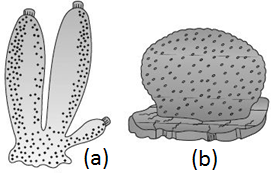
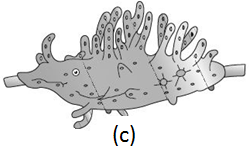
-
30%
a) a – Sycon, b – Spongilla, c – Euspongia.
-
27%
b) a- Scypha, b – Bath sponge, c – Fresh water sponge.
-
24%
c) a – Euspongia, b – Spongilla, c – Sycon.
-
18%
d) a – Fresh water sponge, b – Bath sponge, c – Scypha
Q.9.
Metagenesis is represented by:
-
37%
a) Medusae → Polyp → Egg → Planula → Medusae.
-
43%
b) Egg → Planula → Medusae → Polyp → Medusae.
-
10%
c) Polyp → Medusae → Egg → Planula → Polyp.
-
10%
d) Polyp → Egg → Medusae → Planula → Polyp.
Q.10.
Consider the statements: (i) Molluscans are triploblastic, coelomates and are usually dioecious. (ii) Molluscans are terrestrial, marine or fresh water inhabitants. (iii) In Molluscs, anterior head region has sensory tentacles.
-
35%
a) All are correct.
-
22%
b) Only (i) is wrong
-
30%
c) (i) and (ii) are wrong.
-
13%
d) (ii) and (iii) are wrong
Q.11.
Which of the following statement is wrong regarding Obelia?
-
16%
a) Exhibits alternation of generation or metagenesis.
-
11%
b) In their life cycle, the sexual phase alternates with the asexual phase.
-
42%
c) Polyp produces medusae sexually and medusae forms polyp asexually.
-
32%
d) Polyp produces medusae asexually and medusae forms polyp sexually
Q.12.
Which of the following statements are true/false: (i) Cell aggregates body plan is found in phylum Platyhelminthes. (ii) Radial symmetry is the most common symmetry found in animals. (iii) Pseudocoelom is found only in phylum Aschelminthes. (iv) All triploblastic animals have true coelom. (v) Haemocoel is sometimes observed in animals belonging to phylum Platyhelminthes.
-
11%
a) (i) and (v) are true and (ii), (iii) and (iv) are false.
-
39%
b) (ii), (iii) and (v) are true and (i) and (iv) are false.
-
39%
c) (i), (ii) and (iii) are true and (iv) and (v) are false
-
11%
d) (i), (ii), (iv) and (v) are false, only (iii) is true.
Q.13.
The stage absent in the file cycle of Schistosoma is
-
20%
a) Miracidium
-
20%
b) Redia
-
10%
c) Cercaria
-
50%
d) Both b and c
Q.14.
An insect differs from spider in having:
-
53%
a) 3 pairs of legs and 2 pairs of wings instead of 4 pairs of legs and no wings.
-
16%
b) 3 pairs of legs and 2 pairs of wings instead of 3 pairs of legs and no wings.
-
26%
c) 3 pairs of legs and no wings instead of 5 pairs of legs and generally one pair of wings.
-
5%
d) 6 pairs of legs and one pair of wings instead of 4 pairs of legs and no wings.
Q.15.
Sensory structure of cnidoblast is
-
31%
a) Cnidocil
-
12%
b) Refractile rods
-
44%
c) Myonemes
-
12%
d) Operculum
Q.16.
A list of animals are given below. Identify the animals with bilateral symmetry, Triploblasty and open circulation: (i) Liver flukes. (ii) Grasshopper (iii) Earthworm (iv) Oyster (v) Neries. (vi) Saccoglossus.
-
24%
a) (ii), (iii) and (vi)
-
41%
b) (ii), (iv) and (vi)
-
24%
c) (i), (iii) and (iv)
-
12%
d) (ii), (iii), (iv) and (vi)
Q.17.
The level of organisation seen in roundworms:
-
18%
a) Organ level
-
18%
b) Tissue level
-
24%
c) Protoplasmic level
-
41%
d) Organ system level
Q.18.
Find out the true description regarding ctenophores:
-
35%
a) Bilaterally symmetrical and diploblastic organisms.
-
29%
b) Sexes are separate.
-
24%
c) Flame cells helps in osmoregulation.
-
12%
d) External fertilization and indirect development.
Q.19.
Which of the following groups of animals are bilaterally symmetrical and triploblastic:
-
0%
a) Scypha, Meandrina, Physalia.
-
33%
b) Taenia, Pennatula, Antedon
-
53%
c) Ancylostoma, Locusta, Loligo.
-
13%
d) Antedon, Adamsia, Ascaris.
Q.20.
Metagenesis is:
-
19%
a) Form of asexual reproduction in cnidarians.
-
31%
b) Form of sexual reproduction in cnidarians.
-
31%
c) Alternation of sexual and asexual life stages in Cnidaria
-
19%
d) Metamorphosis of Planula larva into adult.
Q.21.
Members of which of the following phyla exhibit adaptations so widely varies environmental conditions
-
33%
a) Coelenterata
-
13%
b) Porifers
-
33%
c) Echinoddermata
-
20%
d) Mollusca
Q.22.
Nephridia develop from
-
14%
a) Ectoderm
-
14%
b) Mesoderm
-
50%
c) Endoderm
-
21%
d) Archenteron
Q.23.
Which of this is an insect?
-
31%
a) Pinworm
-
23%
b) Hookworm
-
31%
c) Silkworm
-
15%
d) Earthworm.
Q.24.
Which among the following statements is incorrect about metagenesis:
-
21%
a) Alternation of asexual and sexual phases in the life cycle of Obelia is called metagenesis
-
36%
b) Metagenesis is similar to alternation of generation found in plants
-
36%
c) Both Medusa and polyp are diploid
-
7%
d) Medusa is the sexual phase and polyp is the asexual phase
Q.25.
Which of the following animals is not Mollusca?
-
15%
a) Sea pen
-
8%
b) Sea hare
-
38%
c) Sea lemon
-
38%
d) Sea butterfly
Q.26.
An important characteristic that hemichordates share with chordates is:
-
20%
a) Ventral tubular nerve chord
-
24%
b) Pharynx with gill slits
-
28%
c) Closed circulatory system
-
28%
d) Joint appendages
Q.27.
The segmentation or metamerism means:
-
12%
a) Body is externally and internally divided into segments
-
31%
b) Each segment of body has serial repetition of atleast some organs
-
50%
c) Both A and B
-
6%
d) There is no repetition of any organ in successive segments
Q.28.
Ambulacral grooves are absent in the living forms of the calss
-
8%
a) Asteroidea
-
25%
b) Echinoidea
-
25%
c) Qphiuroidea
-
42%
d) All of these
Q.29.
Which group of protochordates contains Balanoglossus?
-
14%
a) Urochordata
-
29%
b) Caphalochordata
-
29%
c) Tunicata
-
29%
d) Hemichordata
Q.30.
Hydra does not feed on lower animals because
-
19%
a) They are so small
-
12%
b) They are distasteful
-
25%
c) They lack glutathione
-
44%
d) All of the above