Q.1.
The flightless birds like Rhea, kiwi and Emu respectively belong to: {Question submitted by Adhithyan js}
-
42%
a) South America, New Zealand and Australia.
-
37%
b) South Africa, Australia and New Zealand.
-
21%
c) North America, Japan, New Zealand.
-
0%
d) North Africa, Australia and Japan.
Q.2.
Snakes and lizards shed their scales as skin cast. It is {Question submitted by Adhithyan js}
-
36%
a) Demris
-
36%
b) Epidermis
-
21%
c) Cornified cells
-
7%
d) Stratum germinativm
Q.3.
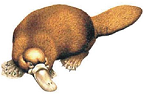
Find the correct option with respect to the diagram below {Question submitted by Adhithyan js}
-
23%
a) This organism belong to class Amphibia
-
38%
b) This organism is oviparous
-
8%
c) This is cold blooded organism
-
31%
d) Both a and b are correct
Q.4.
) Which of the following belongs to class osteichthyes? i) Sea urchin ii)Sea horse iii) Flying fish iv) Sawfish v) Dog fish {Question submitted by Adhithyan js}
-
0%
a) ii and iii
-
50%
b) i, ii and v
-
33%
c) ii and v
-
17%
d) i, iv, v
Q.5.
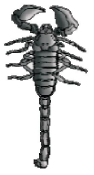
Which of the following is the respiratory organ of given animal {Question submitted by Adhithyan js}
-
18%
a) Gills
-
27%
b) Book lungs
-
36%
c) Trachea
-
18%
d) Book gills
Q.6.
The correct classification of Myxine is {Question submitted by Adhithyan js}
-
22%
a) Chordata → Acraniata → Agnatha → Cyclostomata
-
44%
b) Chordata → Acraniata → Proto chordata → Cephalochordata
-
11%
c) Chordata → Craniata → Vertebrata → Cyclostomata
-
22%
d) Chordata → Craniata → Vertebrata → Ostracodermi
Q.7.
Which of the following is not a characteristic of amphibians? {Question submitted by Adhithyan js}
-
11%
a) Skin of amphibians is moist without scales
-
11%
b) Body is divided into head and trunk
-
67%
c) Amphibians do not breath the same way as other terrestrial vertebrate do. They have positive pressure breathing.
-
11%
d) Heart has two ventricles
Q.8.
Amniotic eggs evolved as a means to _____ {Question submitted by Adhithyan js}
-
14%
a) Protect the embryo from predators
-
29%
b) Prevent the embryo from drying out
-
43%
c) Allow respiratory gases to pass through, but retains water within egg
-
14%
d) Allow waste products from the embryo to be excreted
Q.9.
Find out the mismatch pair? (i) Naja – Middle ear absent, neurotoxic venom. (ii) Vipera – Haemotoxic venom, bifid tongue. (iii) Crocodile – Four chambered heart, presence of diaphragm. (iv) Hemidactylus – Garden lizard, camouflage. (v) Chameleon – prehensile tail, arboreal. (vi) Chelon – Marine, forelimbs modified as flippers. (vii) Tortoise – Limbs with forward digited claws, reptile. {Question submitted by Adhithyan js}
-
29%
a) (iv) and (v)
-
14%
b) (ii) and (iv)
-
29%
c) only (iv)
-
29%
d) (v) and (vi)
Q.10.
6-15 pairs of gill slits are the characteristic feature of: {Question submitted by Adhithyan js}
-
14%
a) Ostracodermi.
-
57%
b) Cyclostomata
-
14%
c) Urochordata
-
14%
d) Fishes.
Q.11.
Syndactyly, prehensile tail and long protrusible tongue are the unique features of: {Question submitted by Adhithyan js}
-
12%
a) Rhesus monkey.
-
25%
b) Archaeopteryx
-
50%
c) Horse fish
-
12%
d) Chameleon.
Q.12.
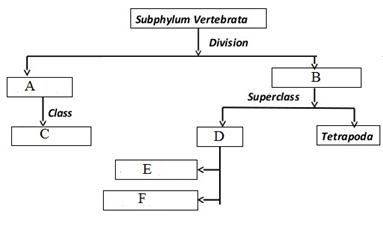
Fill in the blanks marked in the classification table from the choices in the box with respect to A, B, C, D, E and F and choose the correct option: I. Pisces. II. Osteichthys III. Agnatha IV. Gnathostomata. V. Chondrichthys. VI. Cyclostomata {Question submitted by Adhithyan js}
-
0%
a) A - VI ; B - I ; C - V ; D - II ;E -III ; F - IV
-
29%
b) A - III ; B - IV ; C - VI ; D - I ;E -V ; F - VI
-
29%
c) A - I ; B - VI ; C - IV ; D - II ;E -III ; F - V
-
43%
d) A - IV ; B - V ; C - III ; D -II ;E -IV ; F - I
Q.13.
Which of the following is the characteristic feature of birds: {Question submitted by Adhithyan js}
-
33%
a) Two chambered heart.
-
50%
b) Pneumatic bones.
-
17%
c) Hollow nerve chord.
-
0%
d) Large eyes..
Q.14.
In reptiles the class name refers to: {Question submitted by Adhithyan js}
-
17%
a) Their creeping mode of locomotion.
-
50%
b) They are oviparous.
-
17%
c) Their body is covered by dry and cornified skin.
-
17%
d) Absence of external ear.
Q.15.
Pteropus is the scientific name of: {Question submitted by Adhithyan js}
-
20%
a) Lamprey.
-
0%
b) Camel
-
40%
c) Flying fox
-
40%
d) Dolphin.
Q.16.
A jawless fish, which lay eggs in fresh water and whose ammocoetes larvae after metamorphosis return to the ocean is: {Question submitted by Adhithyan js}
-
0%
a) Myxine
-
40%
b) Neomyxine
-
60%
c) Petromyzon
-
0%
d) Eptatretus
Q.17.
Retrogressive metamorphosis is shown by: {Question submitted by Adhithyan js}
-
25%
a) Vertebrates.
-
25%
b) Cephalochordates.
-
50%
c) Urochordata.
-
0%
d) Cyclostomes.
Q.18.
Select the correct option of classification of Rana tigrina upto genus. {Question submitted by Adhithyan js}
-
25%
a) Chordata → Vertebrata → Amphibia → Gnathostomata → Rana.
-
25%
b) Chordata → Vertebrata → Gnathostomata → Amphibia → Rana.
-
25%
c) Chordata → Amphibia → Gnathostomata → Vertebrata → Rana.
-
25%
d) Chordata → Vertebrata → Amphibia → Tetrapoda → Rana.
Q.19.
Besides mammals, vivipary is also found in some members of: {Question submitted by Adhithyan js}
-
25%
a) Chondrichthys
-
50%
b) Osteichthys
-
25%
c) Amphibians
-
0%
d) Aves
Q.20.
Notochord occurs all through the length of body and throughout life in: {Question submitted by Adhithyan js}
-
0%
a) Hemichordate.
-
0%
b) Urochordata
-
100%
c) Cephalochordates
-
0%
d) Vertebrata.
Q.21.
In Chondrichthys, claspers are seen on: {Question submitted by Adhithyan js}
-
33%
a) Pelvic fins of male
-
33%
b) Pelvic fins of female
-
33%
c) Pectoral fins of male
-
0%
d) Pectoral fins of female
Q.22.
Which of the following statements is/are true: (i) Phylum Chordata includes animals without notochord. (ii) Agnatha is a jawless vertebrate. (iii) Gnathostomata has two super classes, Pisces and Tetrapoda. (iv) Limbs are present in snake.(v) Reptiles are homeothermous. {Question submitted by Adhithyan js}
-
0%
a) All the above statements are true
-
25%
b) Statements a, b and c are true.
-
75%
c) Only b and c are true
-
0%
d) Only d and e are true
Q.23.
Which of the following is not a character of chordates? {Question submitted by Adhithyan js}
-
0%
a) Dorsal notochord
-
33%
b) Dorsal central nervous system
-
67%
c) Dorsal heart
-
0%
d) Post – anal tail
Q.24.
Amphibians share with reptiles all of the following characters except: {Question submitted by Adhithyan js}
-
0%
a) Ventral heart
-
33%
b) Dioecious, oviparous
-
33%
c) External fertilization and indirect development
-
33%
d) Cold blooded
Q.25.
Find out the incorrect statement: {Question submitted by Adhithyan js}
-
0%
a) Adult tunicate is enclosed within a leathery test
-
50%
b) Retrogressive metamorphosis is found in Cephalochordates
-
50%
c) In Amphioxus, excretion is carried out by solenocytes
-
0%
d) All vertebrates are chordates
Q.26.
Which of the following statement is incorrect about amphibians. {Question submitted by Adhithyan js}
-
0%
a) Most of them have two pairs of limbs
-
33%
b) Body is divided into head and trunk
-
67%
c) Eyes have no eyelids
-
0%
d) Heart is three chambered
Q.27.
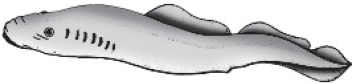
Identify the organism given below, its class along with its character: {Question submitted by Adhithyan js}
-
0%
a) Petromyzon- Class: Agnatha: Endoparasite on fishes
-
60%
b) Lamprey- Class: Agnatha: Ectoparasite on fishes
-
40%
c) Hag fish - Class: Agnatha: Ectoparasite on fishes
-
0%
d) Myxine - Class: Agnatha: Scavengers
Q.28.
Identify the labeled parts in the diagram: {Question submitted by Adhithyan js}
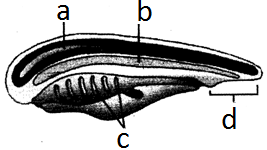
-
25%
a) a-notochord, b-nerve cord, c- Gill slits, d-Post anal tail.
-
25%
b) a-Nerve cord , b- Notochord, c- Gill slits, d- Post anal tail.
-
25%
c) a- Gill slits, b- Notochord, c-Nerve cord, d-Post anal tail
-
25%
d) a-Nerve cord, b-Post anal tail, c- Gill slits, d-Notochord
Q.29.
Which among the following groups of animals belong to super class Tetrapoda. {Question submitted by Adhithyan js}
-
0%
a) Chondrichthys and osteichthys
-
0%
b) Protochordates
-
0%
c) Cyclostomes
-
100%
d) Reptiles and mammals
Q.30.
Crocodiles and penguin are similar to whale and dog fish in which one of the following characters: {Question submitted by Adhithyan js}
-
0%
a) Posses a solid, single stranded central nervous system
-
0%
b) lay eggs and guard them till they hatch.
-
67%
c) possess bony skeleton
-
33%
d) have gill slits at some stage
Q.31.
Choose the true and false statement about osteichthys. (i) They are gnathostomes and the most abundant vertebrates. (ii) Tail fin is homocercal and mouth is terminal. (iii) Heart is three chambered. (iv) External fertilization with young ones called fingerlings or fries. (v) Five gill slits without operculum. {Question submitted by Adhithyan js}
-
20%
a) (i), (ii) and (iii) are true, (iv) and (v) are false.
-
20%
b) (i), (ii) and (iv) are true, (iii) and (v) are false.
-
0%
c) (i), (iv) and (v) are true, (ii) and (iii) are false.
-
60%
d) (i), (iii) and (v) are true, (ii) and (iv) are false.
Q.32.
Ichthyophis is a: {Question submitted by Adhithyan js}
-
0%
a) Fish
-
33%
b) Limbless reptile
-
0%
c) Worm
-
67%
d) Limbless amphibian
Q.33.
Viviparous animals are: {Question submitted by Adhithyan js}
-
0%
a) Running birds, silver fish, prawns
-
33%
b) Turtles, snakes, leeches
-
0%
c) Bony fishes, frogs, lizards
-
67%
d) Flying fox, whales, rabbits
Q.34.
Match the following: {Question submitted by Adhithyan js}
| Column I | Column II |
| a) Ascidia | Auricularia larvae |
| b) Branchiostoma | Osteichthys |
| c) Protochordata | Tunicates |
| d) Pterophyllum | Lancelet |
| - - | Exclusively marine |
-
25%
a) a-1 ; b -2 ; c -3 ; d -4
-
75%
b) a- 3 ; b -4 ; c -5 ; d -2
-
0%
c) a- 3 ; b -4 ; c -2 ; d -5
-
0%
d) a-3 ; b -2 ; c -4 ; d -5
Q.35.
Which of the following is/are not true? (i) In Urochordata, notochord is present only in larval tail. (ii) In cephalochordate, notochord extends from head to tail region. (iii) Branchiostoma belongs to hemichordate. (iv) Only one class of living members, class Cyclostomata represents the division Agnatha. {Question submitted by Adhithyan js}
-
67%
a) (iii) only.
-
33%
b) (i) and (iv) only
-
0%
c) (iii) and (iv) only
-
0%
d) (i), (ii) and (iv) only
Q.36.
Oil gland in birds are located : {Question submitted by Adhithyan js}
-
0%
a) Throughout the skin.
-
20%
b) At the end of the beak
-
40%
c) Inside the mouth
-
40%
d) At the base of the tail
Q.37.
In order for amphibians to be more successful on land, they had to develop which of the following: {Question submitted by Adhithyan js}
-
0%
a) More efficient swim bladder
-
33%
b) More efficient gills
-
33%
c) Cutaneous respiration and lungs
-
33%
d) Shelled eggs
Q.38.
Identify the class from the following features: (i) All living members of this class are ectoparasite on some fishes. (ii) Cranium and vertebral column are cartilaginous in nature. (iii) They are marine but migrate for spawning to fresh water. (iv) After spawning within a few hours they die. {Question submitted by Adhithyan js}
-
0%
a) Cyclostomata
-
75%
b) Chondrichthys
-
25%
c) Osteichthys
-
0%
d) Tetrapoda.
Q.39.
Which of the following characters are absent in Shark but present in Rohu: {Question submitted by Adhithyan js}
-
0%
a) Air bladder, operculum.
-
33%
b) Placoid scales, 6 pairs of gills
-
33%
c) Ctenoid scales, cartilaginous endoskeleton
-
33%
d) Bony endoskeleton, Notochord
Q.40.
Doliolum belongs to the subphylum: {Question submitted by Adhithyan js}
-
0%
a) Amphibia
-
60%
b) Cephalochordata
-
40%
c) Urochordata
-
0%
d) Cyclostomata
Q.41.
Retention of larval characters even after sexual maturity is called: {Question submitted by Adhithyan js}
-
0%
a) Neoteny
-
67%
b) Parthenogenesis
-
0%
c) Ontogeny
-
33%
d) Phylogeny
Q.42.
Which of the following is not true about reptilians. (i) They are mostly terrestrial animals and their body is covered by dry and cornified skin. (ii) Heart is usually three chambered. (iii) Fertilization is external. (iv) Tympanum is absent. (v) They are poikilothermous. {Question submitted by Adhithyan js}
-
0%
a) (iii) only.
-
20%
b) (ii) and (v)
-
80%
c) (iii) and (iv)
-
0%
d) (iv) only
Q.43.
Match the following: {Question submitted by Adhithyan js}
| Column I | Column II |
| 1) Aptenodytes | a. Vulture |
| 2) Neophron | b. Tortoise |
| 3) Bangarus | c. Garden lizard. |
| 4) Testudo | d. Penguin |
| 5) Hemidactylus | e. Krait |
| - - | f. Wall lizard. |
-
20%
a) 1 - c; 2 - d; 3- e; 4- f; 5- a
-
20%
b) 1 - d; 2 - b; 3- e; 4- a; 5- f
-
20%
c) 1 - c; 2 - b; 3- a; 4- d; 5- e
-
40%
d) 1 - d; 2 - a; 3- e; 4- b; 5- f
Q.44.
Match the following: {Question submitted by Adhithyan js}
| Column I | Column II |
| a) Phylum | Liverworts |
| b) Sub phylum | Cyclostomata |
| c) Division | Tetrapoda |
| d) Super class | Chordata |
| e) Class | Vertebrata |
-
33%
a) a -4 ; b -5 ; c-1 ; d-2 ; e-3
-
33%
b) a -4 ; b -5 ; c-2 ; d-3 ; e-1
-
33%
c) a -4 ; b - 5 ; c- 1 ; d- 3 ; e-2
-
0%
d) a - 4 ; b -3 ; c- 2 ; d-1 ; e-5
Q.45.
Given below are the characteristic features of a fish. Identify the fish with the following features: (i) Body is covered by closely fitting shields. (ii) Head is prolonged into a tube like snout bearing small terminal mouth. (iii) Male possess brood pouch for incubating eggs. (iv) Males exhibit parental care. (v) Tail is prehensile used for anchoring. {Question submitted by Adhithyan js}
-
0%
a) Echineis
-
33%
b) Exocoetus
-
33%
c) Etroplus
-
33%
d) Hippocampus
Q.46.
Find out the mismatch: {Question submitted by Adhithyan js}
-
0%
a) Chelone - Turtle.
-
0%
b) Neophron – vulture.
-
100%
c) Struthio – Pigeon.
-
0%
d) Corvus – crow
Q.47.
Chordates possess: {Question submitted by Adhithyan js}
-
0%
a) Ventral, hollow and double nerve cord.
-
33%
b) Ventral, hollow and single nerve cord.
-
67%
c) Dorsal, hollow and single nerve cord
-
0%
d) Dorsal, solid and double nerve cord.
Q.48.
Read the statements: (i) Whale is the largest fish known. (ii) Duck billed platypus is a flying mammal. (iii) prototherians act as a connecting link between reptiles and mammals. (iv) Eutherians are characterised by true placentation. {Question submitted by Adhithyan js}
-
25%
a) Statement (i) and (ii) are correct.
-
0%
b) Statement (iii) and (iv) are correct.
-
25%
c) Statement (i) and (iii) are correct.
-
50%
d) Statement (i) and (iv) are correct
Q.49.
Select the correct set of animals of the same class: {Question submitted by Adhithyan js}
-
0%
a) lion, bat, whale, ostrich.
-
33%
b) Lion, hippopotamus, penguin, bat.
-
33%
c) Whale, kangaroo, bat, hippopotamus.
-
33%
d) Whale, kangaroo, bat, ostrich.
Q.50.
The characteristics of reptilians are: {Question submitted by Adhithyan js}
-
20%
a) Body covered by dry and cornified skin, scales over the body are epidermal, they do not have external ears.
-
40%
b) Body covered with moist skin which is devoid of scales, the ear is represented as tympanum membrane, alimentary canal and reproductive tracts open into a common cloaca.
-
20%
c) Fresh water animals with bony endoskeleton, air bladder to regulate buoyancy.
-
20%
d) Marine animals with cartilaginous endoskeleton, body covered with placoid scales.