Q.1.
Which of the following pair is incorrectly matched?
-
27%
a) Rhodophyceae Stored food is mannitol.
-
33%
b) Phaeophyceae Cell wall is made up of cellulose and algin.
-
27%
c) Chlorophyceae Major pigments are chlorophyll a and b.
-
13%
d) Chlorophyceae Cell wall is made up of cellulose.
Q.2.
Select the correct match of the feature present in column I with its respective terms given in column II.
| Column I | Column II |
| a. Presence of tap roots and coralloid roots | (i)Bryophytes |
| b. The synergids and antipodal cells degenerate after fertilization | (ii) Pteridophytes |
| c. The food is stored as Floridean starch which is very similar to amylopectin and glycogen in structure. | (iii) Red algae |
| d. Presence of sporophyte which is not free living but attached to the photosynthetic gametophyte and derives nourishment from it | (iv) Angiosperms |
| e. Members of this group are used for medicinal purposes, as soil binders and frequently grown as ornamentals | (v) Gymnosperms |
-
38%
a) A-iii B-i C-v D-ii E-iv
-
38%
b) A-v B-iv C-iii D-i E-ii.
-
25%
c) A-i B-ii C-iii D-iv E-v
-
0%
d) A-iii B-v C-ii D-iv E-i
Q.3.
A bryophyte differs from pteridophytes in having:
-
27%
a) Independent gametophytes.
-
27%
b) Archegonia.
-
36%
c) Swimming antherozoids.
-
9%
d) Lack of vascular tissue.
Q.4.
Fern plant is a:
-
38%
a) Diploid sporophyte.
-
25%
b) Haploid sporophyte.
-
25%
c) Diploid gametophyte.
-
12%
d) Haploid gametophyte.
Q.5.
The unique feature of bryophytes compared to other plant groups is that: ()
-
57%
a) They lack roots.
-
29%
b) Their sporophyte is attached to the gametophyte.
-
14%
c) They lack vascular tissues.
-
0%
d) They produce spores.
Q.6.
Match the classes of pteridophytes given in column I with their examples given in column II and choose the correct option
| Column I(Class of pteridophyte) | Column II(Examples) |
| a. Psilopsida | (i) Selaginella |
| b. Lycopsida | (ii) Psilotum |
| c. Sphenopsida | (iii) Dryopteris |
| d. Pteropsida | (iv) Equisetum |
-
40%
a) a – (ii), b – (iv), c – (i), d – (iii).
-
20%
b) a – (i), b – (ii), c – (iv), d – (iii).
-
20%
c) a – (ii), b – (i), c – (iv), d – (iii).
-
20%
d) a – (ii), b – (i), c – (iii), d – (iv).
Q.7.
Interestingly, while most algal genera are haplontic, some of them are exceptions. Identify the true statement:
-
25%
a) Volvox is Diplontic while Ectocarpus and Polysiphonia are Haplo-diplontic.
-
0%
b) Fucus is Diplontic while Ectocarpus and Polysiphonia are Haplo-diplontic.
-
0%
c) Volvox and Fucus are Diplontic while Ectocarpus and Polysiphonia are Haplo-diplontic.
-
75%
d) Ectocarpus and Fucus are Diplontic while Volvox and Polysiphonia are Haplo-diplontic.
Q.8.
Which of the following group of plant is being described by the given statements? (i) They are plants in which the ovules are not enclosed by any ovary wall and remain exposed before and after fertilization. (ii) The giant red wood tree Sequoia is one of the tallest tree species of the group. (iii) The roots are generally tap roots. (iv) They are heterosporous and they produce haploid microspores and megaspores.
-
20%
a) Bryophytes.
-
0%
b) Pteridophytes.
-
60%
c) Gymnosperms.
-
20%
d) Algae.
Q.9.
Which of the following statement(s) is/are correct about angiosperms? (i) In angiosperms or flowering plants, the pollen grains and ovules are developed in specialised structure called flowers (ii) They are divided into two classes: the dicotyledons and the monocotyledons. (iii) The male sex organ in a flower is the pistil or the carpel. (iv) The female sex organ is the stamen.
-
20%
a) Only (i).
-
60%
b) Both (i) and (ii).
-
20%
c) Both (ii) and (iv).
-
0%
d) All of these.
Q.10.
Read the following statements and answer the question: (i) Sporophytic generation is represented only by the one-celled zygote. (ii) Meiosis in the zygote results in the formation of haploid spores. (iii) The dominant, photosynthetic phase in such plants is free-living gametophyte. (iv) Many algae such as Volvox, Spirogyra and some species of Chlamydomonas represent this pattern. Which of the following pattern of life cycle of plant is described by the above statements?
-
75%
a) Haplontic.
-
0%
b) Diplontic.
-
25%
c) Haplo-diplontic.
-
0%
d) None of these.
Q.11.
Select the mismatched pair:
-
20%
a) Pinus – Dioecious.
-
20%
b) Cycas – Dioecious.
-
0%
c) Salvinia – Heterosporous.
-
60%
d) Equisetum – Homosporous.
Q.12.
Statement 1: Double fertilization is a characteristic feature of angiosperms. Statement 2: Double fertilization involves two fusions.
-
0%
a) Both statements -1 and statement - 2 are true and statement - 2 is the correct explanation of statement - 1.
-
25%
b) Both statements -1 and statement - 2 are true but statement - 2 is not the correct explanation of statement - 1.
-
50%
c) Statement -1 is true and statement - 2 is false.
-
25%
d) Statement -1 is false and statement - 2 is true.
Q.13.
Statement 1: Members of Phaeophyceae vary in colour from olive green to various shades of brown. Statement 2: Phaeophyceae possess chlorophyll a, c, Carotenoids and xanthophylls.
-
50%
a) Both statements -1 and statement - 2 are true and statement - 2 is the correct explanation of statement
-
50%
b) Both statements -1 and statement - 2 are true but statement - 2 is not the correct explanation of statement - 1.
-
0%
c) Statement -1 is true and statement - 2 is false.
-
0%
d) Statement -1 is false and statement - 2 is true.
Q.14.
Which of the following statements are incorrect?
-
0%
a) Some of the members of algae also occur in association with fungi (lichen) and animals (e.g., on sloth bear).
-
20%
b) The leaves in pteridophytes are well adapted to withstand extremes of temperature, humidity and wind.
-
60%
c) Sexual reproduction may be Isogamous, Oogamous and anisogamous in green and brown algae
-
20%
d) Pyrenoids contain protein besides starch.
Q.15.
Which of the following statement(s) is/are correct about Gemmae? (i) These are specialised structures by which asexual reproduction take place in liverworts. (ii) They are green, multicellular and asexual buds. (iii) They develop in small receptacles called gemma cups. (iv) They detach from parent body and germinate to form new individuals.
-
100%
a) (i), (ii) and (iii).
-
0%
b) (i) and (iv).
-
0%
c) (ii) and (iii).
-
0%
d) All of these.
Q.16.
The endosperm of a gymnosperm develops _______ fertilization, whereas the endosperm of an angiosperm develops _________ fertilization.
-
40%
a) Before, before
-
0%
b) After, after
-
40%
c) After, before
-
20%
d) Before, after.
Q.17.
Which of the following statements about algae is/are correct? (i) Algae are chlorophyll bearing simple, thalloid, heterotrophic and aquatic (both fresh water and marine) organisms. (ii) Algae reproduce by vegetative means only. (iii) Fusion of two gametes dissimilar in size is termed as Oogamous. (iv) A few of the massive forms of algae such as kelps, form massive plant bodies.
-
33%
a) Only (iv).
-
0%
b) Only (i).
-
67%
c) Both (i) and (iii).
-
0%
d) All of these.
Q.18.
The following statements are associated with one class of algae. Identify the class of algae. (i) One or more storage bodies called Pyrenoids located in the chloroplasts are present in the members of this class. (ii) They have a rigid cell wall made of an inner layer of cellulose and an outer layer of pectose. (iii) Asexual reproduction is by flagellated zoospores produced in zoosporangia. (iv) Chlamydomonas, Volvox, Ulothrix, Spirogyra and Chara are commonly found members of this class.
-
25%
a) Phaeophyceae.
-
50%
b) Rhodophyceae.
-
0%
c) Chlorophyceae.
-
25%
d) None of these.
Q.19.
Refer the following statement(s) and identify the group of plant which is being described by given statements ? (i) They include various mosses and liverworts that are found commonly growing in moist shaded areas in the hills. (ii) They lack true roots, stem or leaves. (iii) The main plant body is haploid. (iv) They produce a multicellular body sporophyte which is not free living but attached to the photosynthetic gametophyte and derives nourishment from it.
-
75%
a) Pteridophytes.
-
0%
b) Bryophytes.
-
25%
c) Algae.
-
0%
d) Fungi.
Q.20.
Which of the following group of plant is being described by given statements ? (i) The plant body is thalloid. (ii) Asexual reproduction takes place by fragmentation of thalli, or by the formation of specialized structures called Gemmae. (iii) The sporophyte is differentiated into a foot, seta and capsule. (iv) They grow usually in moist and shady habitats.
-
33%
a) Moss.
-
0%
b) Fern.
-
33%
c) Liverworts.
-
33%
d) Gymnosperm.
Q.21.
Which of the following statement(s) is/are correct about pteridophytes ? (i) The main plant body is a sporophyte which is differentiated into true roots and leaves. (ii) The leaves are small (microphylls) as in ferns or large (macrophylls) as in Selaginella. (iii) Genera like Selaginella and Salvinia which produce two kinds of spores macro (large) and micro (small) spores, are known as heterosporous. (iv) Common examples are Funaria, Polytrichum and Sphagnum.
-
33%
a) Both (i) and (iii)
-
33%
b) Both (i) and (ii).
-
0%
c) Both (ii) and (iii).
-
33%
d) All of these.
Q.22.
Filaments of Ulothrix are:
-
20%
a) Brick-shaped.
-
40%
b) Girdle-shaped.
-
0%
c) Branched.
-
40%
d) Unbranched.
Q.23.
Fusing gametes in Ulothrix are:
-
25%
a) Morphologically and physiologically different.
-
25%
b) Morphologically different.
-
25%
c) Morphologically similar physiologically different.
-
25%
d) Physiologically different.
Q.24.
Cycas and Dryopteris resemble each other in the presence of:
-
0%
a) Flowers.
-
0%
b) Cambium.
-
80%
c) Ciliated sperms.
-
20%
d) Seeds.
Q.25.
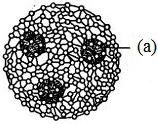
Identify the correct statement regarding the pat labelled (a).
-
75%
a) Stigmatiyum which represents the Daughter colony cells arranged around a mucilaginous cavity.
-
25%
b) Stigmatiyum which represents the Parent colony cells arranged around a mucilaginous cavity.
-
0%
c) Coenobium which represents the Daughter colony cells arranged around a mucilaginous cavi
-
0%
d) Coenobium which represents the Parent colony cells arranged around a mucilaginous cavity.
Q.26.
The epizoic algae growing on the shells of Molluscans.
-
0%
a) Chara.
-
25%
b) Cephaleuros.
-
50%
c) Caulerpa.
-
25%
d) Cladophora.
Q.27.
Read the following statements regarding bryophytes and choose the incorrect option
-
33%
a) Gametophytic phase is dominant in life cycle
-
17%
b) Fertilisation takes place in presence of water
-
50%
c) Zygote undergoes meiosis to produce sporophyte
-
0%
d) Sporophyte is physiologically dependent on gametophyte
Q.28.
Movement of antherozoids towards archegonia is a type of _______.
-
33%
a) Chemotactic movement.
-
33%
b) Turgor change movement.
-
33%
c) Chemotropic movement.
-
0%
d) Chemonastic movement.
Q.29.
Match the Column –I with Colum-II
| Column –I | Column –II |
| A. Chlorophyta | i. Equisetum |
| B. Lycopsida | ii.Chara |
| C. Phaeophyta | iii.Selaginella |
| D. Sphenopsida | iv. Ectocarpus |
-
0%
a) A –iv, B-i, C- ii, D-iii
-
33%
b) A- iv, B- I, c-iii, d-ii
-
67%
c) A –ii, B-iii, C- iv, D-i
-
0%
d) A –ii, B-iii, C- i, D-iv
Q.30.
The structure present in capsule of mosses which helps in dispersal of spores and its correct number is:
-
25%
a) Elaters – 32.
-
25%
b) Peristomial teeth – 32.
-
25%
c) Elaters – 16.
-
25%
d) Peristomial teeth – 16.