Q.1.
How many of the following are heterosporous pteridophytes? Azolla, Lycopodium, Dryopteris, Selaginella, Salvinia, Marsilea, Equisetum, Adiantum.
-
27%
a) 4.
-
27%
b) 3.
-
36%
c) 2.
-
9%
d) 1.
Q.2.
The gymnosperm with double fertilization:
-
25%
a) Juniperus.
-
0%
b) Cedrus.
-
0%
c) Taxus.
-
75%
d) Ephedra.
Q.3.
Which is not true about the anatomy of gymnosperm stem;
-
0%
a) Vascular bundles are arranged as a whorl.
-
17%
b) Vascular bundles are conjoint, collateral and open.
-
50%
c) Secondary growth absent.
-
33%
d) Xylem endarch.
Q.4.
In which among the following combination of possibilities of sexual reproduction, water is not essential for gamete transfer and fertilization:
-
0%
a) Anisogamy, non motile egg and motile male gamete
-
25%
b) Oogamy, non motile egg and non motile male gamete.
-
0%
c) Anisogamy, motile egg and motile male gamete.
-
75%
d) Oogamy, non motile egg and motile male gamete.
Q.5.
r – phycoerythrin, chlorophyll a and b, Fucoxanthin, c – phycocyanin are found respectively in:
-
40%
a) Rhodophyceae, Chlorophyceae, Euglenoids, Phaeophyceae.
-
0%
b) Cyanobacteria, Euglenoids, Phaeophyceae, diatoms.
-
20%
c) Rhodophyceae, Chlorophyceae, Phaeophyceae, Cyanobacteria.
-
40%
d) Cyanobacteria, Euglenoids, Phaeophyceae, Chlorophyceae.
Q.6.
Which of the following is not related to Pinus?
-
0%
a) Presence of haploid endosperm.
-
25%
b) Presence of free living gametophyte.
-
25%
c) Presence of mycorrhiza.
-
50%
d) Monoecious.
Q.7.
Which of the following is not a feature of Chlorophyceae?
-
0%
a) The reserve food material is mannitol and Floridean starch.
-
0%
b) Pigments are chl a, b, Carotenoids ad higher plants.
-
33%
c) Usually they show haplontic life cycle.
-
67%
d) Spirogyra shows aplanogamy during sexual reproduction.
Q.8.
First vascular plant:
-
0%
a) Cycas.
-
25%
b) Chara.
-
50%
c) Marchantia.
-
25%
d) Selaginella.
Q.9.
Female cone is absent in which of the following plants:
-
33%
a) Cycas.
-
0%
b) Pinus.
-
33%
c) Ephedra.
-
33%
d) Gingko.
Q.10.
Read the following description and choose the correct option which matches the description: “In these autotrophs, sporophyte is the dominant generation. Gametophyte is also photosynthetic and not depends on sporophyte for nutrition”.
-
33%
a) Angiosperms.
-
0%
b) Pteridophytes.
-
0%
c) Bryophytes.
-
67%
d) Gymnosperms.
Q.11.
Of the following groups which secrete and deposit calcium carbonate and appear like corals?
-
0%
a) Brown algae.
-
0%
b) Blue green algae.
-
33%
c) Red algae.
-
67%
d) All of these
Q.12.
The juvenile phase of gametophyte in mosses:
-
0%
a) Prothallus.
-
0%
b) Promycelium.
-
100%
c) Progametangium.
-
0%
d) Protonema.
Q.13.
Read the following statements: (i) Salvinia is heterophyllous and heterosporous floating fern which lack roots. (ii) Pinus is a gymnosperm with mycorrhizal roots. (iii) Double fertilization is unique to angiosperms. (iv) The male or female cones or strobili may be on the same tree (Cycas) or on different trees (Pinus). (v) Mycoplasma lack cell wall, smallest living cells known, can survive without oxygen and pathogenic in animals and plants. How many of the above statements are correct?
-
0%
a) Two.
-
75%
b) Three.
-
0%
c) Four.
-
25%
d) Five.
Q.14.
Bryophytes include the various mosses and liverworts commonly growing in moist shaded areas in the hills. These plants:
-
0%
a) Have multicellular rhizoids always.
-
0%
b) Are siphonogamous archegoniates.
-
0%
c) Lack Heterospory and true roots.
-
100%
d) Have less differentiated body than that of algae.
Q.15.
A set of characters shown by green algae and red algae are: (i) Motile stage in vegetative phase. (ii) Chlorophyll b. (iii) Oogamous type sexual reproduction. (iv) Complementary chromatic adaptation. (v) Chlorophyll a.
-
0%
a) (iii), (iv), (v).
-
33%
b) (iii), (v).
-
33%
c) (i), (iii), (iv).
-
33%
d) (ii), (iii), (iv), (v).
Q.16.
Plant body is diploid and meiosis occurs in diploid gametangia at the time of formation of gametes in:
-
0%
a) Chlorella and Spirogyra.
-
0%
b) Fucus.
-
0%
c) Nostoc and Anabaena.
-
100%
d) Ectocarpus.
Q.17.
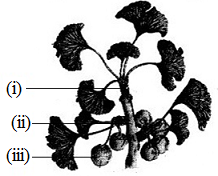
Find out the name of the diagram – (a) and select the correct option for labelling (i), (ii) and (iii) of the above diagram:
-
0%
a) (a) – Cycas; (i) – Dwarf shoot. (ii) – Long shoot, (iii) – Ovule,
-
75%
b) (a) – Gingko; (i) – Dwarf shoot. (ii) – Long shoot, (iii) – Seed,
-
25%
c) (a)-Gingko; (i) – shoot. (ii) – Dwarf shoot, (iii) – Ovule,
-
0%
d) (a) – (i) – Leaf base. Pinus; (ii) – Fruit, (iii) – Stem,
Q.18.
Read the statements (i) – (iv) and find out how many statements are incorrect? (i) In majority of pteridophytes, all the spores are of similar kind. (ii) Genera like Selaginella and Salvinia produce two kinds of spores. (iii) The development of the zygote into young embryos take place within the female gametophyte. This event is a precursor of seed habit. (iv) Azolla is an aquatic fern that is used as a biofertilizer due to the presence of nitrogen fixing cyanobacteria, Anabaena in its leaves.
-
0%
a) Zero.
-
0%
b) One.
-
86%
c) Two.
-
14%
d) Three.
Q.19.
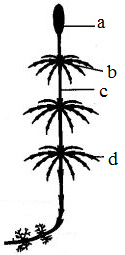
Examine the figure given below and select the correct option giving all the four parts rightly identified:
-
0%
a) (a) a –Strobilus, b – Node, c – Internode. d – Branch,
-
50%
b) a – Megasporophyll, b – Branch, c – Node. d – Internode
-
0%
c) a – Megasporophyll, b – Node, c – Branch. d – Internode,
-
50%
d) a – Strobilus b – Internode, c – Node. d – Branch, ,
Q.20.
Which pair is wrongly matched?
-
0%
a) Gnetum – Absence of archegonia.
-
0%
b) Cycas – Dioecious.
-
0%
c) Ephedra – Source of Ephedrine.
-
100%
d) Pinus – Presence of vessels.
Q.21.
Given below the following statements: (i) The sporophyte of liverworts are more elaborate than sporophyte of mosses. (ii) Both coconut and cucumber are monoecious. (iii) Jacketed sex organs are found in both red and brown algae. (iv) Coralloid roots of Cycas has cyanobacteria for nitrogen fixation. (v) Polyembryony is quite common in angiosperms than gymnosperms. How many of the above statements are wrong:
-
50%
a) Four.
-
50%
b) Three.
-
0%
c) Two.
-
0%
d) One.
Q.22.
Choose the wrong pair:
-
50%
a) Lycopodium – Pteropsida.
-
0%
b) Equisetum – Sphenopsida.
-
0%
c) Selaginella – Lycopsida.
-
50%
d) Psilotum – Psilopsida.
Q.23.
Select the wrong statement:
-
0%
a) Gymnosperms now maintain their dominance only in the colder regions of the world where snow, rather than rain is the source of water.
-
0%
b) The body or thallus of algae is simple photosynthetic with vascular tissue.
-
50%
c) Apospory induce the development of new species in ferns.
-
50%
d) The gymnosperms are more ancient than the angiosperms in evolutionary terms.
Q.24.
Selaginella and Salvinia are considered to represent a significant step towards evolution of seed habit because:
-
0%
a) Female gametophyte lacks archegonia.
-
50%
b) Embryo develops in female gametophyte which is retained on parent sporophyte.
-
50%
c) Megaspores possess endosperms and embryo surrounded by seed coat.
-
0%
d) Female gametophyte is free and gets dispersed like seeds.
Q.25.
Assertion:. The food in red algae is stored as Floridean starch which is similar to amylopectin and glycogen in structure. Reason:. Red algae reproduce asexually by non-motile spores and sexual reproduction shows post fertilization changes.
-
0%
a) Both Assertion and Reason are true and Reason is the correct explanation of Assertion.
-
50%
b) Both Assertion and Reason are true but Reason is NOT the correct explanation of Assertion.
-
50%
c) Assertion is true but Reason is false.
-
0%
d) Both Assertion and Reason are false.
Q.26.
Independent gametophyte and sporophyte are found in the group of plants:
-
50%
a) Cycas, Pinus, Gnetum.
-
0%
b) Gelidium, Gracilaria, Spirogyra.
-
0%
c) Pteris, Selaginella, Marsilea.
-
50%
d) Marchantia, Anthoceros, Funaria.
Q.27.
Dryopteris differs from Funaria in having:
-
50%
a) An independent gametophyte.
-
0%
b) Swimming antherozoids.
-
0%
c) Archegonia.
-
50%
d) An independent sporophyte.
Q.28.
Select the incorrect statement:
-
50%
a) In gymnosperms, endosperm is haploid.
-
0%
b) In Cycas, male and female gametes are motile.
-
0%
c) A typical angiosperm anther is bilobed with each lobe having two theca.
-
50%
d) Chalaza represent the basal part of ovule.
Q.29.
Study the following statements and choose the correct option: (i) Spirulina – Protein source – Cyanobacteria. (ii) Sargassum – Kelps – Phaeophyceae. (iii) Gelidium – Agar-Agar – Chlorophyceae. (iv) Colletotrichum – Red rot of sugarcane – Deuteromycetes.
-
0%
a) (ii) and (iv) are correct but (i) and (iii) are incorrect.
-
0%
b) (i) and (ii) are incorrect but (iii) and (iv) are correct.
-
50%
c) (i), (ii) and (iv) are correct but (iii) is incorrect.
-
50%
d) (i) and (iv) are incorrect but (ii) and (iii) are correct.
Q.30.
A leafy non-vascular plant with parasitic Sporophytic generation should be properly classified in:
-
0%
a) Bryophyta.
-
0%
b) Thallophyta.
-
50%
c) Spermatophyta.
-
50%
d) Pteridophyta.