Q.1.
Protostele is … [ BHU 1996]
-
33%
a) Stele divided into many parts
-
17%
b) Early stele with central solid xylem surrounded by phloem
-
50%
c) latent stele
-
0%
d) Angiosperm stele
Q.2.
Pteridophytes as a group differ from bryophytes in possessing …
-
60%
a) Motile sperm and spores
-
40%
b) Archegonia
-
0%
c) Alternation of generations
-
0%
d) Presence of vascular tissue
Q.3.
External water is not required for fertilization in …. [ BHU 1991]
-
0%
a) Fern/Selaginella
-
20%
b) Moss/Riccia
-
20%
c) Ulothrix
-
60%
d) Gymnosperms/Maize
Q.4.
Golden Mine of Liverworts is … [ kerala 2003]
-
0%
a) Eastern Himalayas
-
50%
b) Western Himalayas
-
50%
c) Western Ghats
-
0%
d) Eastern Ghats
Q.5.
Primary protonema is present in … [ CPMT 2010]
-
0%
a) Agaricus
-
33%
b) Alternaria
-
33%
c) Sphagnum
-
33%
d) Funaria
Q.6.
Find out the similarity between gymnosperms and angiosperms … [ CPMT 1996]
-
25%
a) Naked ovules
-
25%
b) Polyembryony
-
25%
c) Double fertilization
-
25%
d) None of the above
Q.7.
Sieve tubes and companion cells are absent in … [ RPMT 1996]
-
0%
a) Angiosperms
-
33%
b) Pea
-
33%
c) Mango
-
33%
d) Pteridophyte
Q.8.
Coralloid roots of Cycas possess a symbiotic alga … [ BHU 1998]
-
0%
a) Aulosira
-
0%
b) Spirogyra
-
0%
c) Ulothrix
-
100%
d) Anabaena
Q.9.
Structure protecting archegonia of Marchantia is
-
0%
a) Apophysis
-
50%
b) Perichaetium
-
50%
c) Periphysis
-
0%
d) Apophysis
Q.10.
Which one is common between Pinus and Dryopteris .. [ CPMT 1992]
-
0%
a) Presence of antheridia and archegonia
-
50%
b) Presence of pollen tube
-
0%
c) Absence of seeds
-
50%
d) Absence of fruits
Q.11.
Choose the correct statement …
-
0%
a) Apophysis is the basal fertile part of capsule in Funaria
-
0%
b) Apophysis is the apical sterile part of microsporophyll in Cycas
-
50%
c) Apospory is the development of sporophyte from vegetative cells of gametophyte
-
50%
d) Apogamy is the development of gametophyte form vegetative cells of sporophyte
Q.12.
Leaves of moss plant possess .. [ Manipur 2009]
-
100%
a) Stomata and chloroplasts
-
0%
b) No stomata, no chloroplasts
-
0%
c) Stomata but no chloroplasts
-
0%
d) No stomata but chloroplasts
Q.13.
Well developed archegonium with neck having 6 and 4 rows of neck cells occurs in … [ CBSE 1995]
-
0%
a) Pteridophytes and gymnosperms
-
33%
b) Gymnosperms and flowering plants
-
67%
c) Gymnosperms only
-
0%
d) Bryophytes and pteridophytes
Q.14.
Which one has oil and occasionally starch as reserve food? … [ CPMT 1998]
-
0%
a) Chlorophyceae
-
0%
b) Phaeophyceae
-
100%
c) Rhodophyceae
-
0%
d) Xanthophyceae
Q.15.
Sulphur shower is due to … [ Odisha 2008]
-
0%
a) Acid rain
-
0%
b) Excess SO2 and SO3 in atmosphere
-
100%
c) Exposed sulphur rocks
-
0%
d) Pollen Pinus/Cedrus
Q.16.
A prokaryotic autotrophic nitrogen fixing symbiont is found in … [ CBSE 2011]
-
0%
a) Cicer
-
50%
b) Cycas
-
50%
c) Pisum
-
0%
d) Alnus
Q.17.
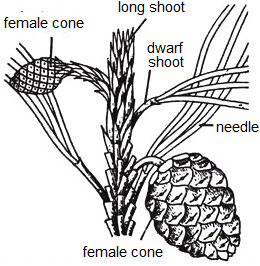
Female cone of Pinus is a … [ HPPMT 2009]
-
0%
a) Modified scale
-
0%
b) Modified needle
-
33%
c) Modified dwarf shoot
-
67%
d) Modified long shoot
Explanation
Q.18.
Angiosperms show … [ Manipal 1999]
-
0%
a) Monospory
-
100%
b) Bispory
-
0%
c) Trispory
-
0%
d) Tetraspora
Q.19.
Cleavage polyembryony occurs in … [ BHU 2006]
-
0%
a) Pinus
-
0%
b) Cycas
-
0%
c) Angiosperms
-
100%
d) Pteridophytes
Q.20.
Dicotyledons are characterized by presence of …
-
0%
a) Tap root
-
0%
b) Adventitious roots
-
100%
c) Fibrous roots
-
0%
d) Epiphytic roots
Q.21.
Fucoxanthin occurs in … [ AMU 1992]
-
0%
a) Cyanophyceae
-
0%
b) Rhodophyceae
-
100%
c) Chlorophyceae
-
0%
d) Phaeophyceae
Q.22.
Sago of Cycas is given to patients with stomach disorders because it is … [ AIIMS 1997]
-
0%
a) Cheap
-
0%
b) Easily digestible with less starch
-
50%
c) Tastier
-
50%
d) With high nutritive value
Q.23.
In a fern sporangium, the number of spores is … [ AFMC 1996]
-
0%
a) 64
-
100%
b) 32
-
0%
c) 128
-
0%
d) 16
Q.24.
Male and female gametophytes are independent and free living in … [ CBSE 2010]
-
0%
a) Castor
-
100%
b) Pinus
-
0%
c) Sphagnum
-
0%
d) Mustard
Q.25.
Which amongst the following are not seed producers … [ CBSE 2003]
-
0%
a) Fern and Funaria
-
0%
b) Funaria and Ficus
-
0%
c) Ficus and Chlamydomonas
-
100%
d) Punica and pinus
Q.26.
A spermatophyte with ciliated stage is … [ BHU 2002]
-
0%
a) Pteridium
-
100%
b) Riccia
-
0%
c) Gymnosperm
-
0%
d) Angiosperm
Q.27.
Seed habit is an important step in evolution. It is due to … [ Odisha 2011]
-
0%
a) Heterogamy
-
100%
b) Heterospory
-
0%
c) Homospory
-
0%
d) Homogamy
Q.28.
A vascular cryptogam is … [ CBSE 2009]
-
100%
a) Cedrus
-
0%
b) Ginkgo
-
0%
c) Marchantia
-
0%
d) Equisetum
Q.29.
Identify the pair that exhibits circinate vernation … [ KCET 2010]
-
0%
a) Equisetum and Selaginella
-
0%
b) Riccia and Nephrolepis
-
100%
c) Nephrolepis and Cycas
-
0%
d) Psilotum and Riccia
Q.30.
The unequally thickened wall of fern sporangium that helps in dehiscence is … [ Manipal 2004]
-
0%
a) Indusium
-
0%
b) Placenta
-
0%
c) Annulus
-
100%
d) Receptacle
Q.31.
Gametophytes do not have free independent existence in … [ CBSE 2008]
-
0%
a) Funaria
-
0%
b) Polytrichum
-
100%
c) Cedrus
-
0%
d) Dryopteris
Q.32.
In oogamous reproduction … [ Pb PMT 1998]
-
0%
a) Both male and female gametes are motile
-
0%
b) Both gametes are product of division of protoplast
-
0%
c) Both male and female gametes are motile
-
100%
d) For male gametes protoplast divides but for female gamete it does not
Q.33.
Prothallus is … [ Bih PMT 2006]
-
0%
a) Gametophyte, monoecious, autotroph present in pteridophytes
-
0%
b) Gametophyte, monoecious, autotroph found in bryophytes
-
100%
c) Sporophyte, dioecious, heterotroph found in bryophytes
-
0%
d) Gametophyte, dioecious, autotroph present in pteridophytes
Q.34.
Heteromorphic alternation of generations occurs in … [ MPPMT 1998]
-
0%
a) Dictyota
-
0%
b) Selaginella
-
0%
c) Rhizopus
-
100%
d) Spirogyra
Q.35.
Marchantia is a bryophyte as it does not possess … [ CET Chd. 2009]
-
0%
a) Vascular tissues
-
100%
b) Seeds
-
0%
c) Roots
-
0%
d) Independent sporophyte
Q.36.
Walking Fern is named so as … [ CBSE 1998]
-
0%
a) It knows walking
-
100%
b) It is dispersed through walking
-
0%
c) Its spores are able to walk
-
0%
d) It spreads and propagates vegetatively by its leaf tips
Q.37.
Seed of Cycas is …
-
0%
a) Exalbuminous and monocotyledonous
-
0%
b) Exalbuminous and dicotyledonous
-
100%
c) Albuminous and dicotyledonous
-
0%
d) Albuminous and monocotyledonous
Q.38.
Which one of the following cannot fix nitrogen … [ CBSE 1994]
-
100%
a) Nostoc
-
0%
b) Azotobacter
-
0%
c) Spirogyra
-
0%
d) Anabaena
Q.39.
Time takes in Pinus from pollination to fertilization is … [ MPPMT 1995]
-
0%
a) 4 months
-
0%
b) Four years
-
0%
c) 15 months
-
100%
d) Two years
Q.40.
Pyrenoids are characteristically found in the chloroplasts of … [ MPPMT 1995]
-
0%
a) Angiosperms
-
0%
b) Pteridophytes
-
0%
c) Algae
-
100%
d) Fungi
Q.41.
Rhynia belongs to … [ Har PMT 2003]
-
0%
a) Silurian
-
0%
b) Devonian
-
0%
c) Carboniferous
-
100%
d) Permian
Q.42.
Gnetum , a gymnosperm differs from Cycas and Pinus but shows affinities with angiosperms in the features … [ CBSE 2008]
-
0%
a) Perianth and two integuments
-
0%
b) Embryo development and apical meristem
-
0%
c) Absence of resin ducts and leaf venation
-
100%
d) Presence of vessel elements and absence of archegonia
Q.43.
Choose the wrong pair .. [ kerala 2008]
-
0%
a) hepaticopsida - Marchantia
-
0%
b) lycopsida - Selaginella
-
100%
c) Bryopsida - Anthoceros
-
0%
d) Pteropsida - Dryopteris
Q.44.
Which is not a fungal disease … [ BHU 1995]
-
0%
a) Rust of Coffee
-
0%
b) Red rust of Tea
-
100%
c) Rust of Wheat
-
0%
d) White rust of cruciferae
Q.45.
Transfusion tissue, a modified vascular tissue is found in leaves of …. [ Har.PMT 2007]
-
0%
a)Dryopteris and Selaginella
-
0%
b) Pinus and Cycas
-
100%
c) Porella and Funaria
-
0%
d) Dalbergia and Mangifera
Q.46.
Which of the following is monoecious .. [ CBSE 2010]
-
0%
a) Marchantia
-
0%
b) Cycas
-
0%
c) Pinus
-
100%
d) Data palm
Q.47.
Phanerogams include … [ BHU 2008]
-
0%
a) Gymnosperms
-
0%
b) Angiosperms
-
0%
c) Pteridophytes
-
100%
d) Both a and b
Q.48.
Fusion between dissimilar gametes is … [ AFMC 1996]
-
100%
a) Autogamy
-
0%
b) Isogamy
-
0%
c) Allogamy
-
0%
d) Dichogamy
Q.49.
Alginic acid is produced by … [ CPMT 2010]
-
0%
a) Red alga
-
0%
b) Green alga
-
0%
c) Blue green alga
-
100%
d) Brown alga
Q.50.
Consider the following statements regarding gymnosperms and choose the correct option .. [ kerla 2010] a) In gymnosperm the male and the female gametophytes have an independent existence. b) The multicellular female gametophyte is retained within megasporangium. c) The gymnosperms are heterosporous. Of these statement .. [ keral 2010]
-
50%
a) b and c are true but a is false
-
50%
b) a and b are true but c is false
-
0%
c) a and c are true but b is false
-
0%
d) b and c are false but a is true