Q.1.
Viruses are also known as:
-
53%
a) Viroids
-
40%
b) Nucleoproteins
-
0%
c) Lipoproteins
-
7%
d) Capsomeres.
Q.2.
Reindeer moss is:
-
17%
a) Cladonia
-
42%
b) Usnea
-
33%
c) Parmelia
-
8%
d) Graphis
Q.3.
Consider the following statements: (i) In this group, the plasmodium differentiates and forms fruiting bodies, bearing spores at their tips. (ii) Spores possess true walls. (iii) The spores are dispersed by air currents. (iv) The spores are extremely resistant and survive for many years even under adverse conditions. The above statements are assigned to:
-
15%
a) Euglenoids.
-
35%
b) Protozoans
-
25%
c) Fungi
-
25%
d) Slime moulds.
Q.4.
R.H. Whittaker proposed the five kingdom classification in which year:
-
58%
a) 1969
-
25%
b) 1869
-
12%
c) 1769
-
4%
d) 1900
Q.5.
During unfavourable conditions bacteria produces:
-
13%
a) buds.
-
17%
b) fission.
-
17%
c) Conidia.
-
52%
d) Spores.
Q.6.
In Euglenoids, the protein rich cell wall layer which makes the body flexible is:
-
52%
a) Pellicle
-
22%
b) Aleurone layer.
-
13%
c) Stigma
-
13%
d) Paramylon bodies.
Q.7.
Find out the mismatch: (
-
11%
a) Sporozoans – Plasmodium.
-
47%
b) Chrysophytes – Gonyaulux
-
16%
c) Flagellated protozoans – Trypanosoma
-
26%
d) Slime mould – Physarium
Q.8.
Asexual spore of ascomycetes is:
-
43%
a) Ascocarp
-
19%
b) Zoospore
-
29%
c) Conidia
-
10%
d) Zygospore
Q.9.
Viroids were discovered by:
-
17%
a) T.O. Diener in 1961.
-
39%
b) T.O. Diener in 1971.
-
33%
c) T.O. Diener in 1861.
-
11%
d) T.O. Diener in 1871.
Q.10.
In a bacteriophage, DNA is present in:
-
43%
a) Head
-
24%
b) Tail
-
29%
c) Head and tail
-
5%
d) Tail fibres
Q.11.
What is not true about bacterial cell wall?
-
29%
a) Bacterial cell wall is made up of peptidoglycan.
-
43%
b) It is a polymer of NAM and NAG.
-
14%
c) It consists of polysaccharide, proteins and lipids.
-
14%
d) The outer covering is known as mesosomes.
Q.12.
The genetic material of bacteriophage is:
-
10%
a) ss RNA
-
19%
b) ds RNA
-
29%
c) ss DNA
-
43%
d) ds DNA.
Q.13.
Identify the mismatched pair:
-
21%
a) Bacteriophage – F.H Twort.
-
50%
b) Viroid – W.M Stanley.
-
14%
c) Virus – D.J. Ivanowsky.
-
14%
d) Prions – Stanley. B. Prusiner.
Q.14.
Hormogonia are the reproductive structures in:
-
31%
a) Chlamydomonas
-
31%
b) Chlorella
-
31%
c) Oscillatoria
-
6%
d) Chara.
Q.15.
Which of the following sentence is wrong?
-
6%
a) Bacterial flagella is made up of flagellin protein.
-
38%
b) Porins are prominent in gram +ve bacteria.
-
50%
c) Mesosomes are less common in gram –ve bacteria.
-
6%
d) Gram –ve bacteria are more resistant to antibiotics.
Q.16.
Which one single organism or the pair of organisms is correctly assigned to its taxonomic group?
-
35%
a) Paramecium and Plasmodium belong to the same kingdom as that of Penicillium.
-
18%
b) Nostoc and Anabaena are examples of Protista.
-
24%
c) Desmids and Euglena belong to the same kingdom as that of Trypanosoma
-
24%
d) Lichen is a composite organism from the symbiotic association of an algae and a protista.
Q.17.
Which of the following statement is correct regarding the sexual reproduction in Basidiomycetes? (i) Plasmogamy occurs by the fusion of two somatic cells of same genotype. (ii) Karyogamy and meiosis occurs in basidium producing four Basidiospores. (iii) Basidiospores are endogenously produced on the basidium. (iv) Plasmogamy occurs by the fusion of two vegetative cells of different strains.
-
23%
a) (ii) and (iv).
-
38%
b) (ii), (iii) and (iv)
-
31%
c) (ii) only.
-
8%
d) (i), (iii) and (iv)
Q.18.
The process in which (genetic material is carried by some external agency) viruses are involved in sexual reproduction of bacteria is called:
-
20%
a) Transduction.
-
27%
b) Transcription
-
40%
c) Transformation.
-
13%
d) Translation.
Q.19.
E.coli belongs to which of the following group:
-
7%
a) Spirochaete
-
21%
b) Actinomycetes
-
29%
c) Rickettsia
-
43%
d) Enterobacteria
Q.20.
The correct statements are: (i) Amphitrichous flagella is found in Nitrosomonas. (ii) Lophotrichous flagella is found in Pseudomonas. (iii) Petritrichous flagella is found in E.coli. (iv) Monotrichous flagella is found in Clostridium.
-
29%
a) (i), (ii) and (iii).
-
24%
b) (i) and (ii).
-
41%
c) (ii) and (iv).
-
6%
d) (i) and (iii).
Q.21.
An example of chemoactetotrophic bacteria is:
-
27%
a) Lactobacillus.
-
47%
b) Nitrosomonas.
-
0%
c) E.coli.
-
27%
d) Rhizobium.
Q.22.
The protistan flagella exhibits organisation:
-
43%
a) 9 + 2.
-
21%
b) 7+2
-
29%
c) 9+0.
-
7%
d) 9+1.
Q.23.
During unfavourable condition, the Euglenoids undergoes:
-
12%
a) Palmella stage
-
31%
b) Diapause stage
-
25%
c) Gametophytic stage
-
31%
d) Erythrocytic stage
Q.24.
Which of the following is a resemblance exhibited by diatoms, Gonyaulux and Euglena:
-
41%
a) All are marine.
-
24%
b) All are motile
-
12%
c) All are photosynthetic
-
24%
d) All are anaerobic
Q.25.
Observe the following figure and select the true statement regarding it:
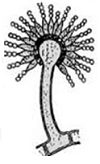
-
47%
a) Sporangiosporous fungi.
-
13%
b) Coprophilous fungi.
-
7%
c) Septate fungi.
-
33%
d) Coenocytic fungi.
Q.26.
Find the incorrect match from the following:
-
9%
a) Puccinia – Basidiomycetes – Club fungi.
-
9%
b) Agaricus – Basidiomycetes – Mushroom.
-
73%
c) Trichoderma – Sexual cycle is found – Perfect fungi.
-
9%
d) Penicillium – Sexual cycle is found – Sac fungi.
Q.27.
Naked fungi (Slime moulds) are naked:
-
25%
a) When they are reproducing.
-
0%
b) When they are not reproducing.
-
50%
c) Always naked.
-
25%
d) Never naked.
Q.28.
Identify the figures and choose the correct option in which one figure is correctly described.
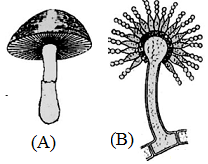
-
18%
a) (a) – Agaricus – a member of class Ascomycetes.
-
27%
b) (b) – Aspergillus – a member of class Basidiomycetes.
-
36%
c) (a) – Agaricus – an edible fungus.
-
18%
d) (b) – Aspergillus – a poisonous mushroom.
Q.29.
Bracket fungi and puffballs belongs to:
-
9%
a) Deuteromycetes.
-
9%
b) Ascomycetes.
-
64%
c) Basidiomycetes.
-
18%
d) Phycomycetes.
Q.30.
) Protozoan protistans are differentiated on the basis of their:
-
33%
a) Nuclei
-
0%
b) Size.
-
33%
c) Shape
-
33%
d) Locomotory structures