Q.1.
Ergotamine tartarate extracted from Claviceps, is used for cure of
-
43%
a) bodyache
-
14%
b) headache
-
29%
c) fever
-
14%
d) severe stomach pain
Q.2.
Clamp connection is found in
-
0%
a) Basidiomycetes
-
29%
b) Ascomycetes
-
29%
c) Saccharomycetes
-
43%
d) Haplomycetes
Q.3.
The metachromatic granules are
-
0%
a) present in plants cell at metaphase stage
-
20%
b) inclusion bodies in bacteria
-
40%
c) produced in insects during metamorphosis
-
40%
d) chromatophores in animals skin
Q.4.
Spirochaetes is/are
-
0%
a) a class of viruses
-
17%
b) myxobacteria
-
83%
c) spiral-shaped bacteria
-
0%
d) richittsias
Q.5.
The common characteristic showing by mushroom smut and rust
-
40%
a) is characterised by presence of basidiocarps
-
0%
b) is characterised by presence of ascocarps
-
20%
c) all are pathogen
-
40%
d) all are saprophytic in nature
Q.6.
Which of the following is a ‘cyanophage”?
-
0%
a) S-13
-
40%
b) φ×174
-
20%
c) SV-40
-
40%
d) LPP-1
Q.7.
Which one of the following shows heterothallism?
-
20%
a) Rhizopus
-
20%
b) Bacterium
-
20%
c) Cycas
-
40%
d) Ricinus
Q.8.
Dikaryotisation (n+n) in Agaricus is brought about be
-
20%
a) Clamp connections
-
40%
b) Somatogamay between two hyphae of different strains
-
40%
c) Both (a) and (b) are correct
-
0%
d) Basidiospores
Q.9.
A bacterium divides every 35 minute./ Ifa culture containing 105 cells/mL is grown for 175 minutes, what will be the cell concentration after175 minutes?
-
40%
a) 5 × 10⁵ cells
-
20%
b) 35 × 105 cells
-
40%
c) 32 × 105 cells
-
0%
d) 4.175 × 10⁵ cells
Q.10.
Read the following statements regarding archaebacteria i. Their cell wall lacks peptidoglycan ii. They contain membrane bound organelles iii. These have distinct ribosomal RNA sequence iv. Lipid in cell membrane of archaebacteria have different structure than those in all other organisms Choose correct option
-
0%
a) Statement i and ii is not correct
-
60%
b) Only Statement ii is not correct
-
40%
c) Statement Only iv is not correct
-
0%
d) Statement iii and iv is not correct
Q.11.
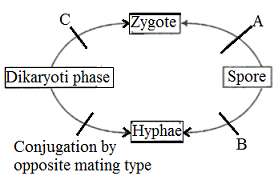
The given below figure shows a generalized life cycle of fungus. Identify A, B, C from the given option
-
0%
a) A = Meiosis , B = Fertilisation , C = Meiosis
-
50%
b) A = Meiosis , B = Mitosis , C = Fertilisation
-
25%
c) A = Mitosis , B = Meiosis, C = Fertilisation
-
25%
d) A = Mitosis, B = Fertilisation , C = Meiosis
Q.12.
Refer to the following figures
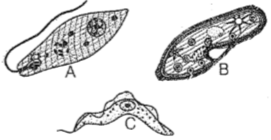
| Column I | Column II | Column III |
| A | Paramecium | I kinetoplast |
| B | Euglena | II. Trichocysts |
| C | Trypanosoma | III. Astaxanthin; |
-
20%
a) A- 3 –II , B- 1-III, C – 2-I
-
20%
b) A- 1 –II , B- 3-I, C – 2- I
-
40%
c) A- 2 –III , B- 1-II, C – 3- I
-
20%
d) A- 3 –I , B- 1-II, C – 1-III
Q.13.
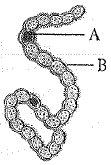
Identify the labeled part in the given figure and select the correct option
-
20%
a) A – Heterocyst B-Mucilaginous sheath
-
40%
b) A – Mucilaginous sheath B – Heterocyst
-
40%
c) A – Heterocyst B- Capsid
-
0%
d) A – Pesudopodia B – Mucliaginous sheath
Q.14.
The genetic material in tobacco mosaic virus is
-
20%
a) ss DNA
-
20%
b) ss RNA
-
60%
c) ds RNA
-
0%
d) ds DNA
Q.15.
Deuteromycetes are known as fungi imperfecti because
-
0%
a) their zygote undergoes meroblastic and holoblastic cleavage
-
40%
b) only asexual stages are known
-
20%
c) they have aseptate mycelium
-
40%
d) they are autotrophic
Q.16.
Which of the following is correct
-
20%
a) All fungi are filamentous
-
40%
b) Transfer of DNA from one bacteria to another bacteria can not take place
-
0%
c) Virus cannot have both DNA and RNA
-
40%
d) Protists reproduce asexually
Q.17.
By all of the following ways bacteria become resistant to antibiotic except
-
50%
a) making enzymes that inactivate the drug
-
0%
b) becoming impermeable to the drug
-
25%
c) modifying the target of the drug
-
25%
d) moving away from the drug
Q.18.
The outermost limiting layer of mycoplasma is made up of
-
0%
a) cell wall
-
50%
b) cell membrane
-
0%
c) mucilaginous sheath
-
50%
d) slime layer
Q.19.
The growth curve of bacterial population in lab is plotted against time. What will be the shape of graph?
-
0%
a) Sigmoid
-
50%
b) Hyperbolic
-
25%
c) Ascending straight line
-
25%
d) Descending straight line
Q.20.
Thermococcus, Methanococcus and Methanobacterium exemplify
-
25%
a) bacteria whose DNA is relaxed orpositively supercoiled but which have a cytoskeleton as well as mitochondria
-
0%
b) bacteria that contain a cytoskeleton and ribosomes
-
75%
c) archaebacteria that contains protein homologous to eukaryotic core histones
-
0%
d) archaebacteria that lack any histones resembling those found in eukaryotes but whose DNA is negatively supercoiled
Q.21.
Which one of the following pairs is not correctly matched
-
25%
a) Streptomyces - Antibiotics
-
0%
b) Serratia – Drug addiction
-
50%
c) Spirulina – Single cell protein
-
25%
d) Rhizobium – Biofertilizer
Q.22.
Which of the following is correct match?
-
0%
a) Disease : Wilt disease; Pathogen : Synchytrium
-
50%
b) Disease : Citrus canker ; Pathogen : Xanthomonas
-
50%
c) Red rot of sugarcane ; Pathogen : Ustilago
-
0%
d) Powdery mildew ; Pathogen : Fusarium
Q.23.
Among rust, smut and mushroom all the three
-
50%
a) are pathogens
-
0%
b) are saprobes
-
25%
c) bear ascocarps
-
25%
d) bear basidicarps
Q.24.
In prokaryotes, chromatophores are
-
0%
a) specialized granules responsible for colouration of cells
-
0%
b) structure responsible for organizing the shape of the organism
-
100%
c) inclusion bodies lying free inside the cells for carrying out various metabolic activities
-
0%
d) internal membrane systems that may become extensive and complex in photosynthetic bacteria
Q.25.
Myxomycetes are
-
20%
a) Saprobes or parasites, having mycelia, asexual reproduction by fragmentation, sexual reproduction by fusion of gametes
-
40%
b) Slimy mass of multinucleate protoplasm, having pseudopodia –like structures for engulfing food, reproduction through fragmentation or zoospores
-
30%
c) prokaryotic organisms, cellular or acellular, saprobes or autotrophic, reproduce by binary fission
-
10%
d) eukaryotic, single-celled or filamentous, saprobes or autotrophic, asexual reproduction by fusion of two cells or their nuclei
Q.26.
Which one of the following pairs is correctly matched?
-
0%
a) Rhizobium – Parasite in the roots of leguminous plants
-
0%
b) Mycorrhizae – Mineral uptake from soil
-
50%
c) Yeast – Production of biogas
-
50%
d) Myxomycetes – The disease ring worm
Q.27.
Which of the following structure helps in the respiration o lichens?
-
0%
a) Soredia
-
0%
b) Isidia
-
50%
c) Cyphella
-
50%
d) Cephalodia
Q.28.
The protists have
-
0%
a) only free nucleic acid
-
0%
b) membrane bound nucleoproteins lying embedded in the cytoplasm
-
50%
c) nucleoprotein in direct contact with rest of the cell substance
-
50%
d) none of these
Q.29.
Select the option that correctly identifies the different genera (A, B, C and D) of Kingdom Fungi shows in figure
-
50%
a) A – Mucor , B – Saccharomyces , C –Morchella, D – Amanita
-
0%
b) A – Mucor , B – Saccharomyces , C – Penicillium D- Agaricus
-
50%
c) A - Rhizopus , B - Saccharomyces ,C – Aspergillus, D –Morchella
-
0%
d) A- Aspergillus, B – Rhizopus , C- Penicillium D- Agaricus
Q.30.
Select the correct option:
-
0%
a) Methanogens and Halophiles are obligate anaerobes.
-
50%
b) Halophiles and Thermoacidophiles are facultative anaerobes.
-
0%
c) Thermoacidophiles and Methanogens are facultative anaerobes.
-
50%
d) Halophiles and Thermoacidophiles are obligate anaerobes.