Q.1.
Which of the following are the characteristics of dinoflagellates? (i) Planktonic golden yellow algae with soap box like structure. (ii) Marine red biflagelleted protista. (iii) Appear yellow, green, brown, blue and red in colour. (iv) Biflagelleted organisms with pellicle. (v) Saprophytic or parasitic unicellular forms.
-
40%
a) (i), (ii) and (iii) only
-
20%
b) (ii), (iv) and (v) only.
-
30%
c) (ii) and (iii) only
-
10%
d) (ii) and (v) only.
Q.2.
hich of the following does not belong to class Basidiomycetes? (i) Agaricus (ii) Trichoderma (iii) Puccinia (iv) Saccharomyces. (v) Ustilago.
-
17%
a) (i) and (ii) only.
-
33%
b) (ii) and (iii) only.
-
50%
c) (iii), (iv) and (v) only.
-
0%
d) (ii) and (iv) only.
Q.3.
Consider the following statements: (i) All prokaryotic organisms were grouped together under kingdom Monera. (ii) The unicellular eukaryotic organisms were placed in kingdom Protista. (iii) Diatoms and Gonyaulux, both have cell walls. (iv) Paramoecium and Amoeba lack cell walls. (v) Kingdom Protista has brought together Diatoms and Gonyaulux with Paramoecium and Amoeba. Which of the following statements given above are correct:
-
57%
a) (i), (ii), (iii) and (iv)
-
0%
b) (ii), (iii), (iv) and (v)
-
0%
c) (i), (ii), (iv) and (v)
-
43%
d) (i), (ii), (iii), (iv) and (v).
Q.4.
Read the following statements regarding Euglenoids and select the incorrect ones: (i) They are mostly fresh water organisms found in stagnant water. (ii) Their body is covered by protein rich layer called pellicle which makes their body flexible. (iii) They are photosynthetic in the presence of sunlight but heterotrophic in the absence of sunlight. (iv) They usually have two flagella, one long and one short. (v) They form fruiting bodies and bears spores at their tips.
-
0%
a) (i) and (v)
-
50%
b) (iv) and (v)
-
33%
c) (iii) only
-
17%
d) (v) only
Q.5.
Find the true statement regarding viruses.
-
29%
a) Viruses are facultative parasites
-
0%
b) Viruses that infect plants have usually single stranded DNA.
-
57%
c) Some viruses contain both DNA and RNA.
-
14%
d) The term virus was coined by Louis Pasteur.
Q.6.
Which one of the following is an incorrect statement regarding Mycoplasma?
-
0%
a) They lack a cell wall.
-
25%
b) They are the smallest living cells.
-
75%
c) They cannot survive without oxygen.
-
0%
d) They are pathogenic in plants and animals.
Q.7.
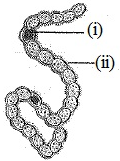
Study the diagram and consider the following statements: (a) Labelling (i) can fix atmospheric nitrogen even in the presence of oxygen. (b) Labelling (ii) is also found in the pollen grains of hydrophilous plants. (c) Labelling (i) is found in Nostoc and Anabaena. (d) Labelling (i) and (ii) are features of photosynthetic autotrophs and chemosynthetic autotrophs. Of the above statements, pick up the incorrect statements about labelling (i) and (ii).
-
50%
a) a, b, c.
-
0%
b) b, d.
-
50%
c) a, d.
-
0%
d) b, c, d.
Q.8.
Identify the incorrect statement:
-
50%
a) D.J. Ivanowsky in 1892 recognised certain microbes as causative organism of the mosaic disease of tobacco.
-
50%
b) M.W. Beijerinek in 1888 demonstrated that extract of infected plants of tobacco causes infection in healthy plants and called the fluid as Contagium vivum fluidum.
-
0%
c) W.M. Stanley in 1935 showed that viruses could be crystallised and crystals consists largely of proteins.
-
0%
d) In 1971, T.O. Diener discovered viroids which were smaller than viruses.
Q.9.
Identify the incorrect statement regarding true bacteria?
-
0%
a) As a group, theyexhibit maximum metabolic diversity
-
33%
b) Chemosyhthetic autotrophic bacteria play a great role in recycling nutrientslike nitrogen,phosphorous,iron and sulphur
-
67%
c) Heterotrophic bacteria are the most abundant in nature
-
0%
d) Bacteria reproduce mainly by fission but someties under favourable conditions, they produce spores
Q.10.
Consider the following statement regarding Mycoplasma: i. They are a genus of bacteria that have a unique cell wall of their own ii. In their genetic code UGA code for tryptophan iii) None of them is pathogenic to humans iv) They havea large genone v) They can be killed by penicillins vi) They can survive without oxygen
-
100%
a) 1
-
0%
b) 2
-
0%
c) 3
-
0%
d) 4
Q.11.
Dinoflagellates i. Are mostly marine and photosynthetic ii. Have a cell wall that has stiff cellulose iii. Have two flagella iv. Have chloroplast bound by three membranes
-
67%
a) i, ii and iii
-
33%
b) i,iii, and iv
-
0%
c) ii, iii, and iv
-
0%
d) i,ii,iii, and iv
Q.12.
How many of the following statements regarding fungi are true? i. Asexual reproduction is common by the formation of spores ii. Their bodies consists of hyphae that maybe interconnected to form mycelium iii. They secrete digestive enzyme onto organic matter and then absorb the products of the digestion iv. Fungi do not enter symbiotic relationship
-
33%
a) 2
-
33%
b) 3
-
33%
c) 4
-
0%
d) 5
Q.13.
Which of the following is not an edible mushroom?
-
0%
a) Agaricus bispora
-
50%
b) Pleurotus ostreatus
-
0%
c) Lentinula edodes
-
50%
d) Amantia phalloides
Q.14.
Consider the following characters i. Nuclear envelop ii. Membranes lacking sterols iii. 80s ribosomes iv. Split genes The characters not shared by fungi with other eukaryotes is /are
-
0%
a) ii alone
-
50%
b) iv alone
-
50%
c) ii and iv only
-
0%
d) iii and iv only
Q.15.
Fungi resemble plants in
-
50%
a) Lack of chloroplasts and hetrotrophic nutrition
-
0%
b) Reproduction by only sexual means
-
0%
c) Having a cell wall and vacuoles
-
50%
d) Exhibition of bioluminiscence
Q.16.
Identify the characteristic that is unique to fungi
-
0%
a) Cell wall of glucans and chitin
-
50%
b) Lack of chloroplasts and heterophic nutrition
-
0%
c) Mannitol, trehalose and glycogen as storage products
-
50%
d) Havinghaploidnuclei and production of spores
Q.17.
What is not true for mycorrhizae? i. Nearly 30% of vascular plants have this symbiotic relationship with fungi ii. The fungus primarily makes nitrogen available to plants iii. Fungi get organic carbon from plants
-
50%
a) i alone
-
0%
b) i and ii only
-
50%
c) ii and iii only
-
0%
d) i,ii and iii only
Q.18.
Identify the group of fungi that is not correctly matched with all the characters given
| 1 | Phycomycetes | Mycelium –aseptate and coenocytic/Asexual reproduction by motile zoospores or by nonmotile aplanospores/spores endogenously produced in sporangium |
| 2 | Ascomycetes | Mycelium –unbranched and septate/Asexual spores are conidia/Conidia produced endogenously on conidiophores |
| 3 | Basidiomycetes | Mycelium –branched and septate/Asexual spore are generally not found |
| 4 | Deuteromycetes | Only the asexual or vegetative phase of the fungi are known |
-
50%
a) 1
-
50%
b) 2
-
0%
c) 3
-
0%
d) 4
Q.19.
Match the names of the scientists with contributions and choose your answer from the codes given below
| Scientist | Contribution |
| i. Beijerinek | Gave the name ‘virus’ |
| ii. Luc Montagnier | Gave the term ‘conragium vivum fluidum’ |
| iii. Pasteur | Discovered bacteriophages |
| iv. Twort | Crystallized TMV |
| v. Stanely | Isolated HIV |
-
50%
a) i – 2, ii- 5, iii – 1, iv -3, v – 4
-
50%
b) i – 2, ii- 3, iii – 1, iv -5, v – 4
-
0%
c) i – 2, ii- 5, iii – 1, iv -4, v – 3
-
0%
d) i – 4, ii- 3, iii – 1, iv -5, v – 2
Q.20.
Identify the incorrect statement
-
0%
a) Virus has a protein coat called capsid made of small subunits called capsomeres
-
0%
b) The core has the genetic material-either RNA or DNA or both
-
50%
c) The capsomeres are arranged in helical or icosahedral forms.
-
50%
d) Virus can infectany type of organisms
Q.21.
Identify the incorrect statement
-
0%
a) Numerical Taxonomy is based on all observable characteristics.
-
50%
b) More weightage is given to reproductive characters and all other characters are given equal importance in numerical taxonomy
-
50%
c) Cytotaxonomy is based on cytological information like chromosome number, structure, behavior
-
0%
d) Chemotaxonomy uses the chemical constituents of the plant
Q.22.
The domain Archaea is not characterized by
-
0%
a) Pseudopeptidoglycan in cell wall
-
0%
b) Linear chromosomes
-
33%
c) Introns present is some genes
-
67%
d) Methanogeneisis as unique metabolism
Q.23.
Members of Kingdom Protista
-
0%
a) are primarily aquatic
-
33%
b) do not have membrane bound organelles
-
33%
c) are all ciliated or flagellated
-
33%
d) reproduce exclusively by asexual means
Q.24.
Match each item in Column I with Column II
| Column I | Column II |
| A. Diatoms | a. Protein rich layer pellicle |
| B. Dinoflagellates | b. Cell wall embedded with silica |
| C. Euglenoids | c. Spore with true walls |
| D. Slime moulds | d. Cellulose plates in cell wall |
-
50%
a) A - b ; B - a ; C - c ; D – d
-
0%
b) A - b ; B - d ; C - a ; D – c
-
0%
c) A - b ; B - c ; C - a ; D – d
-
50%
d) A - b ; B - a ; C - d ; D – c
Q.25.
All the following statements regarding Basidomycetes are correct except
-
0%
a) The mycelium is branched and septate
-
0%
b) Asexual spores and vegetative reproduction generally not found
-
0%
c) Sex organs are absent
-
100%
d) Basidiospores are exogenously produced on the basidium
Q.26.
Which is the correct sequence of the sexual cycle of fungi?
-
0%
a) Mitosis → Meiosis → Fertilization
-
50%
b) Karyogamy → Plasmogamy → Meiosis.
-
50%
c) Plasmogamy → Karyogamy → Meiosis.
-
0%
d) Meiosis → Plasmogamy → Karyogamy.
Q.27.
Match the column I with their contribution in the field of virology given in column II
| Column I | Column II |
| A. Pasteur | a. Given the name “virus” |
| B. Ivanowsky | b. Recognized tobacco mosaic is caused by microbes smaller than bacteria |
| C. Beijerinck | c. Demonstrated extract of infected tobacco plants could cause infection in healthy plants |
| D. Stanley | d. Showed that virus could be crystallized |
-
50%
a) A -a ; B -b ; C - c ; D – d
-
50%
b) A - a ; B -c ; C - b ; D - d
-
0%
c) A - b ; B -a ; C - c ; D – d
-
0%
d) A -b ; B - a ; C - d ; D – c
Q.28.
Identify the parts a-d marked in the given figure:
-
50%
a) a-Head, b-Collar, c-Sheath, d-Tail fibres.
-
0%
b) a-Collar, b-Head, c-Sheath, d-Tail fibres.
-
50%
c) a-Head, b-Collar, c-Tail fibres, d-Sheath
-
0%
d) a-Collar, b-Tail fibres, c-Head, d-Sheath.
Q.29.
In which of the following Paramylon granules are present both in cytoplasm and chloroplasts?
-
0%
a) Euglena.
-
0%
b) Physarium.
-
50%
c) Pinnularia.
-
50%
d) Closterium.
Q.30.
Consider the following statements about features of kingdoms: (i) In Animalia, the mode of nutrition is autotrophic. (ii) In Monera, the nuclear membrane is present. (iii) In protista, cell wall type is prokaryotic. (iv) In Plantae, the cell wall is present. Of the above statements:
-
50%
a) (i) alone is correct.
-
50%
b) (ii) alone is correct.
-
0%
c) (iii) alone is correct.
-
0%
d) (iv) alone is correct.