Q.1.
Difference systolic and diastolic pressure is ... ... [ MHTCET 2010]
-
21%
a) Blood pressure
-
50%
b) Pulse pressure
-
21%
c) Cardiac output
-
7%
d) Pulse
Q.2.
The cation ( mineral) necessary for coagulation of blood is ... [ EAMCET 1995 ]
-
0%
a) Na
-
57%
b) Ca
-
29%
c) K
-
14%
d) Cl
Q.3.
Volume of blood that enters aorta with each ventricular systole is ... ... [ KCET 2012 ]
-
7%
a) Vital capacity
-
33%
b) Cardiac cycle
-
47%
c) Stroke volume
-
13%
d) Cardiac output
Q.4.
Arteries are best defined as vessels which ... ... [ CBSE 2011 ]
-
17%
a) Break up into capillaries which reunite to form a vein
-
33%
b) Carry blood away from heart to different organs
-
33%
c) Supply oxygenated blood to different organs
-
17%
d) Carry blood from one visceral organ to another visceral organ
Q.5.
In which of the following situations, there is risk of erythroblastosis foetalis ... .. [ KCET 2010 ]
-
0%
a) Mother Rh+, father Rh+
-
17%
b) Mother Rh-, father Rh-
-
75%
c) Mother Rh-, father Rh+
-
8%
d) Mother Rh+, father Rh-
Q.6.
Rh factor can produce ... ... [ MPPMT 1992 ]
-
15%
a) AIDS
-
62%
b) Erythroblastosis foetalis
-
23%
c) Turner's syndrome
-
0%
d) Sickle cell anaemia
Q.7.
Which one prevents blood clotting in blood vessels? [ AFMC 2003 ]
-
42%
a) Heparin
-
25%
b) Fibrinogen
-
17%
c) Albumin
-
17%
d) Globulins
Q.8.
Cardiac output is determined by ... ... [ BHU 2008 ]
-
0%
a) Blood flow
-
8%
b) Heart rate
-
25%
c) Stroke volume
-
67%
d) Both b and C
Q.9.
Which is not detected in ECG? [ W.B. 2007 ]
-
17%
a) Arrhythmia
-
17%
b) Myocardial infection
-
25%
c) Heart block
-
42%
d) Valvular defects
Q.10.
heart of Cockroach has ... ... [ AFMC 2005 ]
-
15%
a) 14 chambers
-
38%
b) 13 chambers
-
8%
c) 4 chambers
-
38%
d) 3 chambers
Q.11.
Rh- persons are ... .. [ Pb PMT 2002 ]
-
0%
a) Homozygous dominant
-
50%
b) Homozygous recessive
-
42%
c) Heterozygous recessive
-
8%
d) None of the above
Q.12.
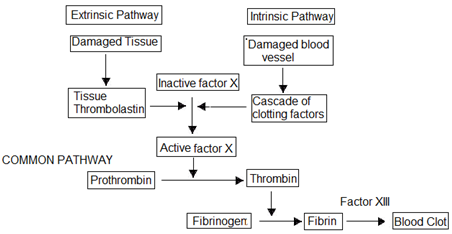
Blood protein which initiate blood coagulation is ... ... [ KCET 2000 ]
-
55%
a) Prothrombin
-
9%
b) Thrombin
-
36%
c) Fibrinogen
-
0%
d) Fibrin
Explanation
Q.13.
Blood pressure is measured by ... ... [ AIIMS 2000 ]
-
55%
a) Sphygmomanometer
-
0%
b) Phonocardiogram
-
36%
c) Electrocardiogram
-
9%
d) Stethoscope
Q.14.
Which is used to prevent bleeding? [ ARMC 1997 ]
-
0%
a) Vitamin A
-
0%
b) Vitamin C
-
17%
c) Vitamin B12
-
83%
d) Vitamin K
Q.15.
Erythroblastosis foetalis occurs when a factor from mother passes into foetus through placenta ... ... [ JIPMER 2002 ]
-
9%
a) Rh antigens
-
0%
b) Agglutinins
-
73%
c) Rh antibodies
-
18%
d) ABO antibodies.
Q.16.
O blood group is universal donor because the blood has .. .. [ CPMT 1991 ]
-
0%
a) Antigen A
-
8%
b) Antigen B
-
25%
c) Both antigens A and B
-
67%
d) No antigens
Q.17.
Systemic heart refers to ... .... [ CBSE 2003 ]
-
9%
a) Heart that contracts under stimulation from nervous system
-
45%
b) Left auricle and left ventricle in higher vertebrates
-
9%
c) Entire heart is lower vertebrates
-
36%
d) The two ventricles together in humans
Q.18.
Blood buffer is formed of ... ... [ kerala 2004 ]
-
8%
a) Haemoglobin and oxyhaemoglobin
-
0%
b) Oxygen and carbon dioxide
-
17%
c) Albumin and globulin
-
75%
d) Sodium bicarbonate and carbonic acid
Q.19.
The most common type of haemophilia is due to congenital absence of ... ... [ CPMT 2004 ]
-
0%
a) Factor II
-
25%
b) Factor V
-
58%
c) Factor VIII
-
17%
d) Factor XI
Q.20.
The ratio of RBC to WBC in humans is ... ... [ CPMT 1993 ]
-
15%
a) 6 : 1
-
15%
b) 60 : 1
-
46%
c) 600 : 1
-
23%
d) 6000 : 1
Q.21.
Blood leaving liver and moving to heart will have more concentration of ... ... [ CPMT 2005 ]
-
27%
a) Bile
-
9%
b) Glycogen
-
27%
c) Amino acids
-
36%
d) Urea
Q.22.
'Dup' sound is produced during closure of ... ... [ CBSE 1994 ]
-
38%
a) Semilunar valves
-
15%
b) Bicuspid valve
-
23%
c) Tricuspid valve
-
23%
d) Both B and C
Q.23.
Parasympathetic nervous system ... ... [ MPPMT 1996]
-
40%
a) Decreases heart beat
-
20%
b) Increases heart beat
-
20%
c) Starts heart beat
-
20%
d) Has no effect on heart beat
Q.24.
Increase in blood pressure is ... .. [ JKCET 2005 ]
-
20%
a) Arteriosclerosis
-
0%
b) Atherosclerosis
-
70%
c) Hypertension
-
10%
d) None
Q.25.
Which one of the following is important phagocyte? ... [ BHU 2005 ]
-
0%
a) RBC
-
18%
b) Basophil
-
0%
c) Eosinophil
-
82%
d) Monocyte
Q.26.
Pace maker is ... ... [ CBSE 1999 ]
-
0%
a) Instrument for measuring heart beat
-
0%
b) Instrument for measuring pulse rate
-
10%
c) Auriculo-ventricular node that provides impulse for heart beat
-
90%
d) Sinu-auricular node that provides impulse for heart beat
Q.27.
Pulse pressure is ... ... [ CPMT 1997 ]
-
0%
a) Diastolic pressure
-
0%
b) Systolic pressure
-
91%
c) Difference between B and A
-
9%
d) Pressure in great veins
Q.28.
How does the spleen help maintain blood? ... ... [ BHU 2005]
-
18%
a) Platelets are stored there
-
27%
b) Defective RBCs and platelets are removed
-
18%
c) Red blood cells are produced there until death
-
36%
d) A and B are correct
Q.29.
Why open circulatory system is advantageous to some animals? .... ... [ BHU 2005]
-
60%
a) They uses less metabolic energy
-
0%
b) They help animal to move faster
-
10%
c) They don’t need heart
-
30%
d) None of the above
Q.30.
Which is incorrect? ... ... [ Manipur 2005]
-
18%
a) Veins are typically larger in diameter than arteries.
-
18%
b) because of their small size, blood flows more rapidly in capillaries than in other parts of circulatory system.
-
9%
c) walls of arteries are elastic enabling them to stretch and shrink during changes in blood pressure
-
55%
d) Veins contain more blood than any other part of circulatory system