Q.1.
Which structure of man is similar to spiracles of cockroach?
-
14%
a) Nostril.
-
29%
b) Bronchioles.
-
14%
c) Lungs.
-
43%
d) Alveoli.
Q.2.
Mark the incorrect pair:
-
0%
a) Dysbarism – SCUBA diving.
-
20%
b) Bysinosis – Fabric manufacture industry.
-
40%
c) Monges disease – Mountain sickness.
-
40%
d) Pneumothorax – Arthropoda.
Q.3.
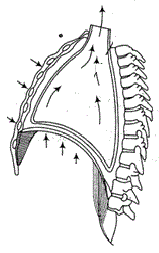
Observe the following picture and find out the correct statements suits for this picture: (i) Diaphragm relaxed and arched upwards. (ii) Volume of thorax increased. (iii) Diaphragm contracted. (iv) Air enters the lungs. (v) Volume of thorax decreased.
-
17%
a) (ii) and (iii).
-
17%
b) (iii) and (iv).
-
33%
c) (i) and (v).
-
33%
d) (iii) and (v).
Q.4.
People who have migrated from the planes to an area adjoining Rohtang Pass about six months back
-
20%
a) have more RBCs and their haemoglobin has a lower binding affinity to O2
-
60%
b) are not physically fit to play games like football
-
20%
c) suffer from altitude sickness with symptoms like nausea, fatigue etc
-
0%
d) have the usual RBC count but their haemoglobin has very high binding affinity to O2
Q.5.
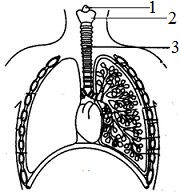
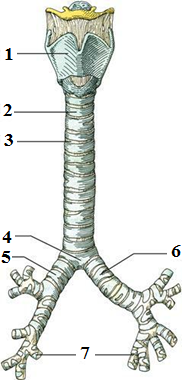
Refer the diagram and answer the following question: What is the function of part labelled 3?
-
0%
a) It acts as a passage for inspired air and expired air.
-
17%
b) It is a passage for food.
-
33%
c) It is the common passage for both food and air.
-
50%
d) Both (A) and (B).
Q.6.
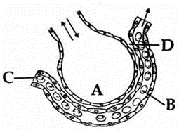
The figure given below shows a small part of human lung where exchange of gases takes place. In which one of the options given below, the one part A, B, C or D is correctly identified along with its function?
-
25%
a) B – Red blood cell – Transport of Carbon dioxide mainly.
-
25%
b) C – Arterial capillary – Passes oxygen to tissues.
-
25%
c) A – Alveolar cavity – Main site of exchange of respiratory gases.
-
25%
d) D – Capillary wall – exchange of oxygen and carbon dioxide takes place here.
Q.7.
Which one of the following is the correct statement for respiration in humans?
-
0%
a) Cigarette smoking may lead to inflammation of bronchi
-
50%
b) Neural signals from pneumotoxic centre in pons region of brain can increase the duration of inspiration
-
25%
c) Workers in grinding and stone breaking industries may suffer, from lung fibrosis
-
25%
d) About 90% of carbon dioxide (CO2) is carried by haemoglobin as carbamino haemoglobin
Q.8.
Chloride back-shift is associated with the transport of
-
0%
a) Oxygen
-
0%
b) Water
-
67%
c) CO2
-
33%
d) Carbamino
Q.9.
In which form CO2 is not transported by blood plasma
-
0%
a) KHCO3
-
75%
b) Carbamino proteins
-
0%
c) KHbO2
-
25%
d) NaHCO3
Q.10.
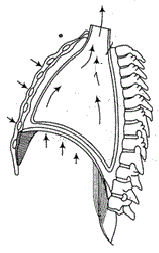
Refer the given diagram and select the correct option for the question that follows: Which of these is incorrect regarding the given mechanism of breathing?
-
50%
a) Volume of thorax decreases.
-
50%
b) Diaphragm relaxes and arches upwards.
-
0%
c) Volume of lungs decreases.
-
0%
d) Ribs and sternum are raised.
Q.11.
Observe the given figure of respiratory passage and answer the following question: Trachea and primary bronchus are labelled as respectively:
-
25%
a) 1 and 2.
-
0%
b) 1 and 4.
-
50%
c) 1 and 6.
-
25%
d) 1 and 7.
Q.12.
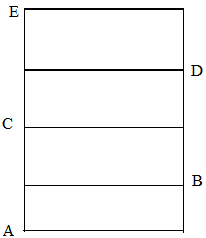
If the following vessel is considered as our lungs and letters AE → Total lung capacity, CD → Tidal volume, ED → Inspiratory reserve volume, CB → Expiratory reserve volume, then vital capacity is denoted by:
-
67%
a) AC.
-
0%
b) BE.
-
33%
c) CE.
-
0%
d) DB.
Q.13.
Respiratory quotient (RQ) is:
-
0%
a)

-
0%
b)

-
67%
c)

-
33%
d)

Q.14.
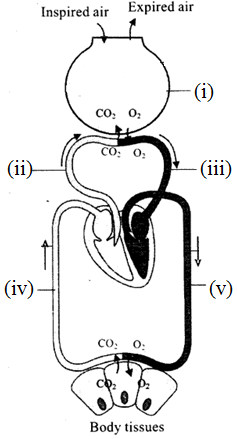
Identify (i) – (v) in the given diagram and choose the correct option accordingly:
-
50%
a) (i) – Alveolus, (ii) – Pulmonary artery, (iii) – Pulmonary vein, (iv) – Systemic artery, (v) – Systemic ve
-
50%
b) (i) – Alveolus, (ii) – Pulmonary vein, (iii) – Pulmonary artery, (iv) – Systemic vein, (v) – Systemic artery.
-
0%
c) (i) – Alveolus, (ii) – Pulmonary vein, (iii) – Pulmonary artery, (iv) – Systemic artery, (v) – Systemic
-
0%
d) (i) – Alveolus, (ii) – Pulmonary vein, (iii) – Pulmonary artery, (iv) – Systemic artery, (v) – Port
Q.15.
Which one of the following statements is incorrect?
-
33%
a) The residual air in lungs slightly decreases the efficiency of respiration in mammals
-
0%
b) The presence of non-respiratory air sacs, increases the efficiency of respiration in birds
-
33%
c) In insects, circulating body fluids serve to distribute oxygen to tissues
-
33%
d) The principle of counter current flow facilities efficient respiration in gills of fishes
Q.16.
People living at sea level have around 5 million RBC per cubic millimetre of their blood whereas those living at an altitude of 5400 meters have around 8 million. This is because at high altitude
-
0%
a) people get pollution-free air to breathe and more oxygen is available
-
33%
b) atmospheric O2 level is less and hence more RBCs are needed to absorb the required amount of O2 to survive
-
33%
c) there is more UV radiation which enhances RBC production
-
33%
d) people eat more nutritive food, therefore more RBCs are formed
Q.17.
What is vital capacity of our lungs?
-
25%
a) Inspiration reserve volume plus tidal volume
-
0%
b) Total lung capacity minus expiratory reserve volume
-
0%
c) Inspiratory reserve volume plus expiratory reserve volume
-
75%
d) Total lung capacity minus residual volume
Q.18.
The haemoglobin of human foetus
-
0%
a) has a lower affinity for oxygen than that of the adult
-
0%
b) its affinity for oxygen is the same as that of an adult
-
0%
c) has only 2 protein subunits instead of 4
-
100%
d) has a higher affinity for oxygen than that of an adult
Q.19.
Assertion: In alveolar side, oxygen combines with haemoglobin to form oxyhaemoglobin. Reason: Oxyhaemoglobin formation depends mainly on PO2.
-
0%
a) Both Assertion and Reason are true and Reason is the correct explanation of Assertion.
-
67%
b) Both Assertion and Reason are true but Reason is NOT the correct explanation of Assertion.
-
33%
c) Assertion is true but Reason is false.
-
0%
d) Both Assertion and Reason are false.
Q.20.
ssertion: Emphysema is caused by cigarette smoking. Reason: Cigarette smoking reduces the gaseous exchange area.
-
0%
a) Both Assertion and Reason are true and Reason is the correct explanation of Assertion.
-
100%
b) Both Assertion and Reason are true but Reason is NOT the correct explanation of Assertion.
-
0%
c) Assertion is true but Reason is false.
-
0%
d) Both Assertion and Reason are false.
Q.21.
Assertion: Smoking causes oxygen deficiency in the body. Reason: Carbon monoxide inhaled while smoking combines with haemoglobin to form chemically stable compound.
-
0%
a) Both Assertion and Reason are true and Reason is the correct explanation of Assertion.
-
75%
b) Both Assertion and Reason are true but Reason is NOT the correct explanation of Assertion.
-
25%
c) Assertion is true but Reason is false.
-
0%
d) Both Assertion and Reason are false.
Q.22.
Assertion: CO2 is carried in the plasma mainly as HCO3- ions. Reason: Enzyme carbonic anhydrase of RBC catalyses the formation of HCO3- ions that enter the plasma.
-
0%
a) Both Assertion and Reason are true and Reason is the correct explanation of Assertion.
-
33%
b) Both Assertion and Reason are true but Reason is NOT the correct explanation of Assertion.
-
67%
c) Assertion is true but Reason is false.
-
0%
d) Both Assertion and Reason are false.
Q.23.
Assertion: Vital capacity is higher in athletes. Reason: Vital capacity is the amount of air which one can exhale or inhale with maximum effort.
-
33%
a) Both Assertion and Reason are true and Reason is the correct explanation of Assertion.
-
0%
b) Both Assertion and Reason are true but Reason is NOT the correct explanation of Assertion.
-
67%
c) Assertion is true but Reason is false.
-
0%
d) Both Assertion and Reason are false.
Q.24.
Read the following statements: (i) Red blood corpuscles show anaerobic respiration only because they have no mitochondria. (ii) Because of residual volume, gaseous exchange continues even at the end of maximum expiration or on holding the breath. (iii) Male shows about 20 – 25% more pulmonary volumes and capacities than female. (iv) Oxyhaemoglobin acts a strong acid. (v) Double Bohr effect states that the oxygen dissociation curve for maternal HbA and foetal Hbf move in opposite directions.
-
33%
a) Only two statements are true.
-
67%
b) Only four statements are true.
-
0%
c) Only three statements are true.
-
0%
d) All statements are true.
Q.25.
The volume of air which remains in the conducting region and is not available for gas exchange is called:
-
0%
a) Functional residual capacity.
-
0%
b) Residual capacity.
-
0%
c) Forced respiratory capacity.
-
100%
d) Anatomic dead space/Dead space air.
Q.26.
Volume of air inhaled or exhaled from a person’s lungs per minute is called:
-
33%
a) Respiratory minute volume/Respiratory minute ventilation (TV × breathing rate).
-
0%
b) Vital capacity (TV + IRV + ERV).
-
67%
c) Functional residual capacity (ERV + RV).
-
0%
d) Expiratory capacity (TV + ERV)
Q.27.
A stable oxidised form of haemoglobin which is unable to release oxygen to the tissues is called:
-
0%
a) Methaemoglobin.
-
67%
b) Carbaminohaemoglobin.
-
33%
c) Oxymyoglobin.
-
0%
d) Emphysemoglobin.
Q.28.
During strenuous activities 75% oxygen will be delivered and 25% will be brought back. Why there is no 100% distribution?
-
0%
a) It is to release O2 to the epithelial tissues.
-
0%
b) It is to keep oxyhaemoglobin saturation at 104mm of Hg in alveoli.
-
100%
c) It is to keep a minimum partial pressure of CO2 in arterial blood, because carbon dioxide is essential for creating breathing urge.
-
0%
d) It is to keep a minimum partial pressure of CO2 in arterial blood, so that Herring breur inflation reflex will be triggered.
Q.29.
Which of the following is an example of Dysbarism?
-
0%
a) Mountain sickness.
-
33%
b) Monge’s disease.
-
67%
c) Caisson disease.
-
0%
d) All of the above.
Q.30.
Which of the following tissues will be more affected during hypoxia?
-
0%
a) Brain, heart.
-
67%
b) Bone, cartilage.
-
0%
c) Gut, axial skeleton.
-
33%
d) Skin and alimentary canal.
Q.31.
Which of the following muscles will not be used in the pulmonary expiration of frog?
-
0%
a) Sternohyal muscles.
-
67%
b) Petrohyal muscles.
-
33%
c) Phrenic muscles.
-
0%
d) All tissues are not equally affected during hypoxia.
Q.32.
Name an animal that shows only anaerobic respiration:
-
33%
a) Yeast.
-
0%
b) Methanobacteria.
-
33%
c) Ancylostoma.
-
33%
d) All the above.
Q.33.
Each haemoglobin molecule shows 4 Haem units. The metallic element present in it is iron. Select the correct oxidation state of iron in haem units:
-
67%
a) Fe-
-
0%
b) Fe3+.
-
33%
c) Fe2+.
-
0%
d) Fe4+.
Q.34.
A foetus respires by means of placenta. Which of the following part of placenta is used for it?
-
33%
a) Amnion.
-
0%
b) Yolk sac.
-
67%
c) Allantois.
-
0%
d) Chorion.
Q.35.
Painful breathing is called:
-
33%
a) Orthopnoea.
-
0%
b) Acapnea.
-
33%
c) Dyspnoea.
-
33%
d) Hypercapnea.
Q.36.
Primary inspiratory muscles are:
-
33%
a) Phrenic muscles.
-
33%
b) Internal intercostal muscles.
-
33%
c) Abdominal muscles.
-
0%
d) External intercostal muscles.
Q.37.
About 3% of oxygen is transported as dissolved state in plasma. Even though CO2 shows 20 – 25 times greater solubility than oxygen, only about 5 -7% CO2 is transported in the form of dissolved state in plasma. Which of the following is a suitable explanation for this phenomenon?
-
67%
a) Double Bohr Effect reduces the solubility of CO2 in plasma.
-
33%
b) Hamberger phenomenon is a hindrance for carbonic acid formation.
-
0%
c) Haldane effect is an impediment for H2CO3 formation.
-
0%
d) It is due to the dissociation nature of H2CO3.
Q.38.
Which of the following muscles contract during both forceful expiration and forceful inspiration?
-
33%
a) Phrenic muscles.
-
0%
b) Abdominal muscles.
-
33%
c) Diaphragm muscles.
-
33%
d) Internal intercostal muscles.
Q.39.
Make the correct pairs.
| (a) Pneumonia | i. Lack of O2 in organs. |
| (b) Bronchitis | ii. Attack of air and particles |
| (c) Emphysema | iii. More coughing. |
| (d) Asbetosis | iv. Filling of dead WBC |
-
33%
a) P - iii , Q - iv , R - ii , S - i
-
33%
b) P - iv , Q - iii , R - ii , S - i
-
33%
c) P - ii , Q - iii , R - iv , S - i
-
0%
d) P - i , Q - ii , R - iii , S - iv
Q.40.
During strenous exercise,glucose is converted into (B.H.U.2005)
-
67%
a) Glycogen
-
0%
b) Lactic acid
-
33%
c) Pyravic acid
-
0%
d) Starch
Q.41.
Carbon monoxide contained in Tobacco smoke
-
33%
a) Is carcinogenic
-
33%
b) Reduces oxygen carrying capacity of blood
-
33%
c) Raises blood pressure
-
0%
d) Causes gastric ulcers
Q.42.
Respiratory centre of brain is stimulated by (A.I.I.M.S 2000)
-
33%
a) Oxygen content in arterial blood
-
0%
b) Oxygen content in venous blood
-
33%
c) Carbon dioxide content in venous blood
-
33%
d) Carbon dioxide content in arterial blood
Q.43.
Exchange of gases in lung alveoli occurs through
-
33%
a) Osmosis
-
0%
b) Simple diffusion
-
33%
c) Passive transport
-
33%
d) Active transport
Q.44.
About 1500 ml of air left in lungs is called
-
33%
a) Inspiratory reserve volume
-
0%
b) Vital capacity
-
33%
c) Residual volume
-
33%
d) Tidal volume
Q.45.
The de-oxygenated blood from heart comes to the lungs by
-
0%
a) Pulmonary vein
-
67%
b) Renal artery
-
0%
c) Pulmonary artery
-
33%
d) Branchial artery
Q.46.
What is called the Upper region of Pharynx in man ?
-
33%
a) Laryngopharynx
-
0%
b) Oropharynx
-
0%
c) larynx
-
67%
d) Nasopharynx
Q.47.
Increase in CO2 concentration shall cause (CB.S.E.2004)
-
33%
a) Slower and shallower breathing
-
0%
b) Slower and deeper breathing
-
0%
c) Faster and deeper breathing
-
67%
d) No effect on breathing
Q.48.
H.Hb is
-
33%
a) H2b
-
0%
b) Heavy hydrogen bond
-
33%
c) Reduced bromide
-
33%
d) Haemoglobin acid
Q.49.
After entering RBC,Cl- reacts with.....
-
33%
a) K+
-
0%
b) KHCO3
-
33%
c) H.Hb
-
33%
d) KHbO2
Q.50.
Make the correct pairs.
| Columan-I | Column-II |
| (a) Silicosis | i. Spreading of fibrous tissue. |
| (b) Emphysema | ii. Little aloveolar elasticity. |
| (c) Asthma | iii. Muscle of the wall of tracheal branches agitate |
| (d) Bronchitis | iv. Burning sensation of bronchus |
-
67%
a) P - iii , Q - iv , R - ii , S - i
-
33%
b) P - iv , Q - iii , R - ii , S - i
-
0%
c) P - ii , Q - iii , R - iv , S - i
-
0%
d) P - i , Q - ii , R - iii , S - iv