Q.1.
A person suffers punctures in his chest cavity in an accident, without any damage to the lungs its effects could be:
-
60%
a) Reduced breathing rate.
-
20%
b) Rapid increase in breathing rate.
-
20%
c) No change in breathing.
-
0%
d) Cessation in breathing.
Q.2.
Regarding the human tracheal rings, mark the wrong entry:
-
12%
a) Made up of hyaline cartilage.
-
25%
b) Prevent collapsing of trachea.
-
38%
c) Dorsally incomplete.
-
25%
d) 10 – 12 in number.
Q.3.
Assertion: The role of O2 in the regulation of respiratory rhythm is quite insignificant. Reason: The diffusion membrane is made up of three layers.
-
43%
a) Both Assertion and Reason are true and Reason is the correct explanation of Assertion.
-
29%
b) Both Assertion and Reason are true but Reason is NOT the correct explanation of Assertion.
-
14%
c) Assertion is true but Reason is false.
-
14%
d) Both Assertion and Reason are false.
Q.4.
Figure shows schematic plan of blood circulation in humans with labels (i) – (iv). Identify the part labelled and its correct description:
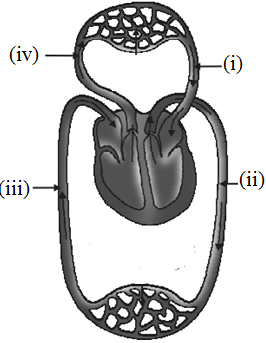
-
17%
a) (iv) – Dorsal aorta takes blood from heart to body parts – PO2 – 95mm Hg
-
50%
b) (i) – Pulmonary vein takes impure blood from body parts – PO2 – 60mm Hg.
-
17%
c) (ii) – Pulmonary artery takes blood from heart to lungs – PO2 – 90mm Hg.
-
17%
d) (iii) – Vena cava takes blood from body parts to right auricle – PCO2 – 45mm Hg.
Q.5.
Four statements are given. How many of them are correct? (i) Oxygen can bind with haemoglobin in a reversible manner to form oxyhaemoglobin. (ii) Each haemoglobin molecule can carry maximum of four molecules of oxygen. (iii) Binding of oxygen with haemoglobin is primarily related to partial pressure of oxygen. (iv) About 97% of oxygen is transported by RBC.
-
33%
a) 1
-
0%
b) 2
-
33%
c) 3
-
33%
d) 4
Q.6.
Read the following enzyme catalysed chemical reaction of respiration: Select the incorrect point about enzyme ‘X’.

-
17%
a) The concentration of enzyme ‘X’ is higher in RBC than in blood plasma.
-
0%
b) The name of enzyme ‘X’ is carbonic anhydrase.
-
33%
c) Enzyme ‘X’ helps in maximum transport of CO2 from tissue to alveoli as carbaminohaemoglobin form.
-
50%
d) Zinc is the cofactor of enzyme ‘X’.
Q.7.
In the tissues, high concentration of carbon dioxide;
-
20%
a) Increases the affinity of haemoglobin to oxygen but decreases its affinity to hydrogen.
-
20%
b) Increases the affinity of haemoglobin to both oxygen and hydrogen.
-
40%
c) Decreases the affinity of haemoglobin to both oxygen and hydrogen.
-
20%
d) Decreases the affinity of haemoglobin to oxygen but increases its affinity to hydrogen.
Q.8.
Mark the incorrect statement:
-
33%
a) Respiratory mechanism is controlled by CNS.
-
0%
b) Near alveoli chloride ions move into RBC.
-
33%
c) Respiratory centre of brain is insensitive to increase in PO2.
-
33%
d) Rate of breathing is controlled by carbon dioxide.
Q.9.
Which of the following would have the same O2 content?
-
0%
a) Blood entering the tissue capillaries – Blood leaving the tissue capillaries.
-
50%
b) Blood entering the lungs – Blood leaving the lungs.
-
50%
c) Blood entering the right side of the heart – Blood leaving the left side of the heart.
-
0%
d) Blood entering the right side of the heart – Blood leaving the right side of the heart.
Q.10.
Read the following four statements: (i) In red fibres, Myoglobin content is high. (ii) Red fibres contain plenty of mitochondria. (iii) These fibres can utilize the large amount of CO2 stored in them for ATP production. (iv) These muscles are called aerobic muscles. How many of the above statements are correct?
-
0%
a) 1
-
50%
b) 2
-
50%
c) 3
-
0%
d) 4
Q.11.
In a healthy person:
-
0%
a) Pulmonary ventilation is less than alveolar ventilation.
-
0%
b) Alveolar ventilation is twice pulmonary ventilation.
-
50%
c) Pulmonary ventilation is equal to alveolar ventilation.
-
50%
d) Alveolar ventilation is less than pulmonary ventilation.
Q.12.
Residual volume is:
-
0%
a) Greater than Tidal volume.
-
20%
b) Greater than Inspiratory reserve volume.
-
0%
c) Greater than vital capacity.
-
80%
d) Lesser than Tidal volume.
Q.13.
In the alveoli, the air sacs is separated from deoxygenated blood through:
-
0%
a) Transitional epithelium + endothelium of blood capillaries.
-
0%
b) Pseudostratified epithelium + Endothelium of blood capillaries.
-
100%
c) Stratified cuboidal epithelium + Basement membrane + Endothelium of blood capillaries.
-
0%
d) Squamous epithelium + Basement membrane + endothelium of blood capillaries .
Q.14.
The gaseous exchange and gas transport are show in the diagram. The PO2 and PCO2 seen at areas marked a, b and c are respectively
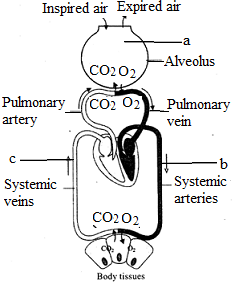
-
20%
a) 104mm Hg/40mm Hg; 95mm Hg/40mm Hg; 45mm Hg/40mm Hg.
-
20%
b) 40mm Hg/104mm Hg; 40mm Hg/95mm Hg; 40mm Hg/45mm Hg.
-
60%
c) 104mm Hg/40mm Hg; 95mm Hg/40mm Hg; 40mm Hg/45mm Hg.
-
0%
d) 104mm Hg/40mm Hg; 40mm Hg/40mm Hg; 45mm Hg/40mm Hg.
Q.15.
Contraction of sternohyal muscles during breathing:
-
0%
a) Closes the glottis.
-
25%
b) Lowers the floor of buccal cavity.
-
50%
c) Raises the floor of buccal cavity.
-
25%
d) Open the nostrils.
Q.16.
Which one of the following is a possibility for most of us in regard to breathing by making a conscious effort?
-
0%
a) One can breathe out air totally without oxygen.
-
100%
b) The lungs can be made fully empty forcefully breathing out all air from them.
-
0%
c) One can breathe out air through Eustachian tube by closing the nose and mouth.
-
0%
d) One can consciously breathe in and out by moving the diaphragm alone without moving the ribs at all.
Q.17.
Which of the following statement is correct;
-
40%
a) During inspiration external intercostal muscles and diaphragm contracts.
-
0%
b) Cyanosis means collapse of alveoli.
-
40%
c) Eupnoea means slow breathing.
-
20%
d) Coryza is caused by human corona virus.
Q.18.
Assertion: Oxygen dissociation curve of haemoglobin is sigmoid. Reason: Oxygen dissociation curve move towards left side with increase in CO2 concentration in air.
-
20%
a) Both Assertion and Reason are true and Reason is the correct explanation of Assertion.
-
80%
b) Both Assertion and Reason are true but Reason is NOT the correct explanation of Assertion.
-
0%
c) Assertion is true but Reason is false.
-
0%
d) Both Assertion and Reason are false.
Q.19.
The blood leaving the lungs has all its haemoglobin present in the oxygenated from and gives up oxygen to the tissues because:
-
25%
a) The tissue can absorb oxygen from oxyhaemoglobin.
-
0%
b) Reduction reaction of haemoglobin occurs.
-
50%
c) O2 conc. in the tissues is lower and CO2 conc. higher than in the lungs.
-
25%
d) O2 conc. in the tissues is higher and CO2 conc. lower than in the lungs.
Q.20.
Which of the following represents Adam’s apple?
-
0%
a) Thyroid cartilage of larynx.
-
40%
b) Arytenoid cartilage of larynx
-
60%
c) Cricoid cartilage of larynx.
-
0%
d) All of the above.
Q.21.
After taking a long deep breath, we do not inspire for sometimes due to:
-
40%
a) More CO2 in blood.
-
40%
b) More O2 in blood.
-
20%
c) Less CO2 in blood.
-
0%
d) Less O2 in blood.
Q.22.
What is the PO2 and PCO2 in systematic arteries?
-
20%
a) PO2 – 40mm Hg/ PCO2 – 45mm Hg.
-
0%
b) PO2 – 95mm Hg/ PCO2 – 45mm Hg.
-
60%
c) PO2 – 95mm Hg/ PCO2 – 40mm Hg.
-
20%
d) PO2 – 45mm Hg/ PCO2 – 40mm Hg.
Q.23.
Reduction in the pH of blood will:
-
50%
a) Reduce the rate of heart beat.
-
25%
b) Reduce the blood supply to the brain.
-
25%
c) Decrease the affinity of haemoglobin with oxygen.
-
0%
d) Release bicarbonate ions by the liver.
Q.24.
The volume of anatomically dead space, airin the lungs of human beings is normally
-
0%
a) 230 mL
-
83%
b) 210 mL
-
0%
c) 190 mL
-
17%
d) 150 mL
Q.25.
Which of the following is correct regarding human breathing? (i) Excess carbon dioxide or hydrogen ions mainly stimulate the respiratory centre o brain and change the Inspiratory and expiratory signals to the respiratory muscles. (ii) Diffusion capacity is the limit of respiratory membrane for gaseous exchange between the alveoli and pulmonary blood. (iii) The right lung is smaller than the left lung and has a concavity called cardiac notch. (iv) The pH of blood falls as its CO2 content decreases.
-
25%
a) All are correct.
-
25%
b) a, b, c are correct.
-
50%
c) a and b are correct.
-
0%
d) b and d are correct.
Q.26.
At 40mm of Hg of partial pressure of oxygen, the saturation is:
-
0%
a) 50%.
-
50%
b) 75%.
-
33%
c) 95%.
-
17%
d) 40%.
Q.27.
Find the mismatched one:
-
0%
a) Bohr effect – displaces oxygen from blood to tissues.
-
50%
b) Haldane effect – displaces carbon dioxide from blood to alveolus.
-
50%
c) High pH and low PCO2 – dissociation of oxyhaemoglobin.
-
0%
d) Herring breur reflex – prevents over inflation of lungs.
Q.28.
How many pieces of cartilage are present in larynx?
-
0%
a) 7
-
25%
b) 8
-
75%
c) 9
-
0%
d) 4
Q.29.
Oxyhaemoglobin dissociates into oxygen and deoxyhaemoglobin at
-
0%
a) low O2 pressure in tissue
-
25%
b) high O2 pressure in tissue
-
75%
c) equal O2 pressure inside and outside tissue
-
0%
d) all times irrespective of O2 pressure
Q.30.
Hiccups can be best described as
-
38%
a) forceful sudden expiration
-
38%
b) forceful contraction of inercostal muscles during deep breathing
-
25%
c) vibration of the soft palate during breathing while sleeping
-
0%
d) jerky incomplete inspiration
Q.31.
What is true about RBCs in humans?
-
0%
a) They carry about 20-25 per cent of CO2
-
50%
b) They transport 99.5 per cent of O2
-
50%
c) They transport about 80 per cent of O2
-
0%
d) They do not carry CO2 at all
Q.32.
Carbon dioxide (CO2) diffuses into blood from tissue site and pressure to alveolar site in the form of
-
50%
a) bicarbonate; 70%
-
50%
b) bicarbonate; 20 – 25%
-
0%
c) carbaminohaemoglobin; 60-70%
-
0%
d) carbaminohaemoglobin; 7%
Q.33.
Which of the following statements are false?
-
0%
a) In human males, lateral movement of thorax constitutes 25% of breathing while abdominal movement accounts for 75% breathing.
-
100%
b) In pregnant women, almost the entire breathing is through lateral movement of thorax.
-
0%
c) Combinations of two or more pulmonary volumes are called lung capacities.
-
0%
d) About 30% of oxygen in the blood is dissolved as plasma.
Q.34.
Abnormal distension of alveolar sacs are called:
-
0%
a) Bronchial asthma.
-
67%
b) Occupational respiratory disorder.
-
0%
c) Emphysema.
-
33%
d) Pulmonary tuberculosis.
Q.35.
Oxygen binding to haemoglobin in blood is
-
0%
a) directly proportional to the concentration of CO2 in the medium
-
50%
b) inversely proportional to the concentration of CO2 in the medium
-
50%
c) directly proportional to the concentration of CO in the medium
-
0%
d) independent of the concentration of CO in the medium
Q.36.
Chemo-sensitive area of respiratory centre in medulla is affected by
-
0%
a) less CO2 and H+ ions
-
0%
b) less O2 and H+ ions
-
100%
c) excess CO2 and H+ ions
-
0%
d) excess O2 and H+ ions
Q.37.
When a man inhales air containing normal concentration ofO2 as well as CO he suffers from suffocation because
-
0%
a) CO reacts with C2 reducing its percentage in air
-
0%
b) haemoblobin combines with CO instead of O2 and forms carboxyhaemoblobin
-
100%
c) CO affects diaphragm and intercostal muscles
-
0%
d) CO affects the nerves of the lungs
Q.38.
Which of the following match is correct?
-
0%
a) Emphysema : reduction of surface area of alveoli and bronchi
-
25%
b) Pneumonia: occupational disease with asbestos
-
50%
c) Silicosis : inflammation of alveoli
-
25%
d) Asthma: excessive secretion of bronchial mucus
Q.39.
The respiratory centre in the brain is stimulated by
-
0%
a) CO2 concentration in venous blood
-
75%
b) O2 concentration in artery blood
-
0%
c) CO2 concentration in artery blood
-
25%
d) O2 concentration in venous blood
Q.40.
During winter a person died during sleep, the room was closed and a container with burnt charcoal was found in the room. What may be the possible reason of his death?
-
50%
a) non-availability of oxygen
-
0%
b) Hb has more affinity to combine with carbon monoxide
-
50%
c) Hb has more affinity to combine with nitrogen
-
0%
d) combined effect of (a) and(b)
Q.41.
In the tissues, high concentrations of carbon dioxide
-
0%
a) increased the affinity of haemoglobin to both oxygen and hydrogen
-
0%
b) increased the affinity of haemoglobin to oxygen but decreases its affinity to hydrogen
-
100%
c) decreases the affinity of haemoglobin to oxygen but increases its affinity to hydrogen
-
0%
d) decreases the affinity of haemoglobin to both oxygen and hydrogen
Q.42.
The inflammation of the bronchi, which is characterised by hypertrophy and hyperplasia of sero-mucosa gland and goblet cells lining the bronchi is:
-
50%
a) Bronchitis.
-
50%
b) Bronchial asthma.
-
0%
c) Emphysema.
-
0%
d) Pneumonia.
Q.43.
Choose the mismatched pair:
-
0%
a) Bohr effect – The effect of CO2 on oxyhaemoglobin.
-
50%
b) Chloride shift – Diffusion of Cl- from plasma to RBCs and bicarbonate ions from RBCs to plasma.
-
0%
c) Hamberger shift – Diffusion of chloride ions from RBC to plasma and bicarbonate ions from plasma to RBC.
-
50%
d) Haldane effect – Associated with gaseous transport in blood.
Q.44.
Identify the false statement:
-
0%
a) Sponges exchange O2 and CO2 by simple diffusion over the body surface.
-
0%
b) Insects have tracheal tubes to transport atmospheric air within the body.
-
100%
c) Respiratory organ in Neries are gills.
-
0%
d) Gills are the respiratory organs in prawns.
Q.45.
Choose the false statement regarding occupational lung diseases in man:
-
0%
a) It is caused due to the exposure of potentially harmful substances such as gas, fumes or dusts present in the environment where a person works.
-
50%
b) Chronic exposure to silica and asbestos dust causes silicosis and asbestosis.
-
50%
c) Occupational lung diseases are characterised by fibrosis of upper part of lung causing inflammation.
-
0%
d) Use of bronchodilators and antibiotics do not help to remove secondary infection.
Q.46.
Listed below are four respiratory capacities and four jumbled respiratory volumes of normal human adult: (i) Residual volume – 2500ml. (ii) Vital capacity – 3500ml. (iii) Inspiratory reserve volume – 1200ml. (iv) Inspiratory capacity – 4500ml. Which one of the following is the correct matching of two capacities and volumes?
-
0%
a) (ii) 2500ml , (iii) 4500ml.
-
50%
b) (iii) 1200ml, (iv) 2500ml.
-
50%
c) (iv) 3500ml, (i) 1200ml.
-
0%
d) (i) 4500ml, (ii) 3500ml.
Q.47.
Raw materials for the synthesis of haemoglobin are:
-
0%
a) Proteins, carbohydrates and lipids.
-
0%
b) Iron, proteins only.
-
67%
c) Iron, folic acid, vit B12 and proteins.
-
33%
d) Iron, pantothenic acid and vit. B12.
Q.48.
In an accident a man dies immediately although there was no injury to brain, kidney, stomach and heart. The probable cause of death may be:
-
25%
a) Larynx got punctured.
-
50%
b) Diaphragm got punctured.
-
25%
c) Clumping of erythrocytes.
-
0%
d) Histotoxic hypoxia.
Q.49.
Which one of these shows least volume?
-
0%
a) Vital capacity.
-
25%
b) Residual capacity.
-
25%
c) Inspiratory capacity.
-
50%
d) Expiratory reserve volume.
Q.50.
When PCO2 increases, oxygen binding capacity of haemoglobin lowers and oxyhaemoglobin dissociation increases. This phenomenon is known as:
-
33%
a) Haldane effect.
-
33%
b) Bohr effect.
-
33%
c) Herring breur reflex.
-
0%
d) Hamburger phenomenon.