Q.1.
Haemoglobin cannot take up oxygen beyond a saturation level of:
-
33%
a) 80%.
-
20%
b) 85%.
-
27%
c) 90%.
-
20%
d) 95%.
Q.2.
Which of the following represents the correct order of the lung volumes and capacities in the ascending order of their values?
-
40%
a) Residual volume < Functional residual capacity < Expiratory reserve volume < Vital capacity.
-
30%
b) Residual volume < Expiratory reserve volume < Functional residual capacity < Vital capacity.
-
20%
c) Expiratory reserve volume < Residual volume < Functional residual capacity < Vital capacity.
-
10%
d) Functional residual capacity < Expiratory reserve volume < Residual volume < Vital capacity.
Q.3.
Haemoglobin in capillaries of the lungs is exposed to an oxygen pressure ofThis haemoglobin is transported within erythrocytes to capillaries in muscle, where the oxygen pressure isWhich of the following will occur in a tired muscle?
-
62%
a) Haemoglobin will bind oxygen from the muscle.
-
12%
b) Haemoglobin will enter the muscle cells.
-
25%
c) Haemoglobin will release most of the oxygen it is carrying.
-
0%
d) Haemoglobin will release less than half of the oxygen it is carrying.
Q.4.
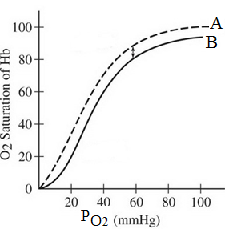
Following is the oxygen – haemoglobin dissociation curve, mark the conditions in which the curve will shift from A to B. (i) Increase in Diffusion pressure gradient. (ii) Increase in partial pressure of carbon dioxide. (iii) Low temperature. (iv) Increase in pH, blood becomes more and more alkaline.
-
29%
a) (i) and (ii).
-
29%
b) (ii) and (iii).
-
14%
c) (iii) and (iv).
-
29%
d) (i) and (iv).
Q.5.
Which of the following statements is/are correct? (i) Bohr’s effect and Haldane’s effect are opposite to each other. (ii) Haldane’s effect occurs at tissue level. (iii) Higher the P50, higher is the affinity of haemoglobin for oxygen. (iv) Decrease of 2, 3 Biphosphoglycerate will cause the shift of dissociation curve to right.
-
33%
a) (i) only.
-
0%
b) (i) and (iii).
-
50%
c) (i) and (iv).
-
17%
d) (i), (iii) and (iv).
Q.6.
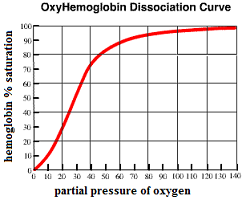
hich of the following is incorrect about the given graph?
-
14%
a) Increase in partial pressure of carbon dioxide shifts the curve to right.
-
43%
b) At low temperature the curve shifts to left.
-
29%
c) At high pH the curve shifts to right.
-
14%
d) Decrease in partial pressure of oxygen shifts the curve to right.
Q.7.
Switch off points of the Inspiratory ramp is controlled by:
-
17%
a) Pneumotaxic centre in upper pons.
-
50%
b) Apneustic centre in lower pons.
-
17%
c) Ventral respiratory group of neurons.
-
17%
d) Stretch receptors present on the walls of bronchi and bronchioles.
Q.8.
Following are few characteristics of a disorder of human body: (i) Inflammation of mucous membrane of nasal passage. (ii) Watery secretions by mucous glands. (iii) Continuous sneezing. (iv) Eye watering. (v) Rise in body temperature. Identify the disorder from the choices given below:
-
50%
a) Bronchial asthma.
-
17%
b) Rhinitis.
-
17%
c) Bronchial carcinoma.
-
17%
d) Emphysema.
Q.9.
Haldane effect plays a more important role in promoting carbon dioxide transport than that of the Bohr’s effect in promoting oxygen transport because:
-
17%
a) Oxyhaemoglobin is a stronger acid which donates hydrogen ions which in turn displace carbon dioxide from blood.
-
50%
b) Carbaminohaemoglobin is a stronger acid which splits into H+ and HCO3-.
-
33%
c) Carbon dioxide reacts with water to form carbonic acid that lowers the pH in tissue.
-
0%
d) Carbon dioxide is less soluble in venous blood than in arterial blood.
Q.10.
Amount of air that remains in the lungs at the end of normal expiration and the maximum volume to which the lungs can be expanded with the greatest possible effort are respectively:
-
0%
a) 5800ml and 2300ml.
-
50%
b) 2300ml and 4600ml.
-
33%
c) 1200ml and 5800ml.
-
17%
d) 2300ml and 5800ml.
Q.11.
Select the incorrect statement from the following:
-
29%
a) In a young man, the diffusion capacity of oxygen under resting condition is about 21ml/min/mm of Hg.
-
29%
b) There are 300 billion alveoli in the two lungs.
-
43%
c) Respiratory unit is composed of respiratory bronchioles, alveolar ducts, atria and alveoli.
-
0%
d) A negative pressure is provided by the pleural space for keeping the lungs as expanded.
Q.12.
Inability of the tissues to use oxygen even when plenty is available is due to:
-
17%
a) Cyanosis.
-
33%
b) Cyanide poisoning.
-
50%
c) Ateclasis.
-
0%
d) Dysbarism.
Q.13.
During severe physical exercise, 100 ml of oxygenated blood release:
-
33%
a) 4.4ml of oxygen to the tissues.
-
33%
b) 15ml of oxygen to the tissues.
-
17%
c) 19.4ml of oxygen to the tissues.
-
17%
d) 14.4ml of oxygen to the tissues
Q.14.
In a person with partially functional or non-functional alveoli in some parts of the lungs, the physiological dead space is:
-
17%
a) Higher than anatomical dead space.
-
0%
b) Lower than anatomical dead space.
-
17%
c) Equal to the anatomical dead space.
-
67%
d) About 150ml but it slightly decreases with age.
Q.15.
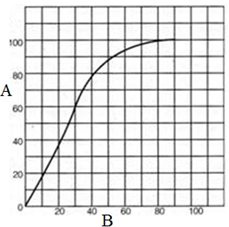
Which of the following is incorrect about the given graph?
-
50%
a) The curve is called oxygen dissociation curve.
-
17%
b) The part A represents percentage saturation of haemoglobin with oxygen.
-
33%
c) The part B represents the partial pressure of Carbon dioxide.
-
0%
d) The curve is highly useful in studying the effect of factors like pCO2, H+ concentration, etc.
Q.16.
Assertion: During inspiration, the volume of thorax increases. Reason: This happens due to the relaxation of diaphragm and Inspiratory muscles.
-
20%
a) Both Assertion and Reason are true and Reason is the correct explanation of Assertion.
-
40%
b) Both Assertion and Reason are true but Reason is NOT the correct explanation of Assertion.
-
40%
c) Assertion is true but Reason is false.
-
0%
d) Both Assertion and Reason are false.
Q.17.
Following are pulmonary air volumes and lung capacities: P = Inspiratory capacity. Q = Vital capacity. R = Functional residual capacity. S = Total lung capacity. From these which one is correct:
-
20%
a) P > Q and S.
-
0%
b) S > Q but P < R.
-
20%
c) P = TV + ERV.
-
60%
d) FRC < P, Q and S.
Q.18.
P50 value of oxygen dissociation curve is decreased by:
-
17%
a) Fever.
-
17%
b) Increase in blood pH.
-
17%
c) Exercise.
-
50%
d) High H+ ions in blood.
Q.19.
Normal intrapleural pressure:
-
20%
a) Is negative to atmospheric pressure.
-
40%
b) Helps in lung expansion.
-
20%
c) Reduces venous return to heart.
-
20%
d) Both (A) and (B) are correct.
Q.20.
Which of the following has respiratory tree for gaseous exchange?
-
25%
a) Asterias.
-
21%
b) Cucumaria.
-
33%
c) Neries.
-
21%
d) Aplysia.
Q.21.
Which of the following statements about vocal cords is incorrect?
-
80%
a) Vocal cords are two pairs of yellow elastic sheath in humans.
-
0%
b) When inspired air strikes the stretched vocal cords, voice production takes place.
-
0%
c) Vocal cords in males are longer and thicker and produce low pitched sound.
-
20%
d) Vocal cords in females are shorter and thinner and produce high pitch sound.
Q.22.
Asthma is caused due to:
-
20%
a) Infection of lungs.
-
60%
b) Inflammation of bronchi and bronchioles.
-
0%
c) Bleeding into pleural cavity.
-
20%
d) Infection of trachea.
Q.23.
Select the correct statement from the following:
-
40%
a) In external respiration, pulmonary capillary blood gains CO2 and loses O2.
-
0%
b) Oxygen dissolves greatly in water only 1.5% of O2 dissolves in blood plasma.
-
20%
c) The diaphragm forms the roof of thoracic cavity and the floor of abdominal cavity.
-
40%
d) Branches of primary bronchus including the terminal bronchioles constitute the bronchial tree.
Q.24.
Human beings have the ability to increase the strength of inspiration and expiration with the help of:
-
40%
a) External intercostal muscles.
-
20%
b) Diaphragm.
-
20%
c) Internal intercostal muscles.
-
20%
d) Additional muscles in the abdomen.
Q.25.
For efficient gas exchange the membrane, through which the exchange of gases takes place should have the following characteristics except:
-
20%
a) It should be easily permeable for O2 and CO2.
-
60%
b) It should be thick and highly vascular.
-
0%
c) Its surface area should be broad.
-
20%
d) It should be moist.
Q.26.
Respiration by gills is called:
-
40%
a) Tracheal respiration.
-
20%
b) Pulmonary respiration.
-
0%
c) Cutaneous respiration.
-
40%
d) Branchial respiration.
Q.27.
The thoracic chamber is an air-tight chamber formed by:
-
40%
a) Dorsal – vertebral column, Ventral – sternum, lateral – ribs, lower side – diaphragm.
-
40%
b) Dorsal – sternum, Ventral – vertebral column, lateral – ribs, lower side – diaphragm.
-
0%
c) Dorsal – vertebral column, Ventral – sternum, lateral – pleura, lower side – diaphragm.
-
20%
d) Dorsal – sternum, Ventral – vertebral column, lateral – pleura, lower side – diaphragm.
Q.28.
Irreversible distension and loss of elasticity of alveoli is a characteristic of which disease:
-
40%
a) Bronchitis.
-
20%
b) Tuberculosis.
-
20%
c) Diphtheria.
-
20%
d) Emphysema.
Q.29.
Match the column A and Column B:
| Column A | Column B |
| a. Pleurisy | Accumulation of mucous and lymph in alveoli |
| b. Asthma | Breakdown of alveolar wall. |
| c. Tuberculosis | Caused by mycobacterium |
| d. Emphysema | Inflammation of pleural membrane |
| e. Pneumonia | Narrowing of bronchi. |
-
40%
a) a → 1 ; b → 2 ; c → 3 ; d → 4 ; e → 5
-
20%
b) a → 2 ; b → 3 ; c → 4 ; d → 5 ; e → 1
-
20%
c) a → 3 ; b → 1 ; c → 2 ; d → 4 ; e → 5
-
20%
d) a → 4 ; b → 5 ; c → 3 ; d → 2 ; e → 1
Q.30.
At a particular pressure difference, the diffusion of oxygen across the respiratory membrane is ............. times faster than nitrogen.
-
0%
a) 2.
-
80%
b) 20.
-
20%
c) 10.
-
0%
d) 5.
Q.31.
Which one of the following statements is not correct?
-
0%
a) Pyruvate can be converted into ethanol and carbon dioxide by yeast.
-
40%
b) Fermentation is a form of aerobic respiration.
-
40%
c) Haemoglobin has greater affinity for carbon dioxide than oxygen.
-
20%
d) Alveoli increase the surface area for the exchange of gases.
Q.32.
Consider the following statements about the respiratory disorders in man: (i) Asthma is the difficulty in breathing causing wheezing due to inflammation of bronchi and bronchioles. (ii) One of the major cause of Emphysema is cigarette smoking. (iii) Pneumonia is an acute infection or inflammation of alveoli of the lungs. Of the above statements:
-
75%
a) (i) and (ii) are correct.
-
25%
b) Only (iii) is correct.
-
0%
c) (i) and (iii) are correct.
-
0%
d) (i), (ii) and (iii) are correct.
Q.33.
The respiratory pigment haemocyanin is present in:
-
0%
a) Insects.
-
67%
b) Lobsters.
-
17%
c) Echinoderms.
-
17%
d) Polychaeta.
Q.34.
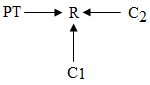
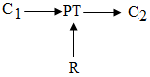
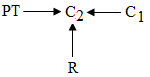
Human beings have a significant ability to maintain and moderate the respiratory rhythm to suit demands of the body. For it, we have: Respiratory rhythm centre in medulla – R. Pneumotaxic centre in pons – PT. Chemosensitive area in medulla – C Peripheral chemoreceptor in aortic arch and carotid artery – C Find out the correct representation for regulation of respiration:
-
50%
a) C2 → R → PT → C1.
-
25%
b)
-
25%
c)
-
0%
d)
Q.35.
Incidence of Emphysema – a respiratory disorder is high in cigarette smokers. In such case:
-
0%
a) The bronchioles are found damaged.
-
50%
b) The alveolar walls are found damaged.
-
0%
c) The plasma membrane is damaged.
-
50%
d) The respiratory muscles are found damaged.
Q.36.
In the alveoli, the factors favourable for the formation of oxyhaemoglobin include;
-
0%
a) Low PO2, high PCO2 and high H+ concentration.
-
60%
b) Low PO2, high PCO2 and high H+ concentration and high temperature.
-
0%
c) High PO2, low PCO2 and high H+ concentration.
-
40%
d) High PO2, low PCO2 and low H+ concentration and low temperature.
Q.37.
Blood analysis of a patient reveals an unusually high quality of carbaminohaemoglobin content. Which of the following conclusion is most likely to be correct? The patient has been inhaling polluted air containing high content of:
-
20%
a) Carbon dioxide.
-
60%
b) Carbon monoxide.
-
20%
c) Carbon disulphide.
-
0%
d) Chloroform.
Q.38.
Read the following statements carefully and find out the correct order of respiration: I. Pulmonary ventilation by which the atmospheric air is drawn in. II. Transport of gases by the blood. III. Diffusion of O2 and CO2 between blood and tissue. IV. Diffusion of gases across alveolar membrane. V. Utilisation of O2 by the cells for catabolic reactions.
-
25%
a) I, II, III, IV, V.
-
75%
b) I, IV, III, II, V.
-
0%
c) I, III, II, IV, V.
-
0%
d) I, IV, II, III, V.
Q.39.
Consider the following statements (a-d) regarding human respiration and select the correct ones out of these: (a) An increase in pulmonary volume leads to an increase in the pulmonary pressure to slightly above the atmospheric pressure. (b) A person has the ability to increase the strength of inspiration and expiration with the help of additional muscles of abdomen. (c) The overall increase in the thoracic volume causes a similar increase in pulmonary volume. (d) Deoxygenated blood present in the systemic veins show no oxygen. The correct statements are:
-
25%
a) a and d.
-
25%
b) b and d.
-
25%
c) b and c.
-
25%
d) a and c.
Q.40.
Name the disorder caused by reduced availability of oxygen to tissues:
-
0%
a) Hypoxia.
-
50%
b) Hypoventilation.
-
25%
c) Oxygen toxicity.
-
25%
d) Dyspnoea.
Q.41.
Death due to suffocation is called:
-
0%
a) Apnoea.
-
25%
b) Asphyxia.
-
50%
c) Dyspnoea.
-
25%
d) Eupnoea.
Q.42.
In humans Nasopharynx communicates with trachea through:
-
0%
a) Glottis.
-
40%
b) Epiglottis.
-
40%
c) Larynx.
-
20%
d) Nasal nares.
Q.43.
The number of lobes and alveoli seen in human lungs are:
-
25%
a) 5 lobes and 300 million alveoli.
-
0%
b) 5 lobes and 300 billion alveoli.
-
50%
c) 3 lobes and 100 million alveoli.
-
25%
d) 3 lobes and 100 billion alveoli.
Q.44.
Inspiration in cockroach is brought about by
-
33%
a) Relaxation of tergo-sternal muscles
-
33%
b) Relaxation of abdominal muscles and it is a passive process
-
33%
c) Contraction of tergo-sternal muscles
-
0%
d) Both (A) and (B)
Q.45.
Exchange of gases in birds occur
-
0%
a) First in the air sacs and then in lungs
-
33%
b) First in lungs and then in air sacs
-
0%
c) In the lungs only and not in air sacs
-
67%
d) Simultaneously in lungs and air sacs
Q.46.
Concae are present in:
-
0%
a) Bronchioles.
-
33%
b) Bronchi.
-
33%
c) larynx.
-
33%
d) Nasal chambers
Q.47.
Why skin of a man cannot act as respiratory organ?
-
33%
a) Because it is not thin
-
0%
b) Because it is dry
-
33%
c) Because it is not permeable to oxygen and carbon dioxide
-
33%
d) Because of all of these
Q.48.
Ring like cartilage of larynx is known as
-
33%
a) Cartilage of Santorini
-
0%
b) Thyroid cartilage
-
67%
c) Arytenoid cartilage
-
0%
d) Cricoid cartilage
Q.49.
The terminal bronchiole is lined by
-
0%
a) Stratified epithelium
-
0%
b) Simple Squamous epithelium
-
33%
c) Ciliated columnar or cuboidal epithelium
-
67%
d) Pseudostratified epithelium
Q.50.
With which of the following ribs move outwards during respiration?
-
0%
a) Petrohyal muscles
-
50%
b) Intercostal muscles
-
25%
c) Pharyngeal muscles
-
25%
d) None of these