Q.1.
Weakest acid among the following is .... [ Punjab CET 1996]
-
43%
a) Acetic acid
-
43%
b) Phenol
-
14%
c) Water
-
0%
d) Acetylene
Q.2.
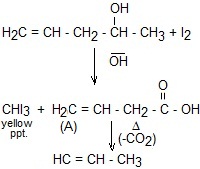
An organic liquid has an empirical formula C5H10O. This liquid gives pale yellow precipitate on warming with iodine in alkaline KI solution. The resulting slat upon acidification gives an acid which easily undergoes decarboxylation on mild heatig. The structural formula of the organic liquid could be ... ... [ DEC 2007]
-
17%
a) H3CCH2CH2CH2CHO
-
50%
b) CH3CH2CH2OCH = CH2
-
0%
c) CH3COCH2CH2CH3
-
33%
d) H2C = CH - CH2 - CH(OH) - CH3
Explanation
Q.3.
Which one of the following orders of acid strength is correct?
-
40%
a) RCOOH > HC ≡ CH > HOH > ROH
-
20%
b) RCOOH > ROH > HOH > HC ≡ CH
-
40%
c) RCOOH > HOH > ROH > HC ≡ CH
-
0%
d) RCOOH > HOH > HC ≡ CH > ROH
Q.4.
Lactic acid on oxidation with Fenton's reagent gives main product
-
50%
a) H2C2O4
-
17%
b) CH3COCOOH
-
17%
c) CH3COOH
-
17%
d) none of these
Explanation

Q.5.
Among the following acids which has the lowest pKa value? ... [ AIEEE 2005]
-
25%
a) CH3COOH
-
25%
b) HCOOH
-
25%
c) (CH3)2CH-COOH
-
25%
d) CH3CH2COOH
Q.6.
Toluene can be oxidised to benzoic acid by
-
25%
a) K2CR2O7 (acidic)
-
0%
b) KMnO4 (alk.)
-
75%
c) Both a and b
-
0%
d) None
Q.7.
Which of the following reactions gives violet colur with neutral ferric chloride?
-
25%
a) Benzoic acid
-
50%
b) Salicylic acid
-
0%
c) Acetic acid
-
25%
d) Formic acid
Q.8.
Benzoic acid gives benzene on being heated with X and phenol gives benzene on being heated with Y. Therefore X and Y are respectively
-
50%
a) Sodalime and zinc dust
-
50%
b) Zinc dust and sodium hydroxide
-
0%
c) Sodalime and copper
-
0%
d) Zinc dust and sodalime
Q.9.
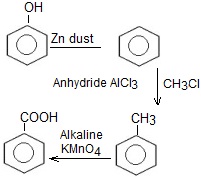
on Q100) What is Z in the following sequence of reactions?

-
33%
a) Toluene
-
67%
b) Benzaldehyde
-
0%
c) Benzene
-
0%
d) Benzoic acid
Explanation
Q.10.
The term carboxylic is a contraction of two terms
-
50%
a) carboxyl and hydroxyl
-
0%
b) hydroxyl and carboxyl
-
25%
c) carbonyl and amine
-
25%
d) carbonyl and hydroxyl
Q.11.
on Q102) Y in the above reactions is ... ..[ IIT 1996]

-
0%
a) Lactic acid
-
67%
b) Alanine
-
33%
c) Ethylamine
-
0%
d) Propyl amine
Q.12.
Which of the following compounds will brisk effervescences of CO2 on treatment with NaHCO3
-
25%
a) Acetic acid
-
25%
b) Phenol
-
50%
c) both a and b
-
0%
d) none
Q.13.
Which of the following cannot reduce Fehling's solution?
-
20%
a) H3CCHO
-
40%
b) H3CCOOH
-
40%
c) HCOOH
-
0%
d) HCHO
Q.14.
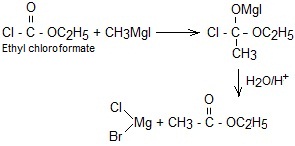
Ethyl acetate is obtained when methyl magnesium iodide reacts with ... [ Tamil Nadu CET 2002]
-
50%
a) Acetyl chloride
-
0%
b) Carbon dioxide
-
50%
c) Ethyl formate
-
0%
d) Ethyl chloroformate
Explanation
Q.15.
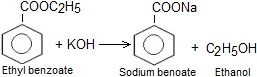
Saponification of ethyl benzoate with caustic soda as alkali gives
-
0%
a) Phenol, ethanoic acid
-
50%
b) Sodium benzoate, ethanol
-
25%
c) Benzyl alcohol, ethanoic acid
-
25%
d) Benzoic acid, sodium ethoxide
Explanation
Q.16.
Electrolysis of aqueous solution of CH3COOK gives
-
0%
a) C2H2
-
80%
b) C2H4
-
20%
c) CH4
-
0%
d) C2H6
Q.17.
The reaction of HCOOH with conc. H2SO4 gives
-
0%
a) CO
-
33%
b) CO2
-
67%
c) oxalic acid
-
0%
d) acetic acid
Q.18.
Carboxylic acids are more acidic than phenol and alcohol because of .... [ Tamil nadu CET 2001]
-
25%
a) Intermolecular hydrogen bonding
-
25%
b) Formation of dimers
-
25%
c) Highly acidic hydrogen
-
25%
d) Resonance stabilization of their conjugate base
Explanation

Q.19.
Dimerisation in carboxylic acid is due to ..... [ karnataka CET 2002]
-
0%
a) Ionic bond
-
0%
b) Covalent bond
-
0%
c) Coordinate bond
-
100%
d) Intermolecular hydrogen bond
Q.20.
Assertion : Nitrobenzoic acid is more acidic than benzoic acid. Reason : Presence of electron repelling group decreases the acidic character in molecule
-
0%
a) Both Assertion and Reason are true and Reason is the correct explanation of Assertion
-
33%
b) The Assertion and Reason are true but Reason is not correct explanation of Assertion
-
67%
c) Assertion is true but, Reason is false
-
0%
d) Assertion is false but, Reason is true
Q.21.
Which one is polyprotic acid?
-
50%
a) Benzoic acid
-
50%
b) Salicylic acid
-
0%
c) Acetic acid
-
0%
d) Oxalic acid
Q.22.
When salicylic acid is treated with acetic anhydride we get ... ...[ DEC 2002]
-
0%
a) Salol
-
0%
b) Paracetamol
-
50%
c) Aspirin
-
50%
d) none of these
Q.23.
Reaction of acetic anhydride with PCl5 gives
-
0%
a) Acetic acid
-
0%
b) Acetaldehyde
-
50%
c) Acetyl chloride
-
50%
d) None
Q.24.
Ammonium formate on heating yields
-
0%
a) ammonia
-
0%
b) formamide
-
50%
c) ethyl amine
-
50%
d) acetamide
Q.25.
Which reagent will bring about the conversion of carboxylic acid into ester
-
0%
a) C2H5OH
-
0%
b) LiAlH4
-
75%
c) Al(OC2H5)3
-
25%
d) Dry HCl + C2H5OH
Q.26.
Which of the following compounds in amphoteric in nature? [ IIT 1993]
-
0%
a) CH3CONH2
-
33%
b) CH3COOC2H5
-
33%
c) (CH3CO)2O
-
33%
d) CH3COCl
Q.27.
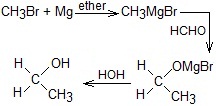
on Q118) Consider the following reaction compound C is

-
0%
a) formic acid
-
33%
b) acetic acid
-
33%
c) acetaldehyde
-
33%
d) ethyl alcohol
Explanation
Q.28.
Acetic acid reacts with chlorine in the presence of catalyst anhydrous FeCl3 to give
-
0%
a) Chloral hydrate
-
0%
b) Acetyl chloride
-
50%
c) Methyl chloride
-
50%
d) Trichloro acetic acid
Q.29.
The conversion of CH3OH into CH3COOH can be brought about by the following reagents
-
0%
a) KMnO4
-
0%
b) CO + Rh
-
100%
c) K2Cr2O7 / H+
-
0%
d) H3PO4
Explanation

Q.30.
In preparation of an ester the commonly used dehydrating agent is ... .. [ KCET 1992]
-
0%
a) phosphorus pentoxide
-
0%
b) anhydrous calcium chloride
-
67%
c) anhydrous aluminium chloride
-
33%
d) concentrated sulphuric acid