Q.1.
Two moles of acetic acid are heated with P2Othe product formed is ... .[ Punjab CET 1991]
-
67%
a) 2 moles of ethyl alcohol
-
22%
b) Formic anhydride
-
11%
c) acetic anhydride
-
0%
d) 2 mole of methyl cyanide
Explanation

Q.2.
The correct order of increasing acid stregth of the compounds ... ..[ IIT 2006] (A) CH3CO2H (B) MeOCH2CO2H (B) CF3CO2H (D) (Me)2 - CO2H
-
17%
a) B < D < A < C
-
67%
b) D < A < C < B
-
17%
c) D < A < B < C
-
0%
d) A < D < C < B
Q.3.
A new carbon-carbon bond is formed in .... ... [ IIT 1998]
-
57%
a) Cannizzaro's reaction
-
0%
b) Friedel-Crafts reaction
-
29%
c) Clemmensen reduction
-
14%
d) none of the above
Q.4.
From the following values of dissociation constant of four acids which value represents the strongest acid??
-
33%
a) 2 × 10⁻²
-
33%
b) 0.02 ×10⁻¹
-
17%
c) 3 × 10⁻⁴
-
17%
d) 2 × 10⁻⁴
Q.5.
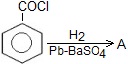
on Q126) Consider the following reaction The product 'A' is
-
25%
a) C6H5OH
-
38%
b) C6H5Cl
-
38%
c) C6H5CHO
-
0%
d) C6H5COCH3
Q.6.
X is heated with sodalime and gives ethane. X is
-
33%
a) Methanoic acid
-
33%
b) Ethanoic acid
-
17%
c) Propanoic acid
-
17%
d) Either a and b
Q.7.
A liquid was mixed with ethanol and a drop of concentrated H2SO4 was added. A compound with a fruity smell was formed. The liquid was ... ...[ AIEEE 2009]
-
0%
a) CH3OH
-
33%
b) HCHO
-
50%
c) CH3COCH3
-
17%
d) CH3COOH
Q.8.
Acetic acid is obtained when
-
33%
a) Methyl alcohol is oxidised with potassium permanganate
-
0%
b) Calcium acetate is distilled in the presence of calcium formate
-
33%
c) Glycerol is heated with sulphuric acid
-
33%
d) Acetaldehyde is oxidised with potassium dichromate and sulphuric acid
Explanation

Q.9.
In a reaction involving ring substitution of C6H5Y, the major product is meta isomer. The group Y can be
-
29%
a) -Cl
-
29%
b) - COOH
-
43%
c) -NH2
-
0%
d) -CH3
Q.10.
In presence of posphorus catalyst, chlorine reacts with acetic acid to form
-
60%
a) CH3CCl2OH
-
20%
b) CH3COCl
-
0%
c) ClCH2COOH
-
20%
d) CH3COOH
Q.11.
Which of the following acids on heating loses a molecule of H2O to form an α, β-unsaturated acid? ... ...[ IIT 1997]
-
0%
a) CH3CHOOHCOOH
-
0%
b) HOCH2COOH
-
100%
c) CH3CHOHCH2COOH
-
0%
d) HOCH2CH2CH2COOH
Explanation

Q.12.
Vinegar obtained from sugarcane is
-
33%
a) HCOOH
-
33%
b) CH3COOH
-
33%
c) CH3CH2COOH
-
0%
d) C6H5COOH
Q.13.
Melting points are normally the higest for
-
20%
a) Primary amides
-
20%
b) Amines
-
40%
c) Secondary
-
20%
d) Tertiary amides
Q.14.
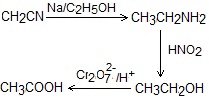
on Q135) Identify the product C in the series ... ...[ MPCET 1999 ]

-
0%
a) CH3CHO
-
60%
b) CH3CH2NHOH
-
40%
c) CH3COOH
-
0%
d) CH3CONH2
Explanation
Q.15.
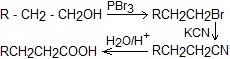
R-CH2-CH2OH can be converted in R-CH2CH2COOH. The correct sequence of reacgent is
-
17%
a) PBr3, KCN, H+
-
50%
b) PBr3, KCN, H2
-
17%
c) KCN, H+
-
17%
d) HCN, PBr3, H+
Explanation
Q.16.
Ethyl alcohol reacts with acetyl chloride to form
-
17%
a) Ethyl chloride
-
17%
b) Acetic acid
-
33%
c) Methyl acetate
-
33%
d) Ethyl acetate
Q.17.
A distinctive and chracteristic functional group in fat is
-
60%
a) ester group
-
0%
b) basic group
-
40%
c) keto group
-
0%
d) none of these
Q.18.
Acetic anhydride is obtained from acetyl chloride by the reaction of
-
0%
a) H2SO4
-
20%
b) CH3COCH3
-
0%
c) P2O5
-
80%
d) CH3COONa
Q.19.
Which of the following compounds on boiling with KMnO4 (alk.) and subsequent acidification will not give benzoic acid? .... [ KCET 2002]
-
25%
a) Benzyl alcohol
-
25%
b) Acetophenone
-
50%
c) Anisole
-
0%
d) Toluene
Q.20.
ion :Acetate ion is more basic than formate ion Reason : The +IE methyl group in acetate ion intensifies electron density on oxygen atom
-
40%
a) Both Assertion and Reason are true and Reason is the correct explanation of Assertion
-
60%
b) The Assertion and Reason are true but Reason is not correct explanation of Assertion
-
0%
c) Assertion is true but, Reason is false
-
0%
d) Assertion is false but, Reason is true
Q.21.
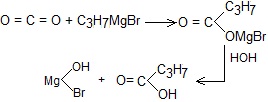
The acid formed when propyl magnesium bromide is treated with CO2is
-
20%
a) C3H7COOH
-
0%
b) C2H5COOH
-
40%
c) both a and b
-
40%
d) none of these
Explanation
Q.22.
Ethylalcohol on oxidation with K2Cr2O7 gives
-
20%
a) Acetic acid
-
0%
b) Formic acid
-
20%
c) Formaldehyde
-
60%
d) Acetaldehyde
Q.23.
What will happen if LiAlH4 is added to an ester?
-
0%
a) Two units of alcohol are obtained
-
0%
b) Two units of acid are obtained
-
80%
c) One unit of alcohol and one unit of acid is obtained
-
20%
d) none of these
Explanation

Q.24.
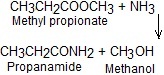
Which will not give acetamide on reaction with ammonia?
-
29%
a) Acetic acid
-
0%
b) Methyl propionate
-
29%
c) Acetyl chloride
-
43%
d) Acetic anhydride
Explanation
Q.25.
If acetyl chloride is reduced in the presence of BaSO4 and Pd
-
0%
a) CH3CH2OH is formed
-
40%
b) CH3COCH3 is formed
-
20%
c) CH3CHO is formed
-
40%
d) CH3COOH is formed
Explanation

Q.26.
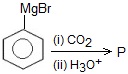
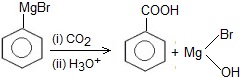
on Q147) In the above reaction, product P is
-
0%
a)

-
80%
b) C6H5 - CO - C6H5

-
20%
c)

-
0%
d)
Explanation
Q.27.
Formic acid cannot be halogenated with chlorine in presence of red P, but acetic acid can be halogenated in the same way, because
-
60%
a) formic acid has no α-H-atom in its molecule
-
0%
b) formic acid is weaker than acetic acid
-
20%
c) both a and b
-
20%
d) none of the above
Q.28.
Identify the correct order of boiling points of the following compounds I. CH3CH2CH2CH2OH II. CH3CJ2CH2CHO III. CH3CH2CH2COOH
-
0%
a) I > II > III
-
75%
b) III > I > II
-
0%
c) I > III > II
-
25%
d) III > II > I
Q.29.
Acid present in tomatoes is
-
25%
a) Oxalic acid
-
25%
b) tartaric acid
-
0%
c) Lactic acid
-
50%
d) Citric acid
Q.30.
on Q151) In the reaction the intermediate 'X' is

-
40%
a) benzoic acid
-
20%
b) o-xylene
-
20%
c) phthalic anhydride
-
20%
d) phthalic acid
Explanation
