Q.1.
The equilibrium constant for reversible reaction N2 + 3H2 ⇔ 2NH3 is K and for the reaction ½ N2 + (3/2)H2 ⇔ NH3 The equilibrium constant is K'. K and K' will be related as [ MP CET 1998]
-
20%
a) K=K'
-
60%
b) K'=√(K)
-
13%
c)K=√(K')
-
7%
d)K × K'=1
Q.2.
Which oxide of nitrogen is most stable at 273 K ?
-
23%
a)

-
15%
b)

-
31%
c)

-
31%
d)

Q.3.
The equilibrium constant for reaction SO3 → SO2 + ½O2 is Kc=4.9 × 10-the value of Kc for the reaction 2SO2 + O2 → 2SO3 will be [ AIEEE 2006]
-
17%
a) 416
-
42%
b) 2.4 × 10⁻³
-
33%
c) 9.8 × 10⁻²
-
8%
d) 4.9× 10⁻²
Explanation
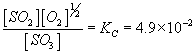
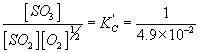
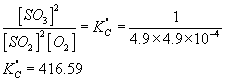
Q.4.
the equilibrium constant Kp for the reaction PCl5 ↔ PCl3 + Cl2 is 16 If the volume of the container is reduced to half of its original volume, the value of Kp for the reaction at the same temperature will be
-
15%
a)32
-
31%
b) 64
-
54%
c)16
-
0%
d)4
Q.5.
For a reaction N2 + 3 H2 → 2NH3; °H=-22 kcal. If energy of activation for this reaction is 70 kcal, the energy of activation for backward reaction is
-
33%
a) 70 kcal
-
33%
b) 92 kcal
-
17%
c)48 kcal
-
17%
d)None of these
Q.6.
the value of reaction quotient before any reaction occurs is
-
18%
a) ∞
-
0%
b) -1
-
64%
c)0
-
18%
d)1
Q.7.
Consider the following equilibrium in closed container N2O4 ⇔ 2NO2 . At a fixed temperature, the volume of the reaction container is halved. For this change, which of the following statement holds true regarding the equilibrium constant (Kp) and degree of dissociation ( α) [ IIT 2002]
-
44%
a) Neither Kp nor α changes
-
0%
b) Both Kp nor α changes
-
22%
c) Kp changes but α does not change
-
33%
d) Kp does not change but α changes
Q.8.
For reaction Co + K2O ⇔ Co2 + H2 at given temperature, the equilibrium amount of CO2 can be increased by [ IIT 1998]
-
0%
a)Adding a suitable catalyst
-
33%
b) Adding an inert gas
-
22%
c)Decreasing the volume of the container
-
44%
d)Increasing the amount of CO
Q.9.
The yields of NH3 in the reaction N2 + 3H2 ↔ 2NH3 ; ΔH=-22.08 kcal is affected by [ Pb CET 1997]
-
22%
a) Change in pressure and temperature
-
22%
b) Change in temperature and concentration of H2
-
11%
c)Change in pressure and concentration of N2
-
44%
d)Change in pressure, temperature and concentration of N2
Q.10.
If 1.0 mole of I2 is introduced into 1.0 litre flask at 1000K which leads to dissociation, at equilibrium, ( Kc=10-6), which one is correct?
-
22%
a) [ I2(g)] > I-]
-
44%
b) [ I2(g)] < I-]
-
22%
c) [ I2(g)]=I-]
-
11%
d) [ I2(g)]=½ I-]
Q.11.
At constant temperature, the equilibrium constant ( Kp) for the decomposition reaction N2O4 ⇔ is expressed by Kp=4x2P/(1-x2) where P is pressure, x is extent of decomposition. Which of the following statement is true [ IIT 2001]
-
14%
a) Kp increases with increase with increase of P
-
29%
b) Kp increases with increase with increase of x
-
14%
c) Kp increases with decrease with increase of P
-
43%
d) Kp remains constant with change in P or x
Q.12.
Four species are listed below (i) HCO3- (ii) H+ (iii) HSO4- (iv) HSO3F Which one of the following is the correct sequence of their acid strength [ AIEEE 2008]
-
0%
a) iii < i < iv < ii
-
38%
b) iv < ii < iii < i
-
38%
c)ii < iii < i < iv
-
25%
d)i < iii < ii < iv
Q.13.
Among the following acids, which has the lowest pKa value?
-
0%
a) CH3COOH
-
50%
b) HCOOH
-
0%
c)(CH3)2CHOOH
-
50%
d)CH3CH2COOH
Q.14.
Which of the following bases is the weakest?
-
0%
a) C9H7N : Kb=6.3 ×10⁻¹⁰
-
25%
b) C2H5NH2 : Kb=5.6 ×10⁻⁴
-
50%
c) C6H5NH2 : Kb=3.8 ×10⁻¹⁰
-
25%
d)NH4OH : Kb=1.6 ×10⁻⁶
Q.15.
A solution which is 10-3 M each in Mn2+, Fe2+, Zn2+ and Hg2+ is treated with 10-16M sulphide ion. If Ksp of MnS, FeS, ZnS and HGS are 10-15,10-23, 10-20 and 10-54 respectively, which one will precipitate first.. [ IIT 2003]
-
14%
a) FeS
-
29%
b) MnS
-
29%
c) HgS
-
29%
d) ZnS
Q.16.
On adding 0.1M solution each of [Ag+], [Ba2+], [Ca2+] in a Na2SO4 solution, species first precipitated is [Ksp of BaSO4=10-11, Ksp of CaSO4=10-6, Ksp of Ag2SO4=10-5]
-
25%
a)Ag2SO4
-
38%
b) BaSO4
-
12%
c)CaSO4
-
25%
d)All of these
Q.17.
Precipitation takes place when the ionic product [ Roorkee 1983]
-
10%
a) Equals the solubility product
-
60%
b) Exceeds the solubility product
-
20%
c)Is less than the solubility product
-
10%
d)Is almost zero
Q.18.
At 25°C, the dissociation constant of Ch3COOH and NH4OH in aqueous solution are almost same ( 10-5). If pH of some acetic acid solution is 3.0 The pH of solution of NH4OH of same concentration at the same temperature would be [ Roorkee 1990]
-
44%
a) 3.0
-
11%
b) 4.0
-
11%
c)10.0
-
33%
d)11.0
Q.19.
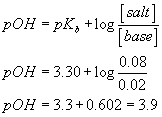
When 0.1 mol of CH3NH2 ( ionization constant,Kb=5 ×10⁻⁴) is mixed with 0.08 mol HCl and the volume is maid up toFind the [H+] of resulting solution. [ IIT 2005]
-
0%
a) 8 × 10⁻⁵
-
50%
b) 2 × 10-11
-
20%
c) 1.23 × 10⁻⁴
-
30%
d) 8 × 10-11
Explanation
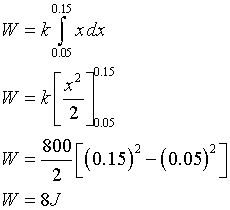
Q.20.
Species acting both as Bronsted acid and base is
-
67%
a)HSO4-
-
28%
b) Na2CO3
-
0%
c)NH3
-
6%
d)OH-
Q.21.
The pH of 0.1M aqueous solution of weak acid ( HA) isIts degree of dissociation is
-
25%
a) 1%
-
38%
b) 10%
-
38%
c)50%
-
0%
d)25%
Q.22.
An acid buffer solution can be prepared by mixing equimolar amount of ..[ IIT 1981]
-
44%
a) Formic acid and sodium formate
-
22%
b) NH4Cl and NH4OH
-
22%
c)H2SO4 and NA2SO4
-
11%
d)CH3CONH2 and KOH
Q.23.
pKa of acetic acid is 4.The concentration of CH3COONa is 0.01 M. The pH of CH3COONa ia [ Orissa JEE 2004]
-
0%
a) 8.37
-
14%
b) 4.37
-
71%
c) 4.74
-
14%
d) 0.474
Q.24.
In a saturated solution of the sparingly soluble strong electrolyte AgIO3 molecular mass=283, the equilibrium which sets in is AgIO3 ⇔ Ag+ + IO3- If the solubility product constant Ksp of AgIO3 at given temperature is 1.0 ×10⁻⁸, what is the mass of AgIO3 contained in 100 ml of its saturated solution [ AIEEE 2007]
-
29%
a)1.0 ×10⁻⁴ g
-
29%
b) 28.3 ×10⁻² g
-
43%
c)2.83 ×10⁻³ g
-
0%
d)1.0 ×10⁻⁷ g
Q.25.
Which of the following salts undergoes anionic hydrolysis?
-
0%
a) CuSO4
-
14%
b) Na2CO3
-
57%
c)NH4Cl
-
29%
d)FeCl3
Q.26.
At 90°C, pure water has H3O+ ion concentration of 10-6 mol/L. the Kw at 90°C is
-
29%
a) 10-12
-
29%
b) 10-14
-
43%
c)10-6
-
0%
d)10-8
Q.27.
A weak acid HX has the dissociation constant 1 × 10⁻⁵M. It forms a salt NaX on reaction with alkali. The degree of hydrolysis of 0.1M solution of NaX is
-
14%
a) 0.0001%
-
43%
b) 0.01%
-
29%
c) 0.1%
-
14%
d) 0.15%
Explanation
Q.28.
An acidic buffer solution can be prepared by mixing solution of .. [ IIT 1981]
-
29%
a)Sodium acetate and acetic acid
-
14%
b) Ammonium chloride and ammonium hydroxide
-
14%
c)Sulphuric acid and sodium sulphate
-
43%
d)Sodium chloride and sodium hydroxide
Q.29.
The value of ionic product of water at 393K is [ Tamil Nadu CET 2002]
-
0%
a) Less than 1 × 10-14
-
43%
b) Greater than 1 × 10-14
-
29%
c)Equal to 1 × 10-14
-
29%
d)Equal to 1 × 10⁻⁷
Q.30.
aht is the decreasing order of strength of the bases:

-
14%
a)

-
14%
b)

-
29%
c)

-
43%
d)

Explanation

