Q.1.
The equilibrium N2 + O2 ↔ 2NO is established in reaction vessel of 2.5L capacity. the amount of N2 and O2 taken at the start were respectively 2 moles and 4moles. Half a mole of nitrogen has been used up at equilibrium. the molar concentration of nitric oxide is [ KCET 1985]
-
25%
a) 0.2
-
50%
b) 0.4
-
25%
c)0.6
-
0%
d)0.1
Q.2.
In case of gaseous homogenous reaction, the active mass of the reactant is obtained by the expression ..[Tamil nadu CET 2002]
-
60%
a) PV/RT
-
20%
b) P/RT
-
0%
c)RT/P
-
20%
d)nRT/V
Q.3.
For the reaction 2A + B ↔ C, ΔH=+x cals, which one of the following conditions would favour the yield of C on the basis of Le Chatelier principle? [ Harayana CEET 1991]
-
60%
a) Higher pressure, higher temperature
-
0%
b) Only low temperature
-
40%
c)Higher pressure, low temperature
-
0%
d)only low pressure
Q.4.
At a certain temperature, the following reactions: NO(g) + ½O2(g) ↔ NO2() NO2(g) + NO(g) ↔ N2O3 (g) have equilibrium constant K1 and K2 respectively. The equilibrium constant for the reaction2NO(g) + ½O2(g) ↔ N2O3(g) at the same temperature would be ..[Pb CET sample paper 1993]
-
20%
a) K1 + K2
-
40%
b) K1 / K2
-
20%
c) K2 / K1
-
20%
d) K1 K2
Q.5.
The effect of increasing the pressure on the following equilibrium 2A + 3B ↔ 3 A + 2B is ...[EAMCET 1980]
-
20%
a)Forward reaction is favoured
-
20%
b) Backward reaction is favoured
-
60%
c)No effect
-
0%
d)None of above
Q.6.
In which of the following cases, does the reaction go farthest to completion? [ MLNR 1990]
-
40%
a) K=102
-
0%
b) K=10
-
60%
c)K=10-2
-
0%
d)K=1
Q.7.
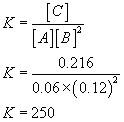
For the system A(g) + 2B(g) ↔ C(g), the equilibrium concentrations are A=0.06 mol/L, B=0.12 mol/L, C=0.216 mol/L The Keq for the reaction is ..[CPMT 1983]
-
0%
a) 250
-
50%
b) 416
-
25%
c)4 × 10⁻³
-
25%
d)125
Explanation
Q.8.
A chemical system is in equilibrium. Addition of catalyst would result in [ KCET 1993]
-
20%
a) increase in the rate of forward reaction
-
0%
b) increase in the rate of reverse reaction
-
40%
c) a new reaction path
-
40%
d) increase the amount of heat evolved in the reaction
Q.9.
The equilibrium constant in a reversible chemical reaction at a given temperature .. [ AIIMS 1982]
-
20%
a)depends on the initial concentration of the reactants
-
20%
b) depends on the concentration of one of the products at equilibrium
-
60%
c)does not depend on the initial concentration of reactants
-
0%
d)is not characteristics of the reaction
Q.10.
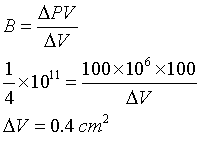
56g of N2 and 6g of H2 were kept at 400°C in 1 litre vessel. The equilibrium mixture contained 27.54g of NHthe approximate value for Ke for the above reaction in mol2/L is ...[CBSE PMT 1989]
-
50%
a) 10
-
50%
b) 20
-
0%
c)30
-
0%
d)40
Explanation
Q.11.
A and B are gaseous substances which react reversibly to give two gaseous substances C and D, accompanied by the liberation of heat. When the reaction reaches equilibrium, it is observed that Kp=Kc. the equilibrium can not be disturbed by [ KCET 1988]
-
25%
a) Adding A
-
25%
b) Adding D
-
25%
c)Increasing pressure
-
25%
d)Rising temperature
Q.12.
In the gas phase reactionC2H4 + H2 ↔ C2H6the equilibrium constant can be expressed in units of ..[CBSE PMT 1992]
-
25%
a) litre-1 mol-1
-
0%
b) mol2 litre-2
-
25%
c) litre mole-1
-
50%
d) mole litre-1
Q.13.
Pure ammonia is placed in vessel at temperature where its dissociation is appreciable. At equilibrium ..[IIT 1984]
-
25%
a)Kp does not change significantly with pressure
-
0%
b) α does not change with pressure
-
50%
c)concentration of NH3 does not change with pressure
-
25%
d)concentration of H2 is less than that of N2
Q.14.
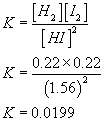
Two moles of HI were heated in a sealed tube at 440°C till the equilibrium was reached. HI was found to be 22% decomposed. the equilibrium constant for dissociation is [ AFMC 1994]
-
0%
a) 0.282
-
25%
b) 0.0796
-
75%
c)0.0199
-
0%
d)1.99
Explanation
Q.15.
For reaction at equilibrium, Le Chatelier's principle predicts the effects of ..[Bihar CEE 1992]
-
25%
a) temperature and pressure
-
25%
b) temperature and volume
-
25%
c)pressure and volume
-
25%
d)only volume
Q.16.
K1 and K2 are equilibrium constant for reaction (1) and (2)N2(g) + O2(g) ↔ 2NO(g) ...(1)NO(g) ↔ ½ N2(g) + ½O2(g) ..(2)Then .. [CBSE PMT 1989]
-
0%
a) K1=(1/K2)2
-
33%
b) K1=K22
-
33%
c) K1K2=1
-
33%
d) K1=(K2)0
Q.17.
k1 and k2 are the velocity constant of forward and backward reaction. The equilibrium constant K of the reaction is ..[KCET 1985]
-
25%
a)k1 × k2
-
0%
b) k1 - k2
-
75%
c)k1/k2
-
0%
d)none of above
Q.18.
According to Le-Chatelier's principle, adding heat to a solid and liquid in equilibrium will cause the [ MLNR 1990]
-
50%
a) temperature to increase
-
25%
b) temperature to decrease
-
25%
c)amount of liquid to decrease
-
0%
d)amount of solid to decrease
Q.19.
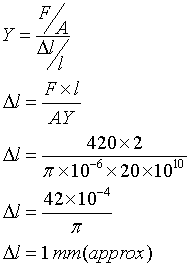
The decomposition of N2O4 to NO2 is carried out at 280°C in chloroform. When equilibrium is reached 0.2 mol of N2O4 and 2×10⁻³ mol of nO2are present in 2 litre solution. The equilibrium constant for the reaction N2O4 ↔ 2NO2 is ..[AIIMS 1984]
-
25%
a) 1 ×10⁻³
-
25%
b) 2 ×10⁻³
-
0%
c)1 ×10⁻⁵
-
50%
d)2 ×10⁻⁵
Explanation
Q.20.
A cylinder filled with a movable piston contains liquid water in equilibrium with water vapour at 25°C. Which one of the following operations results in a decrease in the equilibrium vapour pressure? [ AIIMS 1993]
-
33%
a) Moving the piston downward a short distance
-
0%
b) removing a small amount of vapour
-
67%
c) removing a small amount of the liquid water
-
0%
d) Dissolving salt in water
Q.21.
CH3COOH + C2H5OH ↔ CH3COOC2H5 + H2O In the above reaction one mole each of the acetic acid and alcohol are heated in the presence of little conc.H2SOOn equilibrium being attained [ CPMT 1985]
-
33%
a)1 mole of ethyl acetate is formed
-
0%
b) 2 moles of ethyl acetate are formed
-
67%
c)1/3 mole of ethyl acetate is formed
-
0%
d)unpredictable
Q.22.
The active mass of 64g of HI in a two litre flask would be ..[CPMT 1979]
-
0%
a) 2
-
25%
b) 1
-
25%
c)5
-
50%
d)0.25
Q.23.
In an exothermic reaction, a 10° rise in temperature will [ Bangalore PMT 1993]
-
40%
a) decrease the value of equilibrium constant
-
0%
b) double the value of Kc
-
20%
c)not produce any change in Kc
-
40%
d)produce some increase in Kc
Q.24.
For the homogeneous reaction4NH3 + 5O2 ↔ 4NO + 6H2 the equilibrium constant Kc has the units of ..[CPMT 1990]
-
0%
a) conc.+10
-
67%
b) conc.+1
-
33%
c) conc.-1
-
0%
d) It is dimension less
Explanation

Q.25.
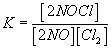
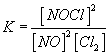
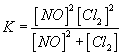
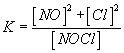
Equilibrium constant for the reaction 2NO(g) + Cl2(g) ↔ 2NOCl(g) is correctly given by the expression.. [ CPMT 1983]
-
33%
a)
-
33%
b)
-
33%
c)
-
0%
d)
Q.26.
A reaction reaches a state of chemical equilibrium only when ..[Pb CET 1989]
-
0%
a) the reactants and the products are reacting
-
25%
b) the concentrations of the reactants and the products become equal
-
25%
c)the products reacts together at the same rate at which they are formed
-
50%
d)all the reactants and the products are in the same state of matter
Q.27.
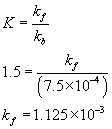
in a chemical reaction, the rate constant for the backward reaction is 7.5×10⁻⁴ and the equilibrium constant is 1.the rate constant for forward reaction is ..[KCET 1989]
-
0%
a) 5 ×10⁻⁴
-
0%
b)2 ×10⁻³
-
100%
c) 1.125 ×10⁻³
-
0%
d) 9 ×10⁻⁴
Explanation
Q.28.
Which one of the following information can be obtained on the basis of Le Chatelier principle? [ CBSE PMT 1992]
-
0%
a) Dissociation constant of weak acid
-
0%
b) Entropy change in a reaction
-
50%
c) Equilibrium constant of a chemical reaction
-
50%
d) Shift in equilibrium position on changing value of a constraint
Q.29.
The equilibrium constant , K for the reaction 2HI(g) ↔ H2(g) + I2(g) at room temperature is 2.85 and that at 698K, it is 1.4×10-This implies that : [ NCERT 1984]
-
0%
a)HI is exothermic compound
-
33%
b) HI is very stable at room temperature
-
33%
c)HI is relatively less stable than H2 and I2
-
33%
d)HI is resonance stabiles
Q.30.
At 500K, the equilibrium constant for reaction cisC2H2Cl2 ↔ transC2H2Cl2 is 0.6At the same temperature, the equilibrium constant for the reactiontransC2H2Cl2 ↔ cisC2H2Cl2
-
33%
a) 0.66
-
0%
b) 1.67
-
67%
cg)0.76
-
0%
d)2.6