Q.1.
Hormone controlling contraction of uterus during parturition is … [ CPMT 2001] Explanation provided, click on
-
8%
a) Luteinising hormone
-
15%
b) Estrogen
-
38%
c) Progesterone
-
38%
d) Oxytocin
Q.2.
Somatostatin (GIH) is secreted by … [ AFMC 1996] Explanation provided, click on
-
20%
a) Pituitary
-
20%
b) Thyroid
-
10%
c) Pineal
-
50%
d) Hypothalamus
Q.3.
Androgens are produced by …[ Manipal 2003] Explanation provided, click on
-
8%
a) Adrenal and ovaries
-
8%
b) Ovaries and testes
-
58%
c) Testes and adrenals
-
25%
d) Adrenals only
Q.4.
Assertion : Diabetes insipidus is marked by excessive urination and too much thirst of water Reason: Antidiuretic hormone (ADH) is secreted by posterior lobe pituitary … [ AIIMS 2008] Explanation provided, click on
-
40%
a) Both Assertion and Reason are true and Reason is the correct explanation of Assertion
-
30%
b) The Assertion and Reason are true but Reason is not correct explanation of Assertion
-
20%
c) Assertion is true but, Reason is false
-
10%
d) Assertion is false but, Reason is true
Q.5.
Insulin deficiency causes …[ JKCMEE 2007] Explanation provided, click on
-
25%
a) Diabetes insipidus
-
8%
b) Goiter
-
58%
c) Diabetes mellitus
-
8%
d) All the above
Q.6.
In hormone action, if receptor molecule are removed from target organ, the target organ will … [ AMU 2000] Explanation provided, click on
-
10%
a) Continue to respond to hormone
-
40%
b) Not respond to hormone
-
50%
c) Continue to respond but requires higher concentration
-
0%
d) Continue to respond but in the opposite way
Q.7.
Intermediate lobe of pituitary secretes a hormone Explanation provided, click on
-
0%
a) Oxytocin
-
18%
b) Melanocytes stimulating hormone
-
55%
c) Corticotropin releasing hormone
-
27%
d) Thyrotropin releasing hormone
Q.8.
Endocrine glands are those glands which pour their secretion directly into ... .. [ JKCMEE 2003] Explanation provided, click on
-
33%
a) Ducts
-
11%
b) Substrate
-
56%
c) Blood
-
0%
d) None of above
Q.9.
Increase in glucose level is called … [ Bih PMT 2004] Explanation provided, click on
-
12%
a) Hypoglycemia
-
25%
b) Hyposuria
-
12%
c) Hypersuria
-
50%
d) Hyperglycemia
Q.10.
Thick skin, long arms and legs are due to hyper-secretion of hormone from …[ CPMT 1997] Explanation provided, click on
-
25%
a) Thyroid
-
12%
b) Thymus
-
62%
c) Anterior pituitary
-
0%
d) Posterior pituitary
Q.11.
Removal of a part of pituitary affected excretory system. It causes …[ Manipal 2005] Explanation provided, click on
-
29%
a) Atrophy of adrenal cortex
-
14%
b) Atrophy of adrenal medulla
-
29%
c) Atrophy of adrenal pyramid
-
29%
d) Atrophy of renal medulla
Q.12.
Disease caused by hyper-or-hypo secretion of thyroxine is ..[ CPMT2003] Explanation provided, click on
-
43%
a) Cretinism
-
43%
b) Acromegaly
-
14%
c) Goiter
-
0%
d) All the above
Q.13.
Cholecystokinin and secretin are secreted by … ..[ RPMT 1996] Explanation provided, click on
-
0%
a) Stomach
-
33%
b) Liver
-
50%
c) Duodenum
-
17%
d) Ileum
Q.14.
Removal or absence of thymus in early life shall bring about Explanation provided, click on
-
0%
a) Lack of lymphocytes
-
50%
b) Lack of antibodies
-
17%
c) Lack of lymph nodes
-
33%
d) All the above
Q.15.
Hormone connected with increased rate of glycogenesis, blood pressure and heart beat is …[CPMT 1998] Explanation provided, click on
-
0%
a) Insulin
-
38%
b) Glucagon
-
62%
c) Adrenaline
-
0%
d) FSH
Q.16.
Gluconeogenesis is controlled by … …[ CPMT 1992] Explanation provided, click on
-
0%
a) Corticosterone
-
50%
b)Thyroxine
-
17%
c) Cortisol
-
33%
d) All the above
Q.17.
Extension of sympathetic nervous system is … [ Pb PMT 2003] Explanation provided, click on
-
0%
a) Adrenal medulla
-
43%
b) Adrenal cortex
-
14%
c) Pineal
-
43%
d) Neurohypophysis
Q.18.
A woman started developing male characteristics. It may be due to ... ..[ MPPMT 1991] Explanation provided, click on
-
0%
a) Overproduction of adrenal androgens
-
70%
b) Overproduction of estrogen
-
30%
c) Damage to mammary estrogen
-
0%
d) Damage to posterior pituitary
Q.19.
Secretion of ductless glands are known as .. Explanation provided, click on
-
33%
a) Hormones
-
17%
b) Pheromones
-
17%
c) Enzymes
-
33%
d) Mucoids
Q.20.
Gastrin hormone is secreted by …[ BHU 2003] Explanation provided, click on
-
14%
a) Pancreas
-
14%
b) Intestine
-
43%
c) Liver
-
29%
d) Stomach
Q.21.
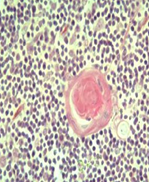
Hassall’s corpuscles are found in …[ DPMT 2005] Explanation provided, click on
-
20%
a) Thyroid
-
40%
b) Thymus
-
0%
c) Adrenal
-
40%
d) Pineal
Explanation
Q.22.
Gigantism and acromegaly are due to …[ MPPMT 2009] Explanation provided, click on
-
17%
a) Hyperthyroidism
-
50%
b) Hypopituitarism
-
17%
c) Hyperpituitarism
-
17%
d) Hypothyroidism
Q.23.
Small amount of iodine is added to common salt so that .. ..[ MPPMT 1992] Explanation provided, click on
-
17%
a) Oedema is prevented
-
17%
b) Common salt is utilised properly in the body
-
50%
c) Occurrence of goiter is prevented
-
17%
d) Kidney remains efficient in maintaining water balance
Q.24.
Match the columns Explanation provided, click on
| a)Adrenaline | 1.Myxoedema |
| b)Hyperparathyroidism | 2.Accelerates heart beat |
| c)Hypothyroidism | 3.Water balance |
| d)Hypothyroidism | 4.Child birth |
| e)Aldosterone | 5.Demineralisation |
-
0%
a) a - 2, b – 5, c – 5, d – 1, e – 3
-
40%
b) a - 5, b – 3, c - 2, d - 4, e - 1
-
60%
c) a - 3, b - 4, c - 5, d - 1, e - 2
-
0%
d) a - 2, b - 3, c - 4, d - 5, e - 1
Q.25.
Match the columns ..[ Guj CET 2010] Explanation provided, click on
| i.Posterior pituitary | a. Encourages the activity of osteoclasts |
| ii.Parathyroid | b. Encourages hydrolysis of stored food |
| iii.β-cells of pancreas | c. Encourages reabsorption of water by uriniferous tubules |
| iv.αcells of pancreas | d. Encourages synthesis of lipid and proteins and thereby prevent their utilization of energy resources |
-
20%
a) i-d, ii-c , iii-a, iv-b
-
20%
b) i-d , ii –a, iii-b, iv-c
-
60%
c) i-c, ii-a, iii –d, iv –b
-
0%
d) i-c, ii-d, iii-b, iv –a
Q.26.
Hypercalcaemia hormone is …[ HPPMT 2012] Explanation provided, click on
-
0%
a) Thyroxine
-
50%
b) Tri-iodo-thyronine
-
17%
c) Parathormone
-
33%
d) Thyrocalcitonin
Q.27.
Melanocyte stimulating hormone (MSH) is secreted by pituitary … Explanation provided, click on
-
20%
a) Anterior lobe
-
40%
b) Median lobe
-
20%
c) Posterior lobe
-
20%
d) Not any particular lobe
Q.28.
Deficiency of hormones increases K+ ion and decreases Na+ ions in blood. It is secreted by ….[ Manipal 2005] Explanation provided, click on
-
0%
a) Zona fasciculate
-
40%
b) Zona glomerata
-
20%
c) Zona reticulate
-
40%
d) Zona pellucida
Q.29.
Enteroendocrine glands are present in … Explanation provided, click on
-
0%
a) Stomach
-
0%
b) Intestine
-
60%
c) Oesophagus
-
40%
d) Both a and b
Q.30.
Match the columns Explanation provided, click on
| a. Adenohypophysis | p. Epinephrine |
| b. Adrenal medulla | q. Somatotropin |
| c. Thyroid gland | r. Thymosin |
| d. Thymus gland | s. Calcitonin |
-
40%
a) a-q, b-p, c-s, d-r
-
20%
b) a-s, b-r, c-q, d-p
-
40%
c) a-r, b-p, c-s, d-q
-
0%
d) a-p, b-q, c-q, d-s
Q.31.
Renin is produced by Explanation provided, click on
-
0%
a) Liver
-
20%
b) Spleen
-
60%
c) Juxtaglomerular cells
-
20%
d) Stomach
Q.32.
Enterogastrone is secreted by .. [ CPMT 2007] Explanation provided, click on
-
40%
a) Gastric mucosa
-
40%
b) Esophageal mucosa
-
20%
c) Saliva
-
0%
d) Duodenal mucosa
Q.33.
The hormone secreted by intermediate lobe of pituitary is ..[ Uttrakhand 2001] Explanation provided, click on
-
0%
a) Oxytocin
-
40%
b) Intermedin
-
60%
c) Vasopressin
-
0%
d) FSH
Q.34.
Hormone responsible for aggressive behaviour of an animal is …[ Pb.PMT 2002] Explanation provided, click on
-
20%
a) Adrenaline
-
20%
b) Thyroxine
-
40%
c) ADH
-
20%
d) Testosterone
Q.35.
Secretion of gastric juice is controlled by …[ CPMT 2002] Explanation provided, click on
-
0%
a) Enterogastrone
-
0%
b) Cholecystokinin
-
80%
c) Gastrin
-
20%
d) Motilin
Q.36.
Which one is endocrine? [ CPMT 2005] Explanation provided, click on
-
20%
a) Brunner’s gland
-
20%
b)Crypts of Lieberkuhn
-
20%
c) Pars radiate
-
40%
d) Juxtaglomerulus
Q.37.
Blood calcium is increased by administration of .. ..[ BHU 1994 Explanation provided, click on
-
40%
a) Glucagon
-
20%
b)Thyroxine
-
0%
c) Parathormone
-
40%
d) Calcitonin
Q.38.
Match the columns -- Explanation provided, click on
| a. Hypothalamus | p. Relaxin |
| b. Anterior pituitary | q. Estrogen |
| c. Testis | r. FSH and LH |
| d. Ovary | s. Androgens |
| - - - - | t. Gonadotropin releasing hormone |
-
40%
a) a - p,b - q,c - s,d - r
-
20%
b) a - r,b - t, c - s, d – q
-
0%
c) a - t, b - r, c - s, d - q
-
40%
d) a - r, b - t, c - s, d - q
Q.39.
The major function of corpus luteum is ... .. [ CPMT 1991] Explanation provided, click on
-
0%
a) Digestive
-
40%
b) Endocrine
-
40%
c) Nervous
-
20%
d) Excretory
Q.40.
Match the column Explanation provided, click on
| Melatonin | a. Thyroid | i. Acts on renal tubules |
| MSH | b. Adrenal | ii. Regulates blood calcium level |
| Aldosterone | c. Pituitary | iii. Maintains diurnal rhythm of our body |
| TCT | d. Pineal | iv. Acts on melanocytes |
-
25%
a) 4-a-iv, 3-d-ii, 1-b-ii, 2-c-i
-
25%
b) 1-d-iii, 2-c-iv, 3-b-I, 4-a-ii
-
25%
c) 1-b-I, 4-a-iii, 3-c-ii, 2-d-iv
-
25%
d) 2-d-ii, 1-b-I, 4-c-iv, 3-c-iii
Q.41.
Match the following ..[ Kerala 2005] Explanation provided, click on
| i. ADH | a. Pituitary |
| ii. ACTH | b)Mineralocorticoid |
| iii. Aldosterone | c)Diabetes mellitus |
| iv. Insulin | d)Diabetes insipidus |
| v. Adrenaline | e) Vasodilator |
-
40%
a) i - a, ii - d, iii - b, iv – c, v – e
-
20%
b) i – d, ii – b, iii – a, iv – c , v – e
-
0%
c) i - d, ii - a, iii - c, iv - b, v - e
-
40%
d) i - d, ii - a, iii - b, iv - c, v - e
Q.42.
Hyposecretion of growth hormone causes …[ Bih PMT 2004] Explanation provided, click on
-
20%
a) Acromegaly
-
20%
b) Cretinism
-
40%
c) Dwarfism
-
20%
d) Myxoedema
Q.43.
An endocrine gland that atrophies at the age of 14-16 years is Explanation provided, click on
-
0%
a) Thyroid
-
20%
b) Thymus
-
80%
c) Pancreas
-
0%
d) Spleen
Q.44.
Which hormone causes dilation of blood vessels, increased oxygen consumption and glucogenesis ? [ CBSE 2006] Explanation provided, click on
-
20%
a) Glucagon
-
40%
b) ACTH
-
40%
c) Insulin
-
0%
d) Adrenaline
Q.45.
Insulin is secreted by … [ CPMT 1996] Explanation provided, click on
-
0%
a) α-cells of pancreas
-
20%
b) β-cells of pancreas
-
60%
c) Spleen
-
20%
d) Mucosa of oesophagus
Q.46.
Endocrine gland that functions as biological clock and a neurosecretory transducer .. [ kerala 2006] Explanation provided, click on
-
40%
a) Adrenal gland
-
0%
b) Thyroid gland
-
60%
c) Thymus gland
-
0%
d) Pineal gland
Q.47.
Feeling tremors of an earthquake, a scared resident begins to climb down the stairs rapidly from seventh floor due to hormone …[ CBSE 2007] Explanation provided, click on
-
20%
a) Glucagon
-
40%
b) Adrenaline
-
20%
c) Gastrin
-
20%
d) Thyroxine
Q.48.
ecretion is under control of neurosecretory nerve axons in … [AIIMS 1998] Explanation provided, click on
-
0%
a) Pineal
-
80%
b) Adrenal cortex
-
20%
c) Anterior pituitary
-
0%
d) Posterior pituitary
Q.49.
Glycoproteinaceous hormone is ..[ CPMT 2004] Explanation provided, click on
-
20%
a) Erythropoietin
-
0%
b) Insulin
-
60%
c) Oxytocin
-
20%
d) Relaxin
Q.50.
Hormone responsible for the development of secondary sexual characters of female is ... ..[ MPPMT 1999 ] Explanation provided, click on
-
50%
a) Progesterone
-
33%
b) Oxytocin
-
17%
c) Estrogen
-
0%
d) Androgen