Q.1.
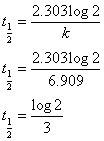
For a zero order reaction A → P t1/2 is ... (k is rate constant)[ BHU 2007]
-
70%
a)

-
13%
b)

-
9%
c)

-
8%
d)

Q.2.
The rate constant for a first order reaction is 4.606 × 10⁻³ s-The time required to reduce 2.0 g of the reactant to 0.2 g is : ... [NEET 2020]
-
46%
a) 500 s
-
23%
b) 1000 s
-
21%
c) 100 s
-
9%
d) 200 s
Q.3.
The calculated spin only magnetic moment of Cr2+ ion is .... ... [NEET 2020]
-
28%
a) 5.92 BM
-
38%
b) 2.84 BM
-
13%
c) 3.87 BM
-
21%
d) 4.90 BM
Explanation
Q.4.
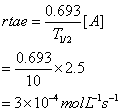
If the rate constant for a first order reaction is k, the time (t) required for the completion of 99% of the reaction is given by: .... [NEET 2019]
-
27%
a) t = 0.693/k
-
26%
b) t = 6.909/k
-
22%
c) t = 4.606/k
-
25%
d) t = 2.303/k
Q.5.
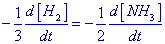
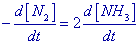
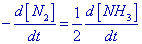
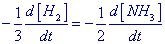
For the chemical reaction N2 (g)+ 3H2 (g) ⇋ 2NH (g) The correct option is: [2019]
-
17%
a)
-
11%
b)
-
60%
c)
-
11%
d)
Q.6.
The correct difference between first- and second-order reactions is that .... [NEET 2018]
-
10%
a) a first-order reaction can be catalyzed; a second-order reaction cannot be catalyzed
-
50%
b) the half-life of a first-order reaction does not depend on [A]0; the half-life of a second-order reaction does depend on [A]0
-
25%
c) the rate of a first-order reaction does not depend on reactant concentrations; the rate of a second-order reaction does depend on reactant concentrations
-
15%
d) the rate of a first-order reaction does depend on reactant concentrations; the rate of a second-order reaction does not depend on reactant concentrations
Q.7.
When initial concentration of the reactant is doubled, the half-life period of a zero order reaction .... [NEET 2018]
-
0%
a) is tripled
-
53%
b) is doubled
-
15%
c) is halved
-
32%
d) remains unchanged
Q.8.
What is the name given to a phenomenon in which both adsorption and absorption takes palace? [ AFMC 2003]
-
39%
a) Chemisorption
-
16%
b) Physisorption
-
16%
c) Desorption
-
29%
d) Sorption
Q.9.
Which of the following statements are true with respect to adsorption of gas on a solids? [ AFMC 2010] i)The extent of adsorption is equal to kpn according to Freundlich isotherm ii) The extent of adsorption is equal to kp1/n according to Freundlich isotherm iii) The extent of adsorption is equal to (1+bp) / ap according to Langmuir isotherm. iv) At low pressure x/m is directly proportional to the pressure
-
18%
a) (i) and (iii)
-
28%
b) (i) and (iv)
-
41%
c) (ii) and (iii)
-
13%
d) (ii) and (iv)
Q.10.
The equation for freundlich adsorption isotherm is .. [ AFMC 2007]
-
18%
a) x/m = kp1/n
-
12%
b) x = mkp1/n
-
30%
c) x/m = kpn-1
-
39%
d) all of these
Q.11.
The coagulation power of an electrolyte for As2S3 decreases in the order. [ AFMC 2011]
-
11%
a) Na+, Al3+, Ba2+
-
32%
b) Cl-, SO42-, PO43-
-
25%
c) Al3+, Ba2+, Na+
-
32%
d) PO43-, SO42-, Cl-
Q.12.
Surface water contains [ AFMC 2003]
-
40%
a) suspended impurities
-
13%
b) organic compound
-
20%
c) salt
-
27%
d) salt and organic compounds
Q.13.
The dispersed phase, dispersion medium and nature of colloidal solution ( lyophobic or lyophilic ) of 'gold sol' respectively are ..[ AMMC 2008]
-
20%
a) solid, solid, lyophobic
-
16%
b) liquid,liquid, lyophobic
-
36%
c) solid, liquid, lyophobic
-
28%
d) solid, liquid, lyophilic
Q.14.
The rate constant of a first order reaction is 6×10⁻³ s-If the initial concentration is 0.1M, the initial rate of reaction is .... [ BHU 1996]
-
23%
a) 6 ×10⁻³ Ms-1
-
54%
b) 6 ×10⁻⁴ Ms-1
-
15%
c) 6 ×10⁻⁶ Ms-1
-
8%
d) 6 ×10⁻⁸ Ms-1
Q.15.
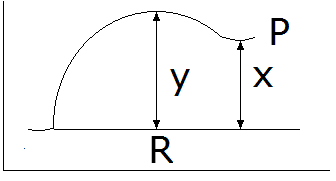
The potential energy diagram for a reaction R → P is given below ΔH of the reaction corresponds to the energy ... [ AIIMS 2003]
-
21%
a) x
-
30%
b) y
-
7%
c) z
-
42%
d) (x+y)
Q.16.
In order to react, a molecule, at the time of collision, must possess a certain amount of energy known as
-
11%
a) free energy
-
16%
b) kinetic energy
-
19%
c) internal energy
-
54%
d) threshold energy
Q.17.
In a first order reaction A → B, if k is rate constant and initial concentration of the reactant A is 0.5M then half-life is ...[ CBSE 2007]
-
16%
a)

-
3%
b)

-
30%
c)

-
51%
d)

Explanation

Q.18.
Rate of a chemical reaction can be kept constant by ...[ BHU 1993]
-
3%
a) stirring the compounds
-
39%
b) keeping the temperature constant
-
42%
c) both a and b
-
16%
d) none of the above
Q.19.
Assertion The rate of reaction sometimes does not depends on concentration Reason The order of reaction can be zero
-
53%
a) Both Assertion and Reason are true and Reason is the correct explanation of Assertion
-
31%
b) The Assertion and Reason are true but Reason is not correct explanation of Assertion
-
12%
c) Assertion is true but, Reason is false
-
3%
d) Assertion is false but, Reason is true
Q.20.
For zero order reaction ..[ EAMCET 1990]
-
53%
a) t1/2 ∝ Ro
-
31%
b) t1/2 ∝ 1/Ro
-
3%
c) t1/2 ∝ Ro2
-
14%
d) t1/2 ∝ 1/Ro2
Q.21.
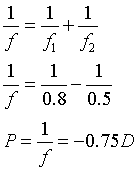
A first order reaction 2N2O(g) → 2N2(g) + O2(g) has a rate constant of 1.3×10⁻¹¹ s-1 at 270°C and 4.5×10⁻¹⁰ s-1 at 350°C. What is the activation energy for this reaction?
-
19%
a) 15 kJ
-
31%
b) 30 kJ
-
31%
c) 120 kJ
-
19%
d) 240 kJ
Explanation
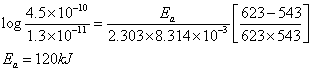
Q.22.
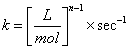
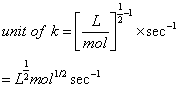
What is the unit of rate of reaction whose rate law is given as Rate = k[A]3/2[B]-1
-
18%
a) sec-1
-
41%
b) mol L-1 s-1
-
29%
c) mol1/2L-1/2s-1
-
12%
d) L1/2mol-1/2s-1
Explanation
Q.23.
Half-life of a first order reaction in 10 min. What % of reaction will be completed in 100 min? [ AFMC 2002 ]
-
9%
a) 25%
-
51%
b) 99.9%
-
23%
c) 75%
-
17%
d) 0.0975%
Q.24.
A substance reacts according to first order kinetics. the rate constant for the reaction is 1×10⁻² sec-Its initial concentration is 1M. Its initial rate is ...[ BHU 2002]
-
16%
a) 2×10² Ms-1
-
3%
b) 1×10² Ms-1
-
71%
c) 1×10⁻² Ms-1
-
10%
d) 2×10⁻² Ms-1
Q.25.
For a reaction, 2A + B → C + D, the concentration of B is kept constant and that of A is tripled the new rate of reaction will be
-
43%
a) nine times
-
34%
b) three times
-
17%
c) same
-
6%
d) zero
Q.26.
The molecularity of a reaction is ...[ AFMC 2001]
-
3%
a) always two
-
11%
b) same as its order
-
14%
c) different than the other
-
71%
d) may be same or different as compared to order
Q.27.
The rate of the reaction, 3A + 2B → Product is given by the rate expression: Rate = k[A][B]2 If A is taken in excess, the order of the reaction would be
-
26%
a) 1
-
38%
b) 2
-
21%
c) 3
-
15%
d) 5
Q.28.
For a given reaction of first order, it takes 20 minutes for the concentration to change from 1.0M to 0.6 M. The time required for the concentration to drop from 0.6M to 0.36M will be i ...
-
16%
a) more than 20 minutes
-
22%
b) less than 20 minutes
-
53%
c) equal to 20 minutes
-
9%
d) infinity
Explanation
Q.29.
The half-life period of first order reaction is 10 minutes. the time required for the concentration of the reactant to change from 0.08M to 0.02M is ...
-
15%
a) 10 min
-
52%
b) 20 min
-
15%
c) 30 min
-
18%
d) 40 min
Explanation

Q.30.
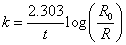
The rate constant for a first order reaction is 6.909 min-therefore, the time required in minutes for the participation of 75% of the initial concentration is
-
30%
a) (2/3)log2
-
18%
b) (2/3)log4
-
42%
c) (3/2)log2
-
9%
d) (3/2) log4
Explanation