Q.1.
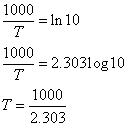
The rate constant k1 and k2 for two different reactions are 1016e-2000/T and 1015e-1000/T, respectively. The temperature at which k1 = k2 is ..[ CBSE 2008]
-
7%
a) 2000K
-
29%
b) 1000k
-
57%
c) (1000/2.303)k
-
7%
d) (2000/2.303)k
Explanation
Q.2.
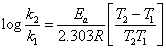
For which of the following reactions k310/k300 would be maximum?
-
8%
a) A + B → C; Ea = 50 kJ
-
8%
b) X + Y → Z; Ea = 40 kJ
-
33%
c) P + Q → R; Ea = 60 kJ
-
50%
d) E + F → G; Ea = 100 kJ
Explanation
Q.3.
For a reaction, the threshold energy is equal to
-
56%
a) activation energy + initial potential energy of reactants
-
12%
b) activation energy - initial potential energy of reactants
-
25%
c) activation energy
-
6%
d) initial potential energy of reactants
Q.4.
For which of the following reactions, the half-life is directly proportional to the initial concentration of the reactant? [ MPPMT 2006]
-
62%
a) zero order
-
25%
b) First order
-
12%
c) Second order
-
0%
d) Third order
Q.5.
Activation energy of a chemical reaction can be determined by ...[ CBSE 1997]
-
13%
a) evaluating rate constant at standard temperature
-
0%
b) evaluating velocities of reaction at two different temperature
-
67%
c) evaluating rate constants at two different temperatures
-
20%
d) changing concentration of reactants
Q.6.
Rate of gaseous reaction is given by the expression Rate = k[A][B] If the volume of reaction vessel is suddenly reduced to one fourth of initial volume, the reaction rate relating to original rate will be
-
21%
a) 1/10
-
36%
b) 1/8
-
14%
c) 8
-
29%
d) 16
Q.7.
The rate of reaction that does not involve gases, is not dependent on
-
36%
a) pressure
-
21%
b) catalyst
-
14%
c) concentration
-
29%
d) temperature
Q.8.
If the rate of the reaction is equal to the rate constant, the order of the reaction is ...[ CBSE 2003]
-
9%
a) 2
-
0%
b) 3
-
82%
c) 0
-
9%
d) 1
Q.9.
In general, with very 10°C rise in temperature, the rate of reaction becomes approximately ...
-
27%
a) ten times
-
55%
b) double
-
18%
c) half
-
0%
d) one tenth
Q.10.
Assertion The rate of reaction increases generally to 2 times for every 10°C rise temperature Reason Increase in temperature increases the collision frequency
-
56%
a) Both Assertion and Reason are true and Reason is the correct explanation of Assertion
-
44%
b) The Assertion and Reason are true but Reason is not correct explanation of Assertion
-
0%
c) Assertion is true but, Reason is false
-
0%
d) Assertion is false but, Reason is true
Q.11.
A first order reaction is 50% completed in 30 minutes at 27°C. Its rate constant is ...[ BHU 1998]
-
36%
a) 2.31 ×10⁻² min-1
-
27%
b) 3.21 ×10⁻⁵ min-1
-
9%
c) 4.75 ×10⁻² min-1
-
27%
d) 1.33 ×10⁻³ min-1
Explanation
Q.12.
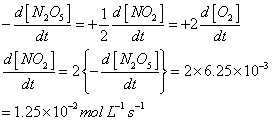
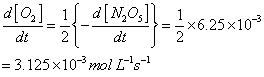
For the reaction N2O5(g) → 2NO2(g) + ½O2(g) the value of rate of disappearance of N2O5 is given as 6.25×10⁻³ mol L-1s-The rate of formation of NO2 and O2 is given respectively as ...[ CBSE 2010]
-
14%
a) 6.25×10⁻³ mol L-1 s-1 and 6.25 ×10⁻³ mol L-1 s-1
-
43%
b) 1.25×10⁻²mol L-1 s-1 and 3.125×10⁻³mol L-1 s-1
-
43%
c) 6.25×10⁻³ mol L-1 s-1 and 3.125 ×10⁻³ mol L-1 s-1
-
0%
d) 1.25×10⁻² mol L-1 s-1 and 6.25 ×10⁻³ mol L-1 s-1
Explanation
Q.13.
In a chemical reaction two reactants take part. The rate of reaction is directly proportional to the concentration of one of them and inversely proportional to the concentration of the other. the order of reaction is ...[ CPMT 2003]
-
50%
a) zero
-
10%
b) 1
-
40%
c) 2
-
0%
d) 4
Q.14.
Assertion The molecularity of the reaction, H2+Br2 → 2HBr is 2 Reason The order of this reaction is 3/2
-
30%
a) Both Assertion and Reason are true and Reason is the correct explanation of Assertion
-
40%
b) The Assertion and Reason are true but Reason is not correct explanation of Assertion
-
30%
c) Assertion is true but, Reason is false
-
0%
d) Assertion is false but, Reason is true
Q.15.
If the rate of reaction between A and B is given by rate = k[A][B]2, then the reaction is
-
0%
a) First order in A
-
20%
b) Second order in B
-
40%
c) Third order overall
-
40%
d) All are correct
Q.16.
The rate constant of first order reaction is 10-2 min-the half-life period of reaction is .... [AFMC 2001]
-
0%
a) 693 min
-
14%
b) 69.3 min
-
43%
c) 6.93 min
-
43%
d) 0.693 min
Q.17.
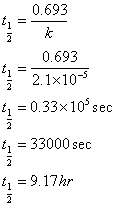
The half-life of a first order reaction having rate constant k=2.1×10⁻⁵ sec-1 is ...[ JIPMER 2006]
-
43%
a) 3.27 hr
-
29%
b) 6 hr
-
14%
c) 8.12hr
-
14%
d) 9.17hr
Explanation
Q.18.
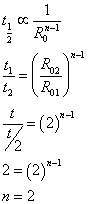
Half-life of reaction is halved as the initial concentration of the reactant is doubled. The order of reaction is
-
0%
a) 0.5
-
33%
b) 1.0
-
33%
c) 2.0
-
33%
d) 0
Explanation
Q.19.
Catalyst increases rate of reaction by ...[ CPMT 1994]
-
11%
a) decreasing equilibrium constant
-
22%
b) decreasing threshold energy
-
44%
c) decreasing activation energy
-
22%
d) none of the above
Q.20.
For a chemical reaction, A → E, it is found that rate of reaction is doubled when the concentration of A is increased four times. The order of the reaction is
-
33%
a) zero
-
11%
b) 1/2
-
11%
c) 1
-
44%
d) 2
Q.21.
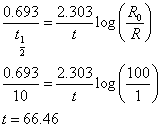
DDT on exposure to water decomposes (t1/2 = 10 years). How much time it will take for decomposition to 99% according to first order kinetics?
-
0%
a) 50 yrs
-
57%
b) 70 yrs
-
29%
c) 500 yrs
-
14%
d) 700 yrs
Explanation

Q.22.
Which of the following statements for the order of reaction is incorrect? [ CBSE 2011]
-
14%
a) Order of reaction is always whole number
-
14%
b) Order can be determined only only experimentally
-
29%
c) Order is not influenced by stoichiometric coefficient of the reactants
-
43%
d) Order of reaction is sum of power to the concentration terms of reactants to express the rate of reaction
Q.23.
A zero order reaction is one
-
17%
a) in which reactants do not react
-
33%
b) in which one of the reactants is in large excess
-
33%
c) whose rate is uniform and not affected by time
-
17%
d) whose rate increases with time
Q.24.
Positive catalyst lower the activation energy of the reaction where as heat of reaction remains same Reason Heat of reaction is equal to the difference between activation energies for forward and the backward reactions
-
33%
a) Both Assertion and Reason are true and Reason is the correct explanation of Assertion
-
67%
b) The Assertion and Reason are true but Reason is not correct explanation of Assertion
-
0%
c) Assertion is true but, Reason is false
-
0%
d) Assertion is false but, Reason is true
Q.25.
The rate at which a substance reacts depends upon its
-
17%
a) atomic mass
-
33%
b) equivalent mass
-
0%
c) molecular mass
-
50%
d) active mass
Q.26.
The reaction A → B follows first order kinetics. The time taken for 0.8 mol of A to produce 0.6mol of B is 1 hour. What is the time taken for conversion of 0.9 mol of A to produce 0.675 mol of B ..[ CBSE 2003]
-
50%
a) 0.25 hour
-
17%
b) 2 hours
-
17%
c) 1 hour
-
17%
d) 0.5 hour
Explanation
Q.27.
Number of molecules of a substance present in 1 litre volume is known as [ MPPMT 1993]
-
57%
a) molar concentration
-
29%
b) active mass
-
0%
c) activity
-
14%
d) none of the above
Q.28.
The half-life of a substance in a first order reaction is 15 minutes. the rate constant is ...[ AIIMS 2002]
-
14%
a) 2.46 ×10² min-1
-
57%
b) 4.62 ×10⁻² min-1
-
14%
c) 3 ×10⁻⁵ min-1
-
14%
d) 3×10⁻⁹ min-1
Explanation

Q.29.
Number of molecules must overcome an energy barrier is given by
-
10%
a) A
-
0%
b) k
-
60%
c) e-Ea/RT
-
30%
d) Ea
Q.30.
Identify the order of reaction whose rate constant is k=3.2×10⁻⁵L mol-1 s-1
-
43%
a) 0
-
0%
b) 1
-
57%
c) 2
-
0%
d) 3
Explanation