Q.1.
Among which of the following factor the specific reaction rate of a first order reaction depends on ...[ AFMC 2003]
-
25%
a) temperature
-
42%
b) concentration of reactant
-
33%
c) pressure
-
0%
d) volume
Q.2.
According to the law of mass action, rate of a chemical reaction is proportional to ..[ AFMC 2005]
-
0%
a) concentration of reactants
-
90%
b) molar concentration of reactants
-
10%
c) concentration of products
-
0%
d) molar concentration of products
Q.3.
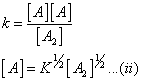
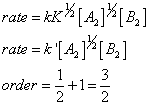
The hypothetical reaction A2 + B2 → 2AB, follows the following mechanism A2 ⇄ A +A (fast) A + B2 → AB + B (slow) A + B → AB (fast) The order of the overall reaction is ....[Pb.PMT 1991]
-
38%
a) zero
-
0%
b) 1
-
25%
c) 2
-
38%
d) 3/2
Explanation
Q.4.
If the concentration of reactants is increased by a factor (x), the rate constnat k becomes:
-
10%
a) ek/x
-
20%
b) k/x
-
30%
c) k
-
40%
d) kx
Q.5.
In a reaction, 2A2 + B2 → 2A2B, the reactant A will disappear at ...
-
10%
a) half the rate that B will decrease
-
30%
b) the same rate that B will decrease
-
30%
c) double the rate that A2B will form
-
30%
d) twice the rate that B will decrease
Q.6.
Assertion The order of the reaction CH3COOC2H5 + H2O ⇒ CH3COOH + C2H5OH is 2 Reason The molecularity of this reaction is 2
-
0%
a) Both Assertion and Reason are true and Reason is the correct explanation of Assertion
-
62%
b) The Assertion and Reason are true but Reason is not correct explanation of Assertion
-
25%
c) Assertion is true but, Reason is false
-
12%
d) Assertion is false but, Reason is true
Q.7.
The activation energy of a reaction is zero. The rate constant of the reaction
-
18%
a) increases with increase of temperature
-
9%
b) decreases with decrease of temperature
-
45%
c) decreases with increase of temperature
-
27%
d) is nearly independent of temperature
Q.8.
If the reaction rate at a given temperature become slower then
-
22%
a) the free energy of activation is higher
-
11%
b) the free energy of activation is lower
-
11%
c) the entropy changes
-
56%
d) the initial concentration of reactants remain constant
Q.9.
The rate of reaction depends upon the ...[ BHU 1998]
-
25%
a) pressure
-
12%
b) volume
-
62%
c) concentration of reactants
-
0%
d) force
Q.10.
For the reaction, 2N2O5 → 4NO2 +O2 rate of reaction is ... [ AIIMS 2006]
-
0%
a)

-
50%
b)

-
50%
c)

-
0%
d)

Q.11.
In the reaction : A + 2B → C + 2D the initial rate at t=0 was found to be 2.6×10⁻² M sec-What is the value of rate of disappearance of B at t=0 in M sec-1
-
17%
a) 2.6×10⁻² M sec-1
-
83%
b)5.2×10⁻² M sec-1
-
0%
c) 1.0×10⁻¹ M sec-1
-
0%
d) 6.5×10⁻³ M sec-1
Q.12.
Assertion The order of a reaction can have fractional value Reason The order of a reaction cannot be written from balanced equation of a reaction ...[ AIIMS 2008]
-
29%
a) Both Assertion and Reason are true and Reason is the correct explanation of Assertion
-
43%
b) The Assertion and Reason are true but Reason is not correct explanation of Assertion
-
0%
c) Assertion is true but, Reason is false
-
29%
d) Assertion is false but, Reason is true
Q.13.
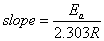
Graph between logk and (1/T) is linear of slope S. Hence Ea is...[ CBSE 2002]
-
10%
a) R ×S
-
0%
b) S/R
-
20%
c) R/S
-
70%
d) 2.303 RS
Explanation
Q.14.
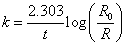
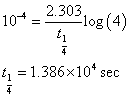
For a first order reaction k=10-4 sec-1, the time of (1/4)th life will be
-
12%
a) 0.693×10⁴ sec
-
38%
b) 1.386 ×10⁴ sec
-
38%
c) 2.303 ×10⁴ sec
-
12%
d) 0.301×10⁴ sec
Explanation
Q.15.
For the reaction, 2NO → N2 + O2, the expression represents

-
0%
a) the rate of formation of NO
-
14%
b) the average rate of the reaction
-
86%
c) the instantaneous rate of the reaction
-
0%
d) none of the above
Q.16.
The rate law for the reaction,Mbr/> RCl + NaOH(aq.) → ROH + NaCl is given by, Rate = k[RCl]. The rate of reaction will be
-
14%
a) unaffected by increasing temperature of the reaction
-
29%
b) doubled on doubling the concentration of NaOH
-
29%
c) halved on reducing the concentration of NaOH to one half
-
29%
d) halved on reducing the concentration of RCl to one half
Q.17.
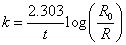
The reaction, X → Y (product) follows first order kinetics. In 40 minutes, the concentration of X changes from 0.1M to 0.025M, then the rate of reaction when concentration of X is 0.01M is
-
20%
a) 3.47 × 10⁻⁴ M/min
-
40%
b) 3.47 × 10⁻⁵ M/min
-
20%
c) 1.73 ×10⁻⁴ M/min
-
20%
d) 1.73 ×10⁻⁵ M/min
Explanation
Q.18.
tion Positive catalysts increases the rate of reaction Reason Catalysts decreases the value of ΔGo
-
0%
a) Both Assertion and Reason are true and Reason is the correct explanation of Assertion
-
40%
b) The Assertion and Reason are true but Reason is not correct explanation of Assertion
-
40%
c) Assertion is true but, Reason is false
-
20%
d) Assertion is false but, Reason is true
Q.19.
A certain zero order reaction has k=0.015 Ms-1 for the disappearance of A. What will be the concentration of A after 20 seconds if the initial concentration is 0.5M?
-
0%
a) 0.1 M
-
50%
b) 0.2 M
-
0%
c) 0.125 M
-
50%
d) 0.25 M
Q.20.
The rate constant of a reaction depends on ...[ BHU 2003]
-
0%
a) the temperature of a reaction
-
0%
b) the time of a reaction
-
25%
c) the extent of reaction
-
75%
d) the initial concentration of the reactant
Q.21.
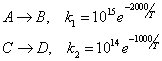
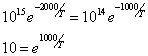
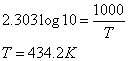
For a gaseous reaction, following data is given The temperature at which k1 = k2 is
-
40%
a) 2000 K
-
20%
b) 432.2 K
-
40%
c) 1000 K
-
0%
d) 868.82 K
Explanation

Q.22.
Which of the following rate laws has an overall order of 0.5 for the reaction involving substances x, y and z?
-
17%
a) Rate = k[Cx][Cy][Cz]
-
50%
b) Rate = k[Cx]0.5[Cy]0.5[Cz]0.5
-
17%
c) Rate = k[Cx]1.5[Cy]-1[Cz]0
-
17%
d) Rate = k[Cx][Cy]-2[Cz]0
Q.23.
The half-life of a first order reaction having rate constant k=1.7×10⁻⁵ sec-1 is ...[ JIPMER 2006]
-
0%
a) 12.1 hrs
-
57%
b) 9.7 hrs
-
43%
c) 11.3 hrs
-
0%
d) 1.8 hrs
Q.24.
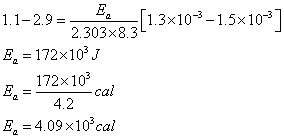
From the following data, the activation energy for the reaction (cal/mol) is
| T(K) | 1/T | log K |
| 769 | 1.3×10⁻³ | 2.9 |
| 667 | 1.5×10⁻³ | 1.1 |
-
0%
d) 3×10⁴
-
60%
a) 2 × 10⁴
-
40%
b) 2 × 10⁴
-
0%
c) 8 ×10⁴
Explanation
Q.25.
The activation energy of a reaction can be lowered by...
-
20%
a) using a positive catalyst
-
20%
b) increasing temperature
-
0%
c) decreasing temperature
-
60%
d) increasing concentration of the reactants
Q.26.
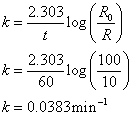
90% of the first order reaction is completed in 60 minutes. The velocity constant of the reaction is ...[ KCET 2008]
-
50%
a) 0.0383 min-1
-
17%
b) 0.383 min-1
-
33%
c) 0.0766 min-1
-
0%
d) 0.0192 min-1
Explanation
Q.27.
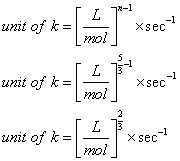
The unit of rate constant obeying the rate expression r=k[A][B]2/3 is
-
80%
a) mol-2/3 litre2/3 time-1
-
0%
b) mol2/3 litre-2/3 time-1
-
0%
c) mol-5/3 litre5/3 time-1
-
20%
d) none of these
Explanation
Q.28.
The number of molecules of the reactants taking part in a single step of the reaction tells about ...[ AMU 1992]
-
20%
a) molecularity of the reaction
-
0%
b) mechanism of the reaction
-
0%
c) order of reaction
-
80%
d) all of the above
Q.29.
75% of a first order reaction was completed in 32 min, when was 50% of the reaction completed? [ BHU 2007]
-
20%
a) 24 min
-
60%
b) 16 min
-
0%
c) 8 min
-
20%
d) 48 min
Q.30.
According to collision theory
-
0%
a) all collisions are sufficiently violent
-
0%
b) all collisions are responsible for product formation
-
20%
c) all collisions are effective
-
80%
d) only fraction of collisions are effective which have enough energy to form products