Q.1.
For N2(g) + 3 NH3(g) → 2NH3(g) +22kcl. Ea for the reaction is 70kcal. Hence, the activation energy for 2NH3)g) → N2(g) + 3H2 is
-
57%
a) 92 kcal kcl
-
29%
b) 46 kcal
-
0%
c) 184 kcal
-
14%
d) 48 kcal
Q.2.
In a reaction, A + B → Product, rate is doubled when the concentration of B is doubled and rate increases by a factor of 8 when the concentration of both the reactants (A and B) are doubled, rate law for the reaction can be written as
-
40%
a) Rate = k[A][B]2
-
20%
b) Rate = k[A]2[B]2
-
0%
c) Rate = k[A][B]
-
40%
d) Rate = k[A]2[B]
Q.3.
A drop of solution (volume 0.05 mL) contains 3×10⁻⁶ mole of H+. if the rate constant of disappearance of H+ is 107 mol litre- sec-1, how long would it take for H+ in the drop to disappear?
-
60%
a) 6×10⁻⁸ sec
-
20%
b) 6×10⁻⁹ sec
-
0%
c) 6×10⁻¹⁰ sec
-
20%
d) 6×10-12 sec
Explanation
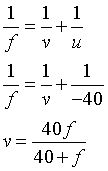
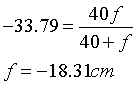
Q.4.
The rate constant of first order reaction is 3×10⁻⁶ per second. the initial concentration is 0.10M. The initial rate is ....[ AIIMS 1996]
-
40%
a) 3 ×10⁻⁷ Ms-1
-
20%
b) 3 ×10⁻⁸ Ms-1
-
20%
c) 3 ×10⁻⁵ Ms-1
-
20%
d) 6 ×10⁻⁹ Ms-1
Q.5.
Assertion In rate laws, the exponents for concentration do not necessarily match the stoichiometric coefficients Reason It is the mechanism and not the balanced chemical equation for the overall change that governs the reaction rate
-
83%
a) Both Assertion and Reason are true and Reason is the correct explanation of Assertion
-
17%
b) The Assertion and Reason are true but Reason is not correct explanation of Assertion
-
0%
c) Assertion is true but, Reason is false
-
0%
d) Assertion is false but, Reason is true
Q.6.
For a reaction A+B → C + D, if the concentration of A is doubled without altering the concentration of B, the rate gets doubled. If the concentration of B is increased by nine times without altering the concentration of A, the rate gets tripled. The order of the reaction is
-
17%
a) 1
-
17%
b) 0
-
67%
c) 3/2
-
0%
d) 2
Q.7.
The rate of reaction A + B → Product, is given by the equation, r=k[A][B]. If B is taken in large excess the order of the reaction would be :
-
29%
a) zero
-
43%
b) 1
-
14%
c) 2
-
14%
d) none of the above
Q.8.
The function of catalyst in chemical reaction is to ...[ AFMC 1995]
-
33%
a) increase the product
-
17%
b) decrease the product
-
33%
c) accelerate the rate of reaction
-
17%
d) increase the reactants
Q.9.
Ina zero order reaction for every 10°C rise of temperature, the rate is doubled. If the temperature is increased from 10°C to 100°C, the rate of reaction will become ...[ AIPMT 2012]
-
0%
a) 64 times
-
60%
b) 128 times
-
0%
c) 256 times
-
40%
d) 512 times
Explanation
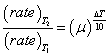
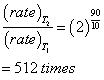
Q.10.
The rate constant is numerically the same for three reactions of first, second and third order respectively. Which one is true for the rates of the three reactions if the concentration of the reactant is greater than 1M?
-
40%
a) r1 = r2=r3
-
20%
b) r1 > r2 > r3
-
40%
c) r1 < r2 < r3
-
0%
d) all of these
Q.11.
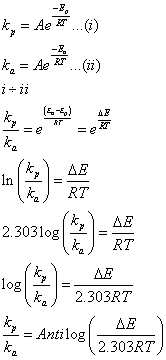
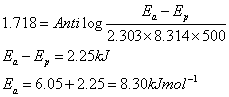
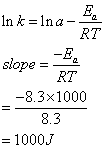
On introducing a catalyst at 500K, the rate of a first order reaction increases by 1.718 times. The activation energy in the presence of a catalyst is 6.05kJmol-the slope of the plot of lnk(sec-1) against 1/T in the absence of catalyst is ...
-
20%
a) +1
-
40%
b) -1
-
20%
c) +1000
-
20%
d) -1000
Explanation
Q.12.
The temperature coefficient of a reaction is ...
-
20%
a) ratio of rate constants at two temperatures differing by 1°C
-
20%
b) specific reaction rate at 25°C
-
20%
c) ratio of rate constants at temperature 30°C and 25°C
-
40%
d) ratio of rate constants at temperature 35°C and 25°C
Q.13.
For a chemical reaction, A → B, the rate of reaction increases by factor of 2.25 when the concentration of A is increased by 1.5 times. The order of reaction with respect to A is
-
20%
a) 1.5
-
60%
b) 2
-
20%
c) 2.5
-
0%
d) 3
Q.14.
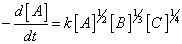
The rate of the reaction, A + B + C → Products, is given by The order of the reaction is
-
50%
a) 1/2
-
33%
b) 13/12
-
17%
c) 1
-
0%
d) 2
Q.15.
Assertion Formation of HI is a bimolecular reaction Reason Two molecules of reactants are involved in this reaction
-
60%
a) Both Assertion and Reason are true and Reason is the correct explanation of Assertion
-
40%
b) The Assertion and Reason are true but Reason is not correct explanation of Assertion
-
0%
c) Assertion is true but, Reason is false
-
0%
d) Assertion is false but, Reason is true
Q.16.
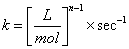
Rate constant of a reaction is 125 litre2 mol-2 sec- What is the order of reaction?
-
0%
a) First
-
50%
b) Second
-
50%
c) Third
-
0%
d) Zero
Explanation
Q.17.
In the reaction 3A → 2B, the rate of reaction of B is equal to
-
0%
a)

-
25%
b)

-
75%
c)

-
0%
d)

Q.18.
version of cane sugar is represented by C12H22O11 + H2O → C6H12O6 + C6H12O6 It is a reaction of ... [ MPPMT 1993]
-
0%
a) zero order
-
0%
b) first order
-
100%
c) pseudo-unimolecular
-
0%
d) unimolecular
Q.19.
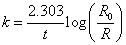
The temperature dependence of rate constant (k) of a chemical reaction is written in terms of Arrhenius equation k=Ae-Ea/RT. Activation energy (Ea) of the reaction can be calculated by plotting ...[ AIIMS 2007]
-
25%
a) log k vs T
-
50%
b) log k vs 1/T
-
25%
c) k vs T
-
0%
d) k vs 1/logT
Q.20.
In a first order reaction, the concentration of the reactant, decreases from 0.5M to 0.4M in 15 minutes. The time taken for the concentration to change from 0.1M to 0.025M is
-
20%
a) 15 min
-
60%
b) 30 min
-
20%
c) 7.5 min
-
0%
d) 60 min
Explanation
Q.21.
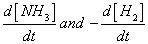
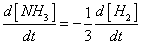
Consider the reaction, N2(g) +3 H2(g) → 2NH3(g) The equality relationship between following is [CBSE 2006]
-
25%
a)
-
50%
b)
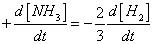
-
25%
c)
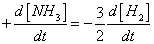
-
0%
d)
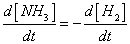
Q.22.
ssertion: Half-life of a first -order reaction is equal to 0.693/k, where 'k' is the rate constant of the reaction Reason For a first order reaction t3/4 = 2×t1/2
-
75%
a) Both Assertion and Reason are true and Reason is the correct explanation of Assertion
-
25%
b) The Assertion and Reason are true but Reason is not correct explanation of Assertion
-
0%
c) Assertion is true but, Reason is false
-
0%
d) Assertion is false but, Reason is true
Q.23.
The temperature coefficient of most of the reactions lies between
-
25%
a) 2 and 3
-
0%
b) 1 and 2
-
75%
c) 2 and 4
-
0%
d) 3 and 4
Q.24.
The rate of the reaction CCl3 - CHO + NO → CHCl3 + NO + CO is given by the equation, rate =k[CCl3CHO][NO]. If the concentration is expressed in mol L-1, the unit of k are ...[ MPPMT 1993]
-
25%
a) mol-2 L2 s-1
-
75%
b) mol L-1 s-1
-
0%
c) L mol-1 s-1
-
0%
d) sec-1
Explanation
Q.25.
ssertion The rate of chemical reaction increases as the temperature is increased Reason The collision frequency between the reactant molecules increases on increasing temperature
-
67%
a) Both Assertion and Reason are true and Reason is the correct explanation of Assertion
-
17%
b) The Assertion and Reason are true but Reason is not correct explanation of Assertion
-
0%
c) Assertion is true but, Reason is false
-
17%
d) Assertion is false but, Reason is true
Q.26.
Consider a reaction, A → B + C. If the initial concentration of A was reduced from 2M to 1M in 1 hour and from 1M to 0.25M in 2 hours, the order of the reaction is ..
-
0%
a) 0
-
75%
b) 1
-
25%
c) 2
-
0%
d) 3
Q.27.
According to Arrhenius equation, rate constant of a chemical reaction is equal to ....
-
50%
a)

-
25%
b)

-
0%
c)

-
25%
d)

Q.28.
The rate of reaction was found to be equal to its rate constant at any concentration of the reactant. The order of the reaction is ...[ AIIMS 1995]
-
67%
a) zero order
-
0%
b) first order
-
33%
c) second order
-
0%
d) third order
Q.29.
Assertion The hydrolysis of methyl acetate by dil HCl is a pseudo first order reaction Reason HCl acts as a catalyst for the hydrolysis
-
25%
a) Both Assertion and Reason are true and Reason is the correct explanation of Assertion
-
75%
b) The Assertion and Reason are true but Reason is not correct explanation of Assertion
-
0%
c) Assertion is true but, Reason is false
-
0%
d) Assertion is false but, Reason is true
Q.30.
According to collision theory of reaction ...
-
20%
a) every collision between reactant molecules leads to a chemical reaction
-
0%
b) rate of reaction is proportional to the velocity of the molecules
-
60%
c) rate of reaction is proportional to the average energy of the molecules
-
20%
d) rate of reaction is proportional to the number of collisions per second