Q.1.
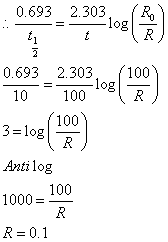
Half-life of a first order reaction is 10 min. What % of reaction will be completed in 100 min?
-
9%
a) 25%
-
36%
b) 50%
-
0%
c) 80%
-
55%
d) 99.9%
Explanation
Q.2.
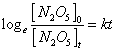
The rate constant for the reaction N2O5(g) → 2NO2(g) + ½ O2(g) is 2.3×10⁻² sec-Which equation given below describes the change of [N2O5] with time [N2O5]0 and [N2O5]t? ... [ AIIMS 2004 ]
-
57%
a) [N2O5]0 = [N2O5]tekt
-
14%
b) [N2O5]t = [N2O5]0 + kt
-
14%
c) log10[N2O5]t = log10[N2O5]0 - kt
-
14%
d)
Q.3.
3A → B + C It would be a zero order reaction when ...[ CBSE 2002]
-
25%
a) the rate of reaction is proportional to square of concentration of A
-
25%
b) the rate of reaction remains same at any concentration of A
-
12%
c) the rate remains unchanged at any concentration of B and C
-
38%
d) the rate of reaction doubles if concentration of B is increased to double
Q.4.
A substance reacts with initial concentration of a mol dm-3, according to zero order kinetics. the time it takes for the completion of reaction is : (k=rate constant, r0 initial concentration) [KCET 2006]
-
38%
a) k/R0
-
50%
b) R0/2k
-
12%
c) R0/k
-
0%
d) kR0
Q.5.
The rate of reaction depends upon .... [ BHU 2000]
-
75%
a) molar concentration
-
0%
b) atomic mass
-
12%
c) equivalent mass
-
12%
d) none of these
Q.6.
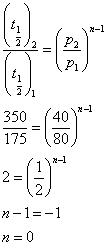
At 500K, the half-life period of a gaseous reaction at an initial pressure of 80 kPa is 350 sec. When the pressure is 40 kPa, the half-life period is 175 sec; the order of the reaction is
-
25%
a) zero
-
38%
b) one
-
12%
c) two
-
25%
d) two and half
Explanation

Q.7.
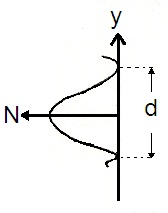
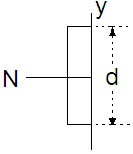
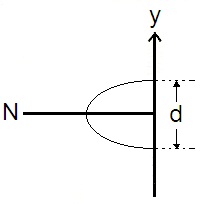
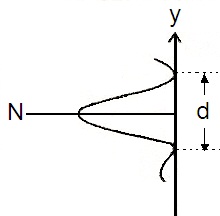
For the reaction 2A+B → 3C + D, which of the following does not express the reaction rate ...[ CBSE 2006]
-
50%
a)
-
25%
b)
-
25%
c)
-
0%
d)
Q.8.
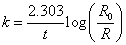
The rate constant for the hydrolysis reaction of an ester by dilute acid is 0.6931×10⁻³ s-The time required to change the concentration of eter from 0.04M to 0.01M is
-
29%
a) 6931 sec
-
14%
b) 1000 sec
-
29%
c) 4000 sec
-
29%
d) 2000 sec
Explanation
Q.9.
he rate of reaction between A and B increases by a factor of 100, when the concentration of A is increased 10 folds. The order of reaction with respect to A is ...
-
38%
a) 2
-
12%
b) 1
-
25%
c) zero
-
25%
d) 10
Q.10.
The decay constant of 6C14 is 2.31 ×10⁻⁴ year-Its half-life is ...[ BHU 2000]
-
29%
a) 2×10³ yrs
-
29%
b) 2.5×10³ yrs
-
43%
c) 3×10³ yrs
-
0%
d) 3.5×10³ yrs
Explanation
Q.11.
The activation energy of exothermic reaction A → B is 80kJmol-The heat of reaction is 200kJmol-The activation energy for the reaction B →A (in kJ/mol) will be
-
0%
a) 40
-
25%
b) 80
-
38%
c) 200
-
38%
d) 280
Q.12.
Activation energy of the reaction is ...
-
29%
a) the energy released during the reaction
-
0%
b) the energy evolved when activated complex is formed
-
43%
c) minimum amount of energy needed to overcome the potential barrier
-
29%
d) the energy needed to form one mole of the product
Q.13.
In the first order reaction, the concentration of reaction is reduced to 25% in one hour. The half life period of the reaction is ...[ AFMC 2005]
-
17%
a) 1/4 hr
-
50%
b) 1/2 hr
-
33%
c) 2 hrs
-
0%
d) 4 hrs
Q.14.
For the reaction 2N2O5 → 4NO2 + O2 rate and rate constant are 1.02×10⁻⁴ Ms-1 and 3.4×10⁻⁵ s-1 respectively then concentration of N2O5 at that time will be ...[ CBSE 2001]
-
14%
a) 17.732 M
-
57%
b) 3 M
-
14%
c) 1.02 ×10⁻⁴ M
-
14%
d) 3.4 ×10⁵ M
Q.15.
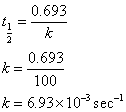
The half-life period of a first order reaction is 1 min 40 seconds. Calculate its rate constant.
-
29%
a) 6.93 × 10⁻³ min-1
-
57%
b) 6.93 × 10⁻³ sec-1
-
0%
c) 1.93× 10⁻³ sec
-
14%
d) 1.93× 10³ sec
Explanation
Q.16.
ssertion k= Ae-Ea/RT, the Arrhenius equation represents the dependence of rate constant with temperature Reason Plot of log K against 1/T is linear and the activation energy can be calculated with this plot
-
67%
a) Both Assertion and Reason are true and Reason is the correct explanation of Assertion
-
17%
b) The Assertion and Reason are true but Reason is not correct explanation of Assertion
-
17%
c) Assertion is true but, Reason is false
-
0%
d) Assertion is false but, Reason is true
Q.17.
For a chemical reaction A → B, the rate of reaction doubles when the concentration of A is increased four times. The order of reaction for A is ...[ BHU 1995]
-
20%
a) zero
-
60%
b) half
-
20%
c) one
-
0%
d) two
Q.18.
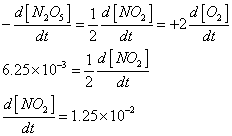
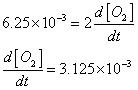
For the reaction N2O5(g) → 2NO2(g) + ½O2(g), the value of rate of disappearance of N2O5 is given as 6.25×10⁻³ mol L-1s-The rate of formation of NO2 and O2 is given retrospectively as ...[ CBSE 2010]
-
0%
a) 6.25×10⁻³ mol L-1s-1 and 6.25×10⁻³ mol L-1s-1
-
40%
b) 1.25×10⁻² mol L-1s-1 and 3.125×10⁻³ mol L-1s-1
-
40%
c) 6.25×10⁻³ mol L-1s-1 and 3.125×10⁻³ mol L-1s-1
-
20%
d) 1.25×10⁻² mol L-1s-1 and 6.25×10⁻³ mol L-1s-1
Explanation
Q.19.
Assertion Order can be different from molecularity of a reaction Reason Slow step is the rate determining step and may involve lesser number of reactants
-
29%
a) Both Assertion and Reason are true and Reason is the correct explanation of Assertion
-
71%
b) The Assertion and Reason are true but Reason is not correct explanation of Assertion
-
0%
c) Assertion is true but, Reason is false
-
0%
d) Assertion is false but, Reason is true
Q.20.
3A → 2B, rate of reaction is equals to ...[ CBSE 2002]
-
17%
a)

-
50%
b)

-
0%
c)

-
33%
d)

Q.21.
The activation energy for a simple chemical reaction A → B is Ea, in forward direction. The activation energy for reverse reaction ...[ CBSE 2003]
-
17%
a) can be less than or more than Ea
-
33%
b) if always double of Ea
-
33%
c) is negative of Ea
-
17%
d) is always less than Ea
Q.22.
The rate of a chemical reaction
-
20%
a) increases as the reaction proceeds
-
20%
b) decreases as the reaction proceeds
-
20%
c) may increases or decreases during the reaction
-
40%
d) remains constant as the reaction proceeds
Q.23.
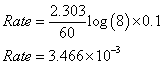
In a first order reaction A → P, the ratio of R0/R was found to be 8 after 60 minutes. If concentration is 0.1M, then the rate of reaction in moles of A reacted per minute is ...[ AIIMS 1996]
-
20%
a) 2.226×10⁻³ mol litre-1 min-1
-
60%
b) 3.466×10⁻³ mol litre-1 min-1
-
0%
c) 4.455×10⁻³ mol litre-1 min-1
-
20%
d) 5.532×10⁻³ mol litre-1 min-1
Explanation
Q.24.
The specific rate constant of a first order reaction depends on ...[ AFMC 2001]
-
0%
a) time
-
50%
b) temperature
-
0%
c) concentration of product
-
50%
d) concentration of the reactants
Q.25.
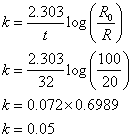
If a first order reaction takes 32 minutes for 80% completion, then time required for 50% completion is ...[ AMU 2006]
-
0%
a) 1.386 min
-
22%
b) 13.86 min
-
11%
c) 8 min
-
67%
d) 4 min
Explanation
Q.26.
For which of the following, the units of rate and rate constant of the reaction are identical?
-
40%
a) zero order
-
20%
b) first order
-
20%
c) second order
-
20%
d) third order
Q.27.
According to the collision theory of reation rates, the rate of reaction increases with temperature due to
-
40%
a) decrease in the activation energy
-
0%
b) greater number of collisions
-
20%
c) higher velocity of reacting ,molecules
-
40%
d) greater number of molecules having the activation energy
Q.28.
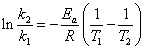
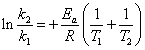
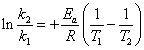
Activation energy (Ea) and rate constant (k1 and k2) of a chemical reaction at two different temperatures (T1 and T2) are related by ...[ AIPMT 2012]
-
0%
a)
-
33%
b)
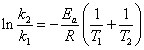
-
33%
c)
-
33%
d)
Q.29.
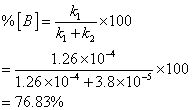
A substance undergoes first order decomposition. The decomposition follows two parallel first order reactions as, k1 = 1.26×10⁻⁴ sec-1, k2 = 3.8 ×10⁻⁵ sec-1 The percentage distribution of B and C are ...[ Kerala PMT 2004]
-
20%
a) 75% B and 25% C
-
40%
b) 80% B and 20% C
-
20%
c) 60% B nad 40% C
-
20%
d) 90% and 10% C
Explanation
Q.30.
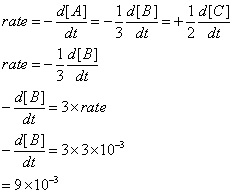
Rate of reaction for following reaction is 3×10⁻³ mol litre-1 min-What is the value of -d[B]/dt A(g) +3B(g) → 2C(g)
-
40%
a) 3×10⁻³
-
20%
b) 9×10⁻³
-
20%
c) 10-3
-
20%
d) 1.5×10⁻³
Explanation