Q.1.
Assertion If the activation energy of a reaction is zero, temperature will have no effect on the rate constant Reason Lower the activation energy, faster is the reaction
-
38%
a) Both Assertion and Reason are true and Reason is the correct explanation of Assertion
-
62%
b) The Assertion and Reason are true but Reason is not correct explanation of Assertion
-
0%
c) Assertion is true but, Reason is false
-
0%
d) Assertion is false but, Reason is true
Q.2.
The activation energy for a hypothetical reaction A → Product is 12.49 kcal/mol. If temperature is raised from 295 to 305, the rate of reaction increases by ...
-
25%
a) 20%
-
42%
b) 50%
-
8%
c) 60%
-
25%
d) 100%
Q.3.
The rate of reaction increases with rise in temperature because of ...[ Karnataka PMT 2008]
-
21%
a) increase in the number of activated molecules
-
21%
b) increase in activation energy
-
14%
c) decrease in the activation energy
-
43%
d) increase in the number of molecular collision
Q.4.
For a reaction Ea=0 and k=2.3×10⁴s-1 at 300k. the value of k at 310K would be
-
20%
a) 6.4×10⁴ s-1
-
30%
b) 2.3×10⁴s-1
-
40%
c) 3.2×10⁸s-1
-
10%
d) 3.2×10⁵s-1
Explanation

Q.5.
For the decomposition of HI at 1000K 2HI → H2 + I2, the following data were obtained The oder of the reaction is
| [HI],M | Rate of decomposition of HI(mol L-1 s-1) |
| 0.1 | 2.75×10⁻⁸ |
| 0.2 | 11×10-8 |
| 0.3 | 24.75×10⁻⁸ |
-
0%
a) 0
-
38%
b) 1
-
38%
c) 1.5
-
25%
d) 2
Q.6.
The rate of chemical reaction depends on ...[ AFMC 2002]
-
0%
a) pressure
-
0%
b) time
-
33%
c) concentration
-
67%
d) all of these
Q.7.
For an endothermic reaction, where, ΔH represents the enthalpy of the reaction in kJ/mol, the minimum value for the energy of activation will be ...
-
0%
a) less than ΔH
-
50%
b) zero
-
40%
c) more than ΔH
-
10%
d) equal to ΔH
Q.8.
Consider the following statements ...] i)increase in concentration of reactant increases the rate of a zero order relation ii)rate constant k is equal to collision frequency 'A' if Ea = 0 iii)rate constant k is equal to collision frequency 'A' if Ea = ∞ iv)logek vs T is a straight line v) loge vs 1/T is a straight line correct statement are ... [ Keranata PMT 2010]
-
25%
a) (i) and (iv)
-
38%
b) (ii) and (v)
-
25%
c) (ii) and (iii)
-
12%
d) (i) and (v)
Q.9.
The temperature dependence of rate constant (k) of a chemical reaction is written in terms of Arrhenius equation. k=A.e-Ea. Activation energyEa of the reaction can be calculated by plotting ...[ CBSE 2003]
-
75%
a) log k vs T-1

-
12%
b) k vs T

-
12%
c)
-
0%
d)
Explanation


Q.10.
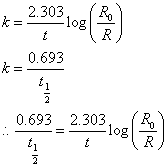
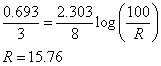
A first order reaction has half-life of 3 hrs. What percentage of the reactant will remain after 8 hrs?
-
33%
a) 118.26%
-
44%
b) 15.76%
-
22%
c) 45.5%
-
0%
d) 68.2%
Explanation
Q.11.
For reaction aA → xP, where [A] = 2.2 m-M, the rate was found to 2.4 mMs-On reducing concentration of A to half, the rate changes to 0.5 mMs-The order of reaction with respect toA is ...[ AIIMS 2005]
-
12%
a) 1.5
-
38%
b) 2.0
-
25%
c) 2.5
-
25%
d) 3.0
Q.12.
Consider the endothermic reaction X → Y with the activation energies Eb and Ef for backward and forward reactions, respectively. In general
-
25%
a) Eb < Ef
-
0%
b) Eb > Ef
-
38%
c) Eb = Ef
-
38%
d) there is no definite relation between Ef and Eb
Q.13.
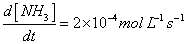
For the reaction N2(g) + 3H2(g) → 2NH3(g), if then value of

-
30%
a) 1×10⁻⁴ mol L-1 s-1
-
30%
b) 3×10⁻⁴ mol L-1 s-1
-
40%
c) 4×10⁻⁴ mol L-1 s-1
-
0%
d) 6×10⁻⁴ mol L-1 s-1