Q.1.
Diazotisation can be carried out by the action of NaNO2 and dilute HCl at ice cold temperature on ... [ KCET 1992]
-
36%
a) aromatic secondary amine
-
36%
b) aromatic primary amine
-
27%
c) aromatic nitro compound
-
0%
d) aliphatic amine
Q.2.
The reaction of chloroform with alcoholic KOH and p-toludine forms
-
33%
a)

-
11%
b)

-
11%
c)

-
44%
d)

Explanation
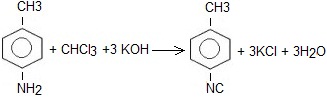
Q.3.
The reduction of which of the following compound would yield secondary amine? ...[ DEC 2004]
-
50%
a) Carbylamine
-
38%
b) Alkyl amne
-
12%
c) Secondary nitro compound
-
0%
d) Primary amine
Q.4.
A compound which on reaction with aqueous nitrous acid gives an oily nitrosoamine is [ CET Haryana) 1998]
-
12%
a) methylamine
-
0%
b) ethylamine
-
75%
c) diethylamine
-
12%
d) triethylamine
Explanation

Q.5.
Which of the following is the strongest base? [ AIEEE 2004]
-
22%
a)

-
22%
b)

-
11%
c)

-
44%
d)

Q.6.
The reagent that reacts with nitromethane to form mehylhydroxylamine is
-
38%
a) Zn/HCl
-
12%
b) Sn/HCl
-
50%
c) Zn/NH4Cl
-
0%
d) Zn/NaOH
Explanation

Q.7.
The compound that is most reactive towards electrophilic nitration is
-
0%
a) Benzene
-
50%
b) Nitrobenzene
-
50%
c) Toluene
-
0%
d) Benzoic acid
Q.8.
The correct order of increasing basic nature of the bases NH3, CH3NH and (CH3)2NH is .... [ AIEEE 2003]
-
25%
a) CH3NH2 < NH3 < (CH3)2NH
-
0%
b) (CH3)2NH < NH3 < CH3NH2
-
62%
c) NH3 < CH3NH2 < (CH3)2NH
-
12%
d) CH3NH2 < (CH3)2NH < NH3
Q.9.
An aromatic primary amine with cold nitrous acid leads to the formation of ... ...[ KCET 1993]
-
14%
a) alcohol
-
14%
b) nitrite
-
71%
c) dizonium salt
-
0%
d) benzene
Explanation

Q.10.
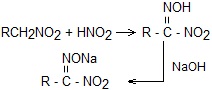
Primary nitro compounds react with nitrous acid to form nitrolic acids which dissolve in NaOH giving
-
29%
a) Colourless solution
-
29%
b) Red solution
-
14%
c) Yellow solution
-
29%
d) Blue solution
Explanation
Q.11.
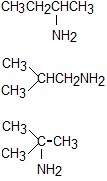
How many primary amines are possible for the formula C4H11N? [ MLNR 1995]
-
0%
a) 1
-
29%
b) 2
-
29%
c) 3
-
43%
d) 4
Explanation
Q.12.
Which of the following is not a nitro-derivative? [ DEC 2004]
-
14%
a) CH3CH2ON=O

-
14%
b) C6H4(OH)NO2
-
29%
c) C6H5NO2
-
43%
d)
Q.13.
Hydrolysis of CH3CH2NO2 with 85% H2SO4 gives
-
0%
a) CH3CH = NOH
-
33%
b) CH3COOH
-
17%
c) C2H6
-
50%
d) CH3CH2OH
Q.14.
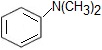
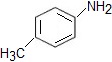
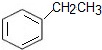
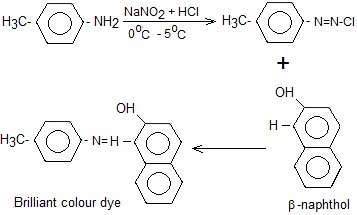
Amongst the compounds given, the one that would form a brilliant colured dye on treatment with NaNO2 in dil HCl followed by addition to an alakline solution of β-naphthol is [ HT 2011]
-
14%
a)
-
14%
b)

-
57%
c)
-
14%
d)
Explanation
Q.15.
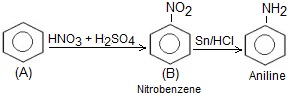
A compound A when treated with HNO3 ( in presence of H2SO4) gives compound B, which is then reduced with Sn and HCl to aniline? The compound is
-
14%
a) Acetamide
-
29%
b) Benzene
-
0%
c) Ethane
-
57%
d) Toluene
Explanation
Q.16.
Assertion: Amine are more basic than esters and ethers Reason: The intermediate carbanion is stabilized due to the presence of nitro group
-
57%
a) both the assertion and reason are true and reason explains the assertion
-
29%
b) both the assertion and reason are true but reason does not explain the assertion.
-
14%
c) assertion is true but reason is false
-
0%
d) assertion is false but reason is true.
Q.17.
Which of the following statements is not correct regarding aniline?
-
14%
a) It is soluble in water
-
29%
b) It reacts with sodium to give hydrogen
-
14%
c) It can be steam-distilled
-
43%
d) It is less basic than ethyl amine
Q.18.
ion Q46) X in the following equation is
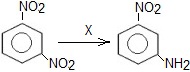
-
29%
a) Na2S
-
57%
b) Sn/HCl
-
0%
c) LiAlH4
-
14%
d) All of these
Q.19.
than one correct answers Q47) Which of the following statements is/are correct?
-
38%
a) In the case of primary, secondary and tertiary amines, the basic strength depends on the extent of hydrogen bonding in the protonated amines
-
38%
b) The presence of groups like -OCH3 anad -CH3 increases the basic strenth of amines
-
25%
c) The presence of groups like -NO2, -CN and halogens decreases the basic strength of amine
-
0%
d) The basic strength of amines depends on their concentration
Q.20.
ion Q48) The correct order of basicities of the following compounds is .... [ IIT 2001]
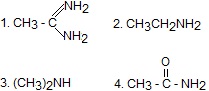
-
0%
a) 2 > 1 > 3 > 4
-
83%
b) 1 > 3 > 2 > 4
-
17%
c) 3 > 1 > 2 > 4
-
0%
d) 1 > 2 > 3 > 4
Q.21.
Among the following, the weakest base is
-
0%
a) C6H5CH2NHCH3
-
33%
b) CH3NHCHO
-
33%
c) C6H5CH2NH2
-
33%
d) O2NCH2NH2
Explanation

Q.22.
Aniline reacts with acetyl chloride gives
-
17%
a) Benzene
-
17%
b) Acetamide
-
17%
c) Phenol
-
50%
d) Acetanilide
Explanation
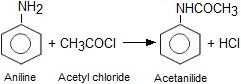
Q.23.
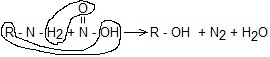
Reaction of nitrous acid with alophatic primary amine in the cold gives
-
0%
a) A dye
-
33%
b) Anitrite
-
50%
c) A dizonium salt
-
17%
d) An alcohol
Explanation
Q.24.
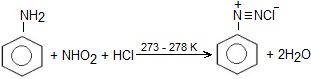
Diazonium salt id formed when nitrous acid is treated with ... [ DEC 2005]
-
33%
a) Primary aliphatic amine
-
17%
b) Secondary aliphatic amine
-
33%
c) Primary aromatic amine
-
17%
d) Secondary aromatic amine
Explanation
Q.25.
Which of the following is least basic
-
0%
a)

-
50%
b)

-
50%
c)

-
0%
d)

Q.26.
tha one correct answers Q54) Urea is
-
17%
a) aliphatic amine
-
33%
b) nitrogenous organic compound
-
17%
c) acid amine
-
33%
d) aromatic amine
Q.27.
Which one of the following is a typical example of zwitter ion?
-
0%
a) Aminophenol
-
17%
b) Acetamide
-
17%
c) Aniline
-
67%
d) Glycine
Explanation

Q.28.
ionMore than one correct answers Q56) Which is/are correct statement
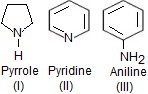
-
33%
a) I is more basic than II
-
17%
b) II is more basic than I and III
-
33%
c) III is more basic than II
-
17%
d) All are atomatic bases
Q.29.
For carbylamine reaction, we need hot alcoholic KOH and
-
17%
a) A secondary amine and trichloromethane
-
33%
b) Any primary amine and chloroform
-
17%
c) Chloroform and silver powder
-
33%
d) A primary amine and an alkyl halid
Q.30.
Acetamide is treated separately with the following reagents. Which one of these would give methyl amine?
-
33%
a) Hot conc. H2SO4
-
33%
b) Sodalime
-
33%
c) NaOH + Br2
-
0%
d) PCl5