Q.1.
Nitrobenzene is generally used for ... [ Roorkee 1991]
-
0%
a) preparing shoe polish
-
20%
b) preparing floor polish
-
20%
c) preparing aniline
-
60%
d) all of these
Q.2.
Assertion: The boiling point of nitro-alkanes is higher than their corresponding alkyl nitrites Reason: Nitro-alkanes show strong dipole-dipole interaction
-
40%
a) both the assertion and reason are true and reason explains the assertion
-
40%
b) both the assertion and reason are true but reason does not explain the assertion.
-
0%
c) assertion is true but reason is false
-
20%
d) assertion is false but reason is true.
Q.3.
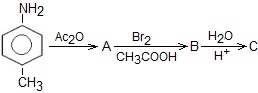
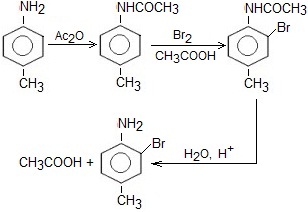
on Q155) Identify C in following reaction
-
20%
a)

-
60%
b)

-
0%
c)

-
20%
d)

Explanation
Q.4.
C3H9N cannot represent
-
0%
a) 1° amine
-
0%
b) 2° amine
-
0%
c) 3° amine
-
100%
d) quaternary salt
Q.5.
The compound that will react most readily with NaOH to form methanol is ... ..[ IIT 2001 ]
-
40%
a) (CH3)4N+I-
-
40%
b) CH3OCH3
-
0%
c) (CH3)3S+I-
-
20%
d) (CH3)3CCl
Q.6.
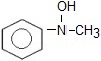
on Q158) Predict the product

-
20%
a)
-
40%
b)
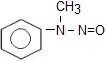
-
20%
c)
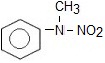
-
20%
d)
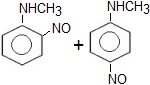
Q.7.
The reaction of aniline with acetyl chloride in presence of NaOH gives .... .. [ Roorkee 1993]
-
0%
a) acetanilide
-
40%
b) aniline hydrochloride
-
60%
c) p-chloroaniline
-
0%
d) a red dye
Q.8.
Pyridine possesses
-
40%
a) aromatic nature
-
20%
b) unsaturated aliphatic nature
-
20%
c) alicylic nature
-
20%
d) aliphatic nature
Q.9.
Mark the correct statement
-
0%
a) Methyl amine forms salts with alkalies
-
60%
b) Methyl amine is slightly acidic
-
40%
c) Methyl amine is a stronger base than ammonia
-
0%
d) Methyl amine forms salts with alkalies
Q.10.
han one correct answers Q162) Which of the following would react with nitrobenzene to produce hydrazobenzene?
-
0%
a) Na3AsO3 + NaOH
-
60%
b) Zn/NaOH, CH3OH
-
20%
c) Zn, NaOH
-
20%
d) NH2NH2 + alc. KON
Q.11.
p-chloroaniline and anilium hydrochloride can be distinguished by ... [ IIT 1998]
-
20%
a) P2O5
-
40%
b) AgNO3
-
20%
c) Carbylamine test
-
20%
d) Sandmeyer's reaction
Q.12.
Which of the following comounds gives a secondary amine on reduction? [ JIPMER 1993]
-
0%
a) Nitromethane
-
20%
b) Nitrobenzene
-
80%
c) Methyl isocyanide
-
0%
d) Methyl cyanide
Q.13.
The ideal starting material for the synthesis of m-chloronitro benzene is ... [ Roorkee 1995]
-
0%
a) benzene
-
20%
b) chlorobenzene
-
40%
c) toluene
-
40%
d) nitrobenene
Explanation
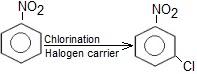
Q.14.
on Q166) Identify 'Z' in the reaction

-
20%
a)

-
40%
b)

-
40%
c)

-
0%
d)

Q.15.
Aniline on heating with conc.HNO3+ conc.H2SO4 mixture yields
-
40%
a) o- and p- Nitroanilines
-
20%
b) m-Nitroaniline
-
20%
c) A black tarry matter
-
20%
d) No reaction
Q.16.
A positive carbylamine test is given by
-
60%
a) p-methyl benzylamine
-
20%
b) 2,4-dimethylaniline
-
0%
c) N,N-dimethylaniline
-
20%
d) N-methyl-o-methylaniline
Q.17.
Which of the following reacts with NaNO2 + HCl at 273-278 K to give alcohol/phenol?
-
20%
a) C6H5NH2
-
40%
b) CH3NH2
-
20%
c) (CH3)2NH
-
20%
d) C6H5CH2NHCH3
Q.18.
Assertion: In strongly acidic solution, aniline becomes more reactive towards electrophilic reagents Reason: The amino group being completely protonated n strongly acidic solution, the lone pair of electrons on the nitrogen is no longer available gor resonance
-
40%
a) both the assertion and reason are true and reason explains the assertion
-
20%
b) both the assertion and reason are true but reason does not explain the assertion.
-
40%
c) assertion is true but reason is false
-
0%
d) assertion is false but reason is true.
Q.19.
Which one of the following methods neither means for the synthesis nor for separation of amines? [ AIEEE 2005]
-
20%
a) Hinsberg's method
-
0%
b) Hofmann's method
-
20%
c) Wurtz reaction
-
60%
d) Curtius method
Q.20.
Assertion: Benzo nitrile is prepared by the reaction of chlorobenzene with potassium cyanide Reason: Cyanide (CN-) is strong nucleophile
-
20%
a) both the assertion and reason are true and reason explains the assertion
-
80%
b) both the assertion and reason are true but reason does not explain the assertion.
-
0%
c) assertion is true but reason is false
-
0%
d) assertion is false but reason is true.
Q.21.
Which statement is not correct regarding aniline? [ MLNT 1993]
-
20%
a) It is less basic than ethyl amine
-
20%
b) It can be steam distilled
-
20%
c) It reacts with sodium to give hydrogen
-
40%
d) It is soluble in water
Q.22.
In the dizotization of arylamines with sodium nitrite and hydrochloric acid, an excess of hydrochloric acid is used primarily to
-
20%
a) Ensure a stoichiometric amount of nitrous acid
-
60%
b) Neutralise the base liberated
-
20%
c) Suppress the concentration of free aniline available for coupling
-
0%
d) Suppress hydrolysis of phenol
Q.23.
A compound Z reacts with three moles of CH3I and gives a product which on hydrolysis gives [(CH3)4N]+OH-. Compound Z is
-
0%
a) (CH3)2NH
-
40%
b) (CH3)4N+Cl-
-
20%
c) CH3NH2
-
40%
d) (CH3)3N
Explanation
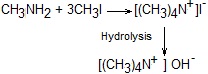
Q.24.
Nitrosobenzene on further excessive nitration gives
-
0%
a) sym-Trinitrobenzene
-
0%
b) p-Dinitrobenzene
-
60%
c) m-Dinitrobenzene
-
40%
d) All of these
Q.25.
Acetanilide on nitration followed by alkaline hydrolysis mainly gives
-
0%
b) p-Nitroaniline
-
20%
c) o-Nitroacetanilide
-
20%
a) 2,4,6-Trinitroaniline
-
60%
d) m-Nitroaniline
Explanation
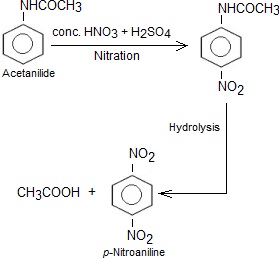
Q.26.
Among the following most basic compound is .... ..[ AIEEE 2005]
-
60%
a) benzyl amine
-
20%
b) aniline
-
0%
c) acetanilide
-
20%
d) p-nitro aniline
Q.27.
When acetamide is treated with NaOBr, the product formed is
-
0%
a) CH3OH
-
40%
b) CH3COBr
-
20%
c) CH3CN
-
40%
d) CH3NH2
Q.28.
A nitrogenous substance X is treated with HNO2 and the product so formed is further treated with NaOH solution, which produces blue colouration. X can be .... [ Roorkee 1997]
-
20%
a) CH3CH2NH2
-
20%
b) CH3CH2NO2
-
20%
c) CH3CH2ONO
-
40%
d) (CH3)2CHNO2
Explanation
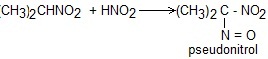
Q.29.
on Q181) R-O-N=O and are .... isomers

-
20%
a) functional
-
20%
b) chain
-
40%
c) position
-
20%
d) all of these
Q.30.
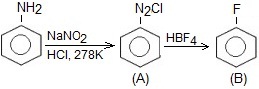
on Q182) In the following chemical reaction the compound A and B respectively are ... [ AIEEE 2010]
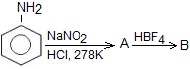
-
20%
a) nitrobenzene and chlorobenzene
-
40%
b) nitrobenzene and fluorobenzene
-
20%
c) phenol and benzene
-
20%
d) benzenediazonium chloride and fluorobenzene
Explanation