Q.1.
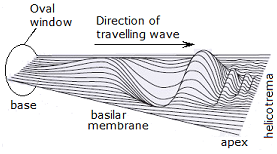
Loudness of sound is transferred to Answer : (a)
-
54%
a) Increased movement of basilar fibres of cochlea
-
27%
b) Increased vibrations of semicircular canals
-
13%
c) Vibrations of endolymphatic sac
-
6%
d) Vibrations of tympanic bulla
Explanation
Q.2.
Diencephalon is related to
-
28%
a) Pons
-
20%
b) Corpora quadrigemina
-
12%
c) Basal ganglia
-
40%
d) Hypothalamus
Q.3.
What happens if ophthalmic branch of trigeminal is cut in frog? Match the following columns and select the correct option. .... [NEET 2020]
| Column-I | Column-II |
| (a) Organ of Corti | (i) Connects middle ear and pharynx |
| (b) Cochlea | (ii) Coiled part of the labyrinth |
| (c) Eustachian tube | (iii) Attached to the oval window |
| (d) Stapes | (iv) Located on the basilar membrane |
-
23%
a) a → iv; b → ii; c → i; d → iii;
-
32%
b) a → i; b → ii; c → iv; d → iii;
-
34%
c) a → ii; b → iii; c → i; d → iv;
-
11%
d) a → iii; b → i; c → iv; d → ii;
Q.4.
Which part of the brain is responsible for thermoregulation?[NEET 2019]
-
22%
a) Cerebrum
-
39%
b) Hypothalamus
-
15%
c) Corpus callosum
-
23%
d) Medulla oblongata
Q.5.
Which of the following statements is correct? [NEET 2019]
-
43%
a) Cornea is an external, transparent and protective proteinacious covering of the eye-ball.
-
13%
b) Cornea consists of dense connective tissue of elastin and can repair itself.
-
20%
c) Cornea is convex, transparent layer which is highly vascularised.
-
24%
d) Cornea consists of dense matrix of collagen and is the most sensitive portion the eye.
Q.6.
The transparent lens in the human eye is held in its place by ... .. [NEET 2018]
-
29%
a) smooth muscles attached to the iris
-
16%
b) ligaments attached to the iris
-
17%
c) ligaments attached to the ciliary body
-
38%
d) smooth muscles attached to the ciliary body
Q.7.
Which is mismatched?
-
16%
a) Cerebrum-memory
-
61%
b) Medulla oblongata- temperature regulation
-
19%
c) Cerebellum- equilibrium
-
4%
d) Olfactory lobes- smell
Q.8.
Animals which see well during night have abundant
-
38%
a) Rods
-
17%
b) Cones
-
10%
c) Scotopic cells
-
35%
d) Night vision cells
Q.9.
A man is suffering from abnormally low body temperature, loss of appetite and extreme thirst. His brain scan is liable to show tumour in … [ KCET 2009]
-
11%
a) Pons
-
16%
b) Cerebellum
-
27%
c) Medulla oblongata
-
46%
d) Hypothalamus
Q.10.
Part of ear concerned with hearing is
-
10%
a) Reissner’s membrane and tectorial membrane
-
34%
b) Basilar membrane and tectorial membrane
-
24%
c) Reissner’s membrane and basilar membrane
-
32%
d) Ampulla
Q.11.
Vater’s corpuscles are sensitive to
-
40%
a) Pressure
-
18%
b) Smell
-
24%
c) Temperature
-
17%
d) Touch
Q.12.
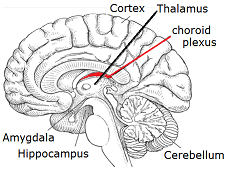
Anterior choroid plexus occurs over … [ KCET 2008]
-
26%
a) Cerebral hemisphere
-
28%
b) Floor of diencephalon
-
22%
c) Roof of medulla oblongata
-
23%
d) Roof of diencephalon
Explanation
Q.13.
Assertion. Hearing aid help the hearing impaired to hear. Reason. They make sound travel through skull bones.
-
28%
a) Both Assertion and Reason are true and Reason is the correct explanation of Assertion
-
31%
b) The Assertion and Reason are true but Reason is not correct explanation of Assertion
-
35%
c) Assertion is true but, Reason is false
-
7%
d) Assertion is false but, Reason is true
Q.14.
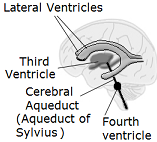
Third and fourth ventricles of brain are connected by … … [ WB 2012]
-
17%
a) Foramen of Monro
-
26%
b) Foramen magnum
-
46%
c) Corpus callosum
-
11%
d) Aqueduct of Sylvius
Explanation
Q.15.
Purely motor nerve is
-
40%
a) Optic
-
19%
b) Abducens
-
25%
c) Ophthalmic
-
16%
d) Palatinus
Q.16.
Forward stereoscopic visual field will be greatest in
-
29%
a) Cat
-
34%
b) Rabbit
-
25%
c) Deer
-
13%
d) Horse
Q.17.
Passage of action of potential from one node of Ranvier to the next is
-
36%
a) Nodal conduction
-
26%
b) Saltatory conduction
-
23%
c) Threshold stimulus
-
15%
d) Mechanical conduction
Q.18.
Eye lens is
-
14%
a) Biconcave
-
19%
b) Concave
-
44%
c) Convex
-
23%
d) Biconvex
Q.19.
The number of cranial nerves in a mammal including man is
-
10%
a) 10
-
39%
b) 12
-
34%
c) 24
-
17%
d) 36
Q.20.
A central opening of iris is
-
15%
a) Cornea
-
14%
b) Lens
-
64%
c) Pupil
-
8%
d) Fovea centralis
Q.21.
Intercellular communication in multicellular organisms occur through
-
5%
a) Digestive system
-
32%
b) Nervous system
-
59%
c) Both nervous and endocrine system
-
3%
d) Respiratory system only
Q.22.
Mark out correct and incorrect statements … [ kerala 2011] a) Synaptic cleft of neurons secrete adrenaline b) Myelinated nerve fibres are enveloped with Schwann cells that secrete myelin sheath around axon c) Non-myelinated nerve fibres are enclosed by Schwann cells that do not form myelin sheath d) Spinal cord and cranial nerves are made of non-myelinated nerve fibres
-
15%
a) a, b, c correct, d incorrect
-
23%
b) c, d correct, a and b incorrect
-
33%
c) a, b correct , c and d incorrect
-
29%
d) b, c correct, a and d incorrect
Q.23.
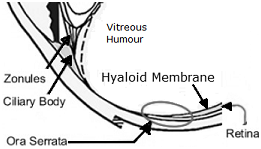
Anterior irregular wavy part of retina is
-
9%
a) Ora serrata
-
25%
b) Pars optica
-
39%
c) Ocular conjunctiva
-
28%
d) Fovea centralis
Explanation
Q.24.
In a resting neuron, the axon membrane is …. [ CBSE 2011]
-
28%
a) Impermeable to both Na+ and K ions
-
25%
b) Comparatively more permeable to Na+ and nearly impermeable to K+ ion
-
33%
c) Comparatively more permeable to K+ and nearly impermeable to Na+ ions
-
14%
d) Equally permeable to both Na+ and k+ ions
Q.25.
Lesion of ventromedial hypothalamus
-
34%
a) Decreases hunger
-
36%
b) Increases hunger
-
22%
c) Does not change hunger
-
8%
d) Stops eating
Q.26.
Pick the correct statements … a) Preganglionic nerve fibres of III and VII, IX and X cranial nerves form part of parasympathetic nervous system b) V, VII, IX and X cranial nerves are mixed nerves c) Trochlear nerves are largest cranial nerves d) Abducens nerves are motor and originate from gasserian ganglion … [ EAMCET 2008]
-
27%
a) a, d
-
41%
b) b, c
-
23%
c) a, b
-
9%
d) a, c
Q.27.
Which prevent internal reflection of light in eye
-
16%
a) Choroid
-
48%
b) Cornea
-
17%
c) Sclera
-
19%
d) Ciliary body
Q.28.
Gaps in myelin sheath are called …. [ kerala 2008]
-
26%
a) Synaptic cleft
-
48%
b) Nodes of Ranvier
-
16%
c) Schwann cells
-
9%
d)Synaptic knob
Q.29.
Ventricles of brain are filled with a fluid called … ..[ MHTCET 2009]
-
8%
a) Lymph
-
13%
b) Endolymph
-
11%
c) Plasma
-
68%
d) Cerebrospinal fluid
Q.30.
Iter is present between … ..[ Wardha 2011]
-
13%
a) Two cerebral hemispheres
-
32%
b) Cerebrum and diencephalon
-
37%
c) Diencephalon and medulla oblongata
-
17%
d) Medulla oblongata and spinal cord
Q.31.
An animal having more rods will be .....
-
71%
a) More active at night
-
16%
b) More active during day
-
4%
c) More active during dusk
-
10%
d) Having color vision.
Q.32.
In mammals, the organs of corti is found in
-
21%
a) Scala vestibule
-
31%
b) Scala tympani
-
31%
c) Scala media
-
16%
d) Cochlear canal
Q.33.
Diencephalon is the centre for the following except .. ..[ MHTCET 2011]
-
18%
a) Sweating
-
40%
b) Sneezing
-
21%
c) Thirst
-
22%
d) Hunger
Q.34.
Organ of ruffini is sensitive to
-
21%
a) Cold
-
37%
b) Pressure
-
22%
c) Touch
-
21%
d) Heat
Q.35.
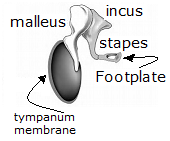
Ear drum is Explanation is provided, please click on
-
16%
a) Tensor tympani
-
15%
b) Scala tympani
-
54%
c) Tympanic membrane
-
15%
d) Scala vestibule
Explanation
Q.36.
Assertion Owls move freely during night. Reason They have large number of rods on their retina.
-
57%
a) Both Assertion and Reason are true and Reason is the correct explanation of Assertion
-
11%
b) The Assertion and Reason are true but Reason is not correct explanation of Assertion
-
17%
c) Assertion is true but, Reason is false
-
14%
d) Assertion is false but, Reason is true
Q.37.
Cranial nerve showing maximum branching is
-
17%
a) Trigeminal
-
27%
b) Vagus
-
45%
c) Optic
-
11%
d) Facial
Q.38.
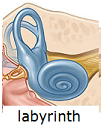
Phonoreceptors occur in
-
13%
a) Skin
-
28%
b) Middle ear
-
22%
c) Tympanum
-
37%
d) Internal ear
Explanation
Q.39.
Pressure is maintained on two sides of ear drum by
-
31%
a) Auditory ossicles
-
20%
b) Membrane labyrinth
-
40%
c) Eustachian tube
-
9%
d) Cochlea
Q.40.
Ear ossicle, incus is modified
-
17%
a) Jugal bone
-
25%
b) Articular bone
-
38%
c) Quadrate bone
-
21%
d) Hyomandibular bone
Q.41.
Synapse is bringing together of
-
5%
a) Two ventricles
-
3%
b) Two veins
-
8%
c) Two arteries
-
84%
d) Two neurons
Q.42.
Parasympathetic nervous system develops from region … ..[ CPMT 2010]
-
17%
a) Thoracolumbar
-
37%
b) Cervical
-
29%
c) Craniosacral
-
17%
d) Lumbar
Q.43.
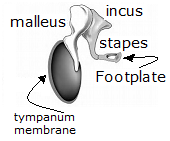
Which one belongs to middle ear?
-
43%
a) Malleus
-
22%
b) Choroid
-
19%
c) Odontoid process
-
17%
d) Malpighian cells
Q.44.
The sequence of ear ossicles from outside (tympanum) to inside is
-
27%
a) Stapes, incus and malleus
-
41%
b) Malleus, incus and stapes
-
25%
c) Stapes, malleus and incus
-
7%
d) Incus, malleus and stapes
Explanation
Q.45.
Assertion. Organ of corti rests on tectorial membrane Reason. It helps to maintain equilibrium of body
-
28%
a) If both the assertion and reason are true and reason explains the assertion
-
26%
b) If both the assertion and reason are true but reason does not explain the assertion.
-
32%
c) If assertion is true but reason is false
-
14%
d) If assertion is false but reason is true.
Q.46.
Transmission of nerve impulse is unidirectional due to
-
12%
a) Insulation of nerve fibre by medullary sheath
-
55%
b) Neurotransmitter released only at axon ending
-
16%
c) Neurotransmitter released only at dendrite ends
-
16%
d) Sodium pump starts from cyton and proceeds axon end
Q.47.
If medulla oblongata is destroyed what function is affected … .. [ AIIMS 2011]
-
16%
a) No vision
-
13%
b) No memory
-
42%
c) No thermoregulation
-
28%
d) No response when pricked with needle
Q.48.
Nerve net of Hydra lacks
-
25%
a) Neurons
-
35%
b) Direction in impulse
-
19%
c) Connections
-
21%
d) Dendrites
Q.49.
Additional parasympathetic ganglia occur in …. [ AFMC 2012]
-
13%
a) Head and neck
-
13%
b) Lateral chains
-
34%
c) Spinal cord
-
40%
d) All the above
Q.50.
Shape of eye lens is changed by
-
10%
a) Iris
-
65%
b) Ciliary muscle
-
16%
c) Pupil
-
9%
d) Optic nerve