Q.1.
During transmission of nerve impulse through a nerve fibres, the potential on the inner side of plasma membrane would change …. [ CBSE 2007]
-
20%
a) First negative, then positive and continue to be positive
-
37%
b) First positive, then negative and continue to be negative
-
17%
c) First positive, then negative and again back to positive
-
27%
d) First negative, then positive and again back to negative
Q.2.
Facial nerve arising from medulla is
-
15%
a) Motor
-
22%
b) Sensory
-
57%
c) Both a. and b.
-
5%
d) None of the above
Q.3.
Joint between the axon of a neuron and dendrite of next is called
-
66%
a) Synapse
-
17%
b) Synapsis
-
17%
c) Junction
-
0%
d) Bridge
Q.4.
The branched tree-like structure / Tree of life present in the cerebellum is
-
38%
a) Arbor vitae
-
24%
b) Arborial
-
17%
c) Archenteron
-
21%
d) Areole
Explanation

Q.5.
Organs of Ruffini are receptors of
-
7%
a) Cold
-
45%
b) Pressure
-
31%
c) Heat
-
17%
d) Touch
Q.6.
Fluid found between piamater and arachnoid is … [ MHTCET 2010]
-
7%
a) Subdural fluid
-
54%
b) Cerebrospinal fluid
-
32%
c) Tissue fluid
-
7%
d) Lymph
Q.7.
Blood brain barrier .. .. [ JKCET 2012]\
-
0%
a) Consists of anatomical and physiological factors
-
30%
b) Regulates passage of substances from blood to interstitial fluid
-
11%
c) Due to formation of tight junction between adjacent endothelial capillary cells
-
59%
d) All the above
Q.8.
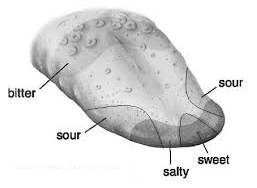
The sweet taste is better detected by
-
50%
a) Tip of the tongue
-
8%
b) Base of the tongue
-
21%
c) Middle of the tongue
-
21%
d) Lateral sides of the tongue
Explanation
Q.9.
Organ of corti occurs in
-
25%
a) Internal ear
-
30%
b) Middle ear
-
20%
c) External ear
-
25%
d) In between internal ear and middle ear
Q.10.
Autonomic nervous system affects
-
22%
a) Reflex actions
-
43%
b) Internal organs
-
26%
c) Sensory organs
-
9%
d) Motor organs
Q.11.
Correct sequence of regions in organization of auditory mechanoreceptor organ is
-
18%
a) Pinna – tympanic membrane – auditory canal – cochlea – malleus – incus – stapes – auditory nerve
-
12%
b) Pinna – malleus – incus – stapes – auditory canal – tympanic membrane – cochlea – auditory nerve
-
41%
c) Pinna – auditory canal – tympanic membrane – malleus – incus – stapes – cochlea – auditory nerve
-
29%
d) Pinna – cochlea – tympanic membrane – auditory membrane - auditory canal – incus – malleus – stapes – cochlea auditory nerve
Q.12.
Characteristics of graded potential is … .. [ AMU 2009]
-
18%
a) Always followed by a refractory period
-
29%
b) Amplitude is always the same
-
18%
c) Duration and strength varies
-
35%
d) All or none response
Q.13.
Which is required intact for sound reflex action
-
15%
a) Spinal cord
-
8%
b) Hypothalamus
-
38%
c) Cerebellum
-
38%
d) Medulla oblongata
Q.14.
Sound is transmitted from middle ear to internal ear due to
-
33%
a) Vibrations of tympanum
-
47%
b) Vibrations of stapes
-
7%
c) Striking of stapes
-
13%
d) All of these
Q.15.
It converts short term memory into long term remembrance … ..[ Guj CET 2011]
-
20%
a) Reticular system
-
20%
b) Thalamus
-
33%
c) Medulla oblongata
-
27%
d) Hippocampus
Q.16.
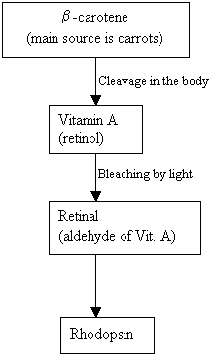
Purplish red pigment rhodopsin contained in rod type of photoreceptor cells of the human eye, is a derivative of
-
57%
a) Vitamin A
-
21%
b) Vitamin B
-
7%
c) Vitamin C
-
14%
d) Vitamin D
Explanation
Q.17.
Aperture of pupil is controlled by
-
42%
a) Conjunctiva
-
17%
b) Cornea
-
33%
c) Iris
-
8%
d) Retina
Q.18.
Match the column
| a) Diencephalon | 1) Cerebellum |
| b) Telencephalon | 2) Medulla |
| c) Myelencephalon | 3) Amygdala |
| d) Metencephalon | 4) Thalamus |
-
47%
a) a – 4, b – 3, c – 2 d- 1
-
27%
b) a – 4, b -3, c – 1, d – 2
-
20%
c) a -3, b – 4, c – 1, d -2
-
7%
d) a -1, b -2, c -3 d – 4
Q.19.
Nerve axon takes part in
-
14%
a) Receiving impulse
-
14%
b) Transformation of energy
-
43%
c) Conduction of impulse
-
29%
d) Providing energy for impulse transmission
Q.20.
Number of cranial nerves in Camel is
-
0%
a) 10
-
38%
b) 11
-
38%
c) 12
-
23%
d) 14
Q.21.
Adaptation of eye in dark occurs due to
-
25%
a) Depletion of visual pigments in rode
-
33%
b) Depletion of visual pigments in cones
-
17%
c) Repletion of visual pigments in cones
-
25%
d) Repletion of visual pigments in rod
Q.22.
Assertion: The imbalance in concentration of Na+, K+ and proteins generates resting potential reason: To maintain unequal distribution of Na+ and K+ neurons use electrical energy
-
67%
a) Both Assertion and Reason are true and Reason is the correct explanation of Assertion
-
8%
b) The Assertion and Reason are true but Reason is not correct explanation of Assertion
-
17%
c) Assertion is true but, Reason is false
-
8%
d) Assertion is false but, Reason is true
Q.23.
Synaptic vesicle occurs in … ..[ DPMT 2007]
-
60%
a) Presynaptic neuron
-
27%
b) Post-synptic neuron
-
13%
c) Synaptic cleft
-
0%
d) None of the above
Q.24.
Venom of cobra affects
-
0%
a) Respiratory system
-
54%
b) Nervous system
-
31%
c) Circulatory system
-
15%
d) Digestive system
Q.25.
Static equilibrium is maintained by
-
8%
a) Sacculus
-
15%
b) Utriculus
-
54%
c) Semicircular canals
-
23%
d) Both a and b
Q.26.
Which one is photosensitive in mammals
-
9%
a) Retinol
-
55%
b) Rhodopsin
-
27%
c) Melanin
-
9%
d) Sclerotin
Q.27.
State of complete inexcitability between polarization and repolarisation is
-
17%
a) Refractory period
-
25%
b) Synaptic delay
-
33%
c) Action potential
-
25%
d) Depolarisation
Q.28.
Cornea is transplantation is successful as cornea is
-
0%
a) Easily available
-
80%
b) Without blood supply
-
20%
c) Easily preserved
-
0%
d) Easily stiched
Q.29.
Releasing of chemical messenger from synaptic vesicles is triggered by … ..[ AIIMS 2012]
-
17%
a) Mg2+, Sr2+
-
17%
b) Fe, S
-
17%
c) Cl
-
50%
d) Ca2+
Q.30.
Color blindness is due to defect in
-
22%
a) Cones
-
22%
b) Rods
-
33%
c) Rods and cones
-
22%
d) Rhodopsin
Q.31.
When we move from dark to light, we fail to see for some time but soon the visibility becomes normal. It is
-
9%
a) Accommodation
-
45%
b) Adaptation
-
36%
c) Photoperiodism
-
9%
d) Mutation
Q.32.
Spinal cord and brain constitute … [ MHT CET 2008]
-
18%
a) Autonomous nervous system
-
0%
b) Brain stem
-
73%
c) Central nervous system
-
9%
d) Corpus callosum
Q.33.
Gland found in eye skin of rabbit is
-
36%
a) Meibomian gland
-
18%
b) Perineal gland
-
45%
c) Lacrymal
-
0%
d) Harderian gland
Q.34.
A purely motor cranial nerve is ….. [ MHTCET 2010]
-
9%
a) Olfactory
-
18%
b) Optic
-
55%
c) Abducens
-
18%
d) Vagus
Q.35.
Autonomic nervous system affects … [ MPPMT 2007]
-
33%
a) Reflex actions
-
42%
b) Internal organs
-
17%
c) Sensory organs
-
8%
d) Motor organs
Q.36.
Reflex arc made of two neutrons is …. [ WB 2011]
-
0%
a) Asynaptic
-
17%
b) Monosynaptic
-
50%
c) Disynaptic
-
33%
d) Polysynaptic
Q.37.
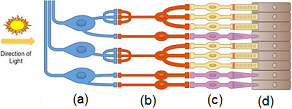
The direction of light reaching retina will be
-
55%
a) Photosensory cells - Bipolar neurons – Ganglionic cells
-
18%
b) Ganglionic cells – Photosensory cells – Bipolar neurons
-
27%
c) Ganglionic cells – Bipolar neurons – Photosensory cells
-
0%
d) Photosensory cells – Ganglionic cells – Bipolar neurons
Explanation
Q.38.
By origin brain is
-
17%
a) Endodermal
-
0%
b) Peridermal
-
25%
c) Mesodermal
-
58%
d) Ectodermal
Q.39.
Cells of Deiter occur in
-
10%
a) Retina
-
20%
b) Organ of corti
-
20%
c) Utriculus
-
50%
d) Sebaceous gland
Q.40.
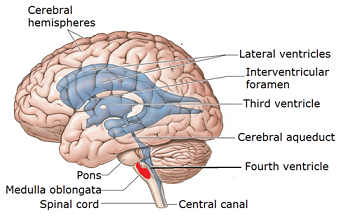
Ventricle connecting medulla oblongata with spinal cord is
-
54%
a) Fourth
-
0%
b) Fifth
-
23%
c) Third
-
23%
d) Second
Explanation
Q.41.
In mammals the brain centre regulating body temperature is found in
-
9%
a) Cerebellum
-
9%
b) Cerebral lobe
-
64%
c) Hypothalamus
-
18%
d) Medulla oblongata
Q.42.
Too short eye ball and too flat lens produce
-
11%
a) Astigmatism
-
22%
b) Presbyopia
-
33%
c) Near sightedness
-
33%
d) Far sightedness
Q.43.
Myelin sheath is produced by ….[NEET- 2017]
-
45%
a) Schwann Cells and Oligodendrocytes
-
27%
b) Astrocytes and Schwann Cells
-
18%
c) Oligodendrocytes and Osteoclasts
-
9%
d) Osteoclasts and Astrocytes
Q.44.
Cutaneous plexus and papillary plexus consist of
-
20%
a) A network of arteries providing dermal supply
-
60%
b) Network of nerves providing dermal sensation
-
10%
c) Specialized cells for cutaneous sensation
-
10%
d) Gland cells that release cutaneous secretions
Q.45.
A serious eye effect which can lead to blindness is … [ kerala 2003]
-
40%
a) Myopia
-
10%
b) Hypermetropia
-
20%
c) Presbyopia
-
30%
d) Glaucoma
Q.46.
Fenestra ovalis is
-
22%
a) Air filled cavity of middle ear
-
22%
b) External opening of tympanic cavity
-
44%
c) Opening of auditory capsule
-
11%
d) Communication between pharynx and tympanic cavity
Q.47.
Excessive stimulation of vagus nerve may lead to
-
10%
a) Hoarse voice
-
40%
b) Peptic ulcers
-
0%
c) Efficient digestion of proteins
-
50%
d) Irregular contraction of diaphragm
Q.48.
The following diagram indicates reflex arc. identify the parts labelled as a, b, c, d, e ,f and g. Choose the correct option ...[ KCET 2005]
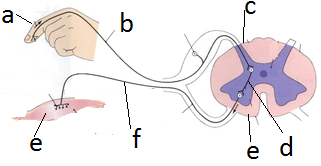
-
33%
a) a - effector, b - motor nerve, c - ventral horn, d - interneuron, e- dorsal horn, f- sensory nerve, g - sense organ
-
11%
b) a - effector, b - motor nerve, c - dorsal horn, d - interneuron, e- ventral horn, f - sensory nerve, g - effecter
-
33%
c) a - sense organ , b - sensory nerve, c - ventral horn, d - interneuron, e - dorsal horn, f - motor nerve, g- effector
-
22%
d) a - sense organ, b - sensory nerve, c - dorsal horn, d - interneuron, e - ventral horn, f - motor nerve, g - effector
Q.49.
In the given diagram which stage of the donduction of nerve impulse through nerve fibre is obsereved .... [ Guj CET 2006]
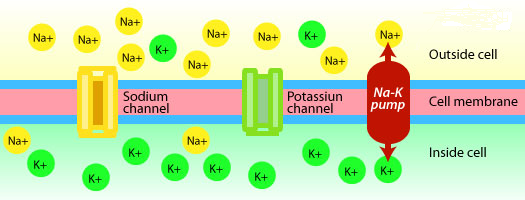
-
29%
a) Repolarisation
-
7%
b) Polarisation
-
50%
c) Depolarisation
-
14%
d) Resting potential
Q.50.
In the accompanying diagram what do a, b, c, d and e respectively .... [ Kerala 2009]
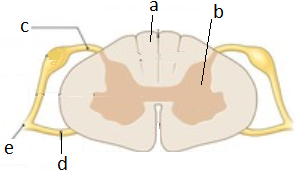
-
45%
a) a - white matter, b - grey matter, c - dorsal root, d - ventral root, e - spinal nerve
-
18%
b) a -white matter , b - grey matter, c - ventral root, d - dorsal root, e - spinal nerve
-
18%
c) a - grey matter, b - white matter, c - ventral root, d - dorsal root, e - spinal nerve
-
18%
d) a -white matter , b - grey matter,, c - spinal root, d - ventral root, e - dorsal nerve