Q.1.
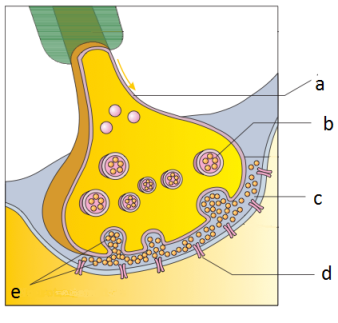
In the diagram, what do a, b, c, d and e represent .. [kerala 2010]
-
13%
a) Axon terminal, synaptic cleft, synaptic vesicls, neurotransmitters and acceptors
-
33%
b) Synaptic cleft, synaptic vesicles, axon terminal, neurotansmitter and receptors
-
40%
c) Axon terminal, synaptic vesicles, synaptic clef, receptors and neurotransmitters
-
13%
d) Synaptic vesicles, axon terminal, synaptic cleft, receptors and neurotransmitters
Q.2.
Which one of the following statements is not correct ? …[AIPMT 2014]
-
50%
a) Retinal is a derivative of Vitamin C.
-
17%
b) Rhodopsin is the purplish red protein present in rods only.
-
8%
c) Retinal is the light absorbing portion of visual photo pigments.
-
25%
d) In retina the rods have the photopigment rhodopsin while cones have three different photopigments.
Q.3.
A gymnast is able to balance his body upside down even in the total darkness because of : …[AIPMT 2015]
-
38%
a) Organ of corti
-
8%
b) Cochlea
-
46%
c) Vestibular apparatus
-
8%
d) Tectorial membrane
Q.4.
Which of the following regions of the brain is incorrectly paired with its function ? …[AIPMT 2015]
-
18%
a) Cerebrum - calculation and contemplation
-
36%
b) Medulla oblongata - homeostatic control
-
45%
c) Cerebellum - language comprehension
-
0%
d) Corpus callosum - communication between the left and right cerebral cortices
Q.5.
Photosensitive compound in human eye is made up of :- …[AIPMT-2016]
-
8%
a) Guanosine and Retinol
-
75%
b) Opsin and Retinal
-
0%
c) Opsin and Retinol
-
17%
d) Transducin and Retinene
Q.6.
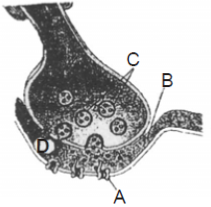
A diagram showing axon terminal and synapse is given. Identify correctly at least two of A-D …[NEET 2013]
-
45%
a) A – Receptor C - Synaptic vesicles
-
18%
b) B - Synaptic connection D - K+
-
27%
c) A – Neurotransmitter B - Synaptic cleft
-
9%
d) C – Neurotransmitter D - Ca++
Q.7.
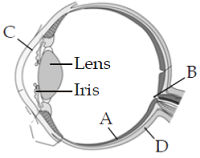
Parts A, B, C and D of the human eye are shown in the diagram. Select the option which gives correct identification along with its functions/ characteristics …[NEET 2013]
-
78%
a) A – Retina – contains photo receptors – rods and cones.
-
11%
b) B – Blind spot – has only a few rods and cones.
-
11%
c) C – Aqueous chamber – reflects the light which does not pass through the lens.
-
0%
d) D – Choroid – its anterior part forms ciliary body.
Q.8.
Choose the correct statement. …[NEET 2016]
-
60%
a) Photoreceptors in the human eye are depolarized during darkness and become hyperpolarized in response to the light stimulus.
-
30%
b) Receptors do not produce graded potentials.
-
10%
c) Nociceptors respond to changes in pressure.
-
0%
d) Meissner's corpuscles are thermo receptors.
Q.9.
Good vision depends on adequate intake of carotene rich food Select the best option from the following statements ….[NEET- 2017] (a) Vitamin A derivatives are formed from carotene (b) The photopigments are embedded in the membrane discs of the inner segment (c) Retinal is a derivative of vitamin A (d) Retinal is a light absorbing part of all the visual photopigments
-
0%
a) (a) & (b)
-
38%
b) (a), (c) & (d)
-
62%
c) (a) & (c)
-
0%
d) (b), (c) & (d)
Q.10.
Receptor sites for neurotransmitters are present on ….[NEET- 2017]
-
9%
a) Membranes of synaptic vesicles
-
36%
b) Pre-synaptic membrane
-
18%
c) Tips of axons
-
36%
d) Post-synaptic membrane
Q.11.
In mammalian eye, the 'fovea' is the center of the visual field, where : [ ReAIPMT 2015]
-
14%
a) more rods than cones are found.
-
57%
b) high density of cones occur, but has no rods
-
14%
c) the optic nerve leaves the eye
-
14%
d) Only rods are present
Q.12.
Destruction of the anterior horn cells of the spinal cord would result in loss of :- [ ReAIPMT 2015]
-
10%
a) Integrating impulses
-
30%
b) Sensory impulses
-
50%
c) voluntary motor impulses
-
10%
d) Commissural impulses
Q.13.
The transparent lens in the human eye is held in its place by … … [NEET 2018]
-
25%
a) ligaments attached to the ciliary body
-
25%
b) ligaments attached to the iris
-
0%
c) smooth muscles attached to the iris
-
50%
d) smooth muscles attached to the ciliary body
Q.14.
Which of the following structures or regions is incorrectly paired with its function ? … … [NEET 2018]
-
11%
a) Medulla oblongata : controls respiration and cardiovascular reflexes.
-
56%
b) Limbic system : consists of fibre tracts that interconnect different regions of brain; controls movement.
-
22%
c) Hypothalamus : production of releasing hormones and regulation of temperature, hunger and thirst.
-
11%
d) Corpus callosum : band of fibers connecting left and right cerebral hemispheres.