Q.1.
Common neurotransmitter of peripheral nervous system is
-
0%
a) Colcohicine
-
44%
b) Epinephrine
-
22%
c) GABA
-
33%
d) Acetylcholine
Q.2.
Cranial nerves found in man and frog are respectively
-
43%
a) 12 and 10
-
14%
b) 10 and 12
-
29%
c) 10 and 13
-
14%
d) 11 and 12
Q.3.
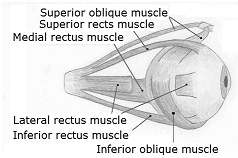
Eye ball is moved in the orbit by
-
0%
a) Four rectus and two oblique muscles
-
50%
b) Ciliary muscles
-
50%
c) Suspensory ligaments and ciliary muscles
-
0%
d) Three circular ad four oblique muscles
Explanation
Q.4.
Saltatory transmission occurs in
-
14%
a) Nonmyelinated nerve fibre
-
14%
b) Myelinated nerve fibre
-
71%
c) Both
-
0%
d) None of the above
Q.5.
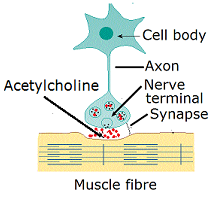
Neurotransmitter between neuron and a muscle cell is
-
29%
a) Dopamine
-
0%
b) Serotonin
-
29%
c) Endorphin
-
43%
d) Acetylcholine
Explanation
Q.6.
Action potential of a nerve cell is
-
11%
a) -60 mv
-
22%
b) -80 mv
-
44%
c) +20 mv
-
22%
d) +60 mv
Q.7.
Motor neuron of reflex arc carries impulse from … [ CET Chd 2006]
-
0%
a) Receptor to central nervous system
-
80%
b) Central nervous system of effectors
-
0%
c) Central nervous system to receptors
-
20%
d) Effectors to central nervous system
Q.8.
Broca’s area and Wernicke centre of association area occur in cerebrum. They are connected with
-
40%
a) Memory
-
0%
b)Voluntary
-
40%
c) Blind spot
-
20%
d) Both a. and b.
Q.9.
Parasympathetic nerve endings release
-
0%
a) Adrenaline
-
40%
b) GABA
-
40%
c) Acetylcholine
-
20%
d) Noradrenaline
Q.10.
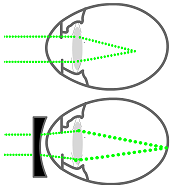
In myopia or short sightedness
-
0%
a) Image is formed slightly in front of retina because eye ball is longer
-
0%
b) Eye ball is normal but image is formed over blind spot
-
60%
c) Eye ball is normal but images is formed slightly behind the retina due to faulty lens
-
40%
d) Curvature of cornea becomes irregular
Explanation
Q.11.
Temporal lobe does not contain …[ MHTCET 2010]
-
17%
a) Wernicke's area
-
50%
b) Olfactory area
-
17%
c) Auditory area
-
17%
d) Broca’s area
Q.12.
Centre for sense of smell is
-
17%
a) Cerebellum
-
83%
b) Olfactory lobes
-
0%
c) Cerebrum
-
0%
d) Midbrain
Q.13.
Memory centre is present in
-
17%
a) Cerebellum
-
33%
b) Parietal lobe
-
33%
c) Temporal lobe
-
17%
d) Occipital lobe
Q.14.
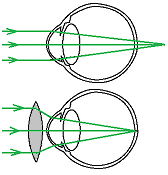
The defective condition of eye in which distant objects are seen distinct but near objects are indistinct is called
-
0%
a) Myopia
-
0%
b) Astigmatism
-
50%
c) Presbyopia
-
50%
d) Hypermetropia
Explanation
Q.15.
Which is absent in aqueous humor
-
0%
a) Carbon dioxide
-
25%
b) Oxygen
-
50%
c) Hyaluronic acid
-
25%
d) Glucose
Q.16.
Amount of CSF in cranial cavities is … ..[ WB 2011]
-
25%
a) 500 ml
-
0%
b) 150 ml
-
50%
c) 1 itre
-
25%
d) 1.5 ml
Q.17.
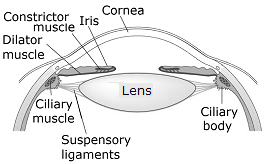
Eye focused on distant object would have
-
0%
a) Relaxed ciliary muscles and taut suspensory ligament
-
0%
b) Taut suspensory ligament and rounded lens
-
100%
c) Contracted ciliary muscles and relaxed suspensory ligaments
-
0%
d) Contracted ciliary muscles and rounded lens
Explanation
Q.18.
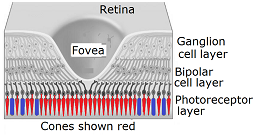
Depression in retina which has cones only is
-
0%
a) Blind spot
-
50%
b) Fenestra rotunda
-
0%
c) Fovea centralis
-
50%
d) Fenestra ovalis
Explanation
Q.19.
Ventral root of spinal nerve is composed of
-
0%
a) Somatic motor and visceral sensory fibres
-
0%
b) Somatic sensory and visceral sensory fibres
-
33%
c) Somatic motor and visceral motor fibres
-
67%
d) Somatic sensory and visceral motor fibres
Q.20.
Muller’s fibers occur in ..
-
0%
a) Heart
-
0%
b) Kidney
-
50%
c) Pancreas
-
50%
d) Retina
Q.21.
Which of the following is the tenth cranial nerve?
-
25%
a) Pneumogastric
-
25%
b) Glossopharyngeal
-
25%
c) Trochlear
-
25%
d) Tri geminal
Q.22.
Dorsal root ganglion is ....
-
0%
a) Motor
-
33%
b) Mixed
-
0%
c) Sensory
-
67%
d) None of the above
Q.23.
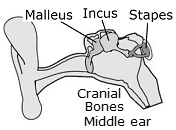
Middle ear has ...
-
0%
a) Two sets of tiny bones
-
67%
b) Three sets of tiny bones
-
33%
c) Two sets of large bones
-
0%
d) Three sets of large bones
Explanation
Q.24.
Body coordination is maintained by ...
-
0%
a) Circulatory system
-
50%
b) Nervous system
-
0%
c) Endocrine system
-
50%
d) Both b. and c.
Q.25.
Myelin sheath occurs in .... Answer : (d)
-
0%
a) Unipolar neuron
-
33%
b) Bipolar neuron
-
0%
c) Non – medullated neuron
-
67%
d) Medullated nerve fibre
Q.26.
Nerve related to diaphragm is
-
0%
a) Vagus
-
33%
b) Phrenic
-
33%
c) Trigeminal
-
33%
d) Glossopharyngeal
Q.27.
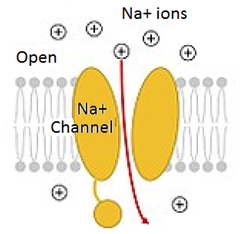
Nerve depolarization is maintained by ...
-
25%
a) Ca2+
-
25%
b) Mg2+
-
50%
c) K+
-
0%
d) Cl-
Explanation
Q.28.
Color blindness is due to defect in ...
-
0%
a) Cones
-
67%
b) Rods
-
33%
c) Rods and cones
-
0%
d) None of these
Q.29.
A frog with crushed brain is pinched on the leg is drawn away. It is ...
-
0%
a) Automatic motor response
-
25%
b) Neurotransmitter induced response
-
25%
c) Conditional reflex
-
50%
d) Simple reflex
Q.30.
Motor nerve is ...
-
0%
a) Olfactory
-
33%
b) Optic
-
0%
c) Oculomotor
-
67%
d) Vagus
Q.31.
Part of brain controlling balance and coordination is ...
-
25%
a) Cerebrum
-
0%
b) Medulla oblongata
-
50%
c) Hypothalamus
-
25%
d) Cerebellum
Q.32.
Ivan Pavlov performed experiments on ...
-
50%
a) Simple reflexes
-
0%
b) Conditioned reflexes
-
0%
c) Cardiac reflexes
-
50%
d) Origin of life
Q.33.
Under prolonged starvation , brain receives energy from ...
-
0%
a) Carbohydrates
-
33%
b) Fats
-
33%
c) Proteins
-
33%
d) Acetoacetate
Q.34.
Part of eye controlling amount of light entering is ....
-
0%
a) Iris
-
0%
b) Cornea
-
67%
c) Ciliary body
-
33%
d) Suspensory ligament
Q.35.
Occipital lobe is connected with …. [ MHTCET 2007]
-
0%
a) Smell
-
50%
b) Vision
-
50%
c) Hearing
-
0%
d) Speech
Q.36.
Cerebrum is in contact with … ..[ MHT CET 2011]
-
25%
a) Duramater
-
0%
b) Arachnoid
-
50%
c) Piamater
-
25%
d) Enterocoel
Q.37.
Assertion. No taste sensation occurs when drop of distilled water is put on tongue. Reason. Human does not have taste buds for water
-
33%
a) Both Assertion and Reason are true and Reason is the correct explanation of Assertion
-
0%
b) The Assertion and Reason are true but Reason is not correct explanation of Assertion
-
67%
c) Assertion is true but, Reason is false
-
0%
d) Assertion is false but, Reason is true
Q.38.
Color perception in human is due to ...
-
33%
a) Rhodopsin pigment in rod cells
-
33%
b) Rhodopsin pigment in cone cells
-
33%
c) Iodopsin pigment in rod cells
-
0%
d) Iodopsin pigment in cone cells
Q.39.
An isolated neuron placed in Calcium free medium is given a suprathreshold stimulus. An assay on release of neurotransmitter shows …. .. [ JKCET 2002]
-
0%
a) No neurotransmitter as Ca influx is required for conduction of action potential
-
67%
b) Neurotransmitter detected due to suprathreshold stimulus and non-requirement of Ca
-
33%
c) No neurotransmitter is detected due to absence of Ca influx into synaptic knob
-
0%
d) No prediction possible without knowing whether the neuron was myelinated
Q.40.
Alcohol affects ...
-
25%
a) Medulla oblongata
-
50%
b) Cerebellum
-
0%
c) Cerebral cortex
-
25%
d) Thalamus
Q.41.
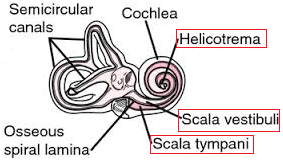
Semicircular canals occur in ...
-
33%
a) Heart
-
0%
b) Kidney
-
33%
c) Intestine
-
33%
d) Ear
Explanation
Q.42.
The processes that occur during repolarisation of nerve fibres are (i) Open Na+ channel (ii) Closed Na+ channels(ii) Closed K+ channels (iv) Open K+ channels …. [ Guj CET 2007]
-
0%
a) (ii) and (iii)
-
33%
b) (i) and (ii)
-
33%
c) (ii) and (iv)
-
33%
d) (i) and (iii)
Q.43.
Vasomotor nerves are ...
-
0%
a) Sympathetic
-
67%
b) Parasympathetic
-
33%
c) Both a. and b.
-
0%
d) None of the above
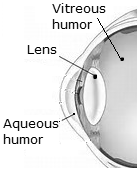
Q.44.
Aqueous and vitreous humours are separated by
-
33%
a) Lens
-
0%
b) Iris
-
33%
c) Retina
-
33%
d) Optic nerve
Explanation
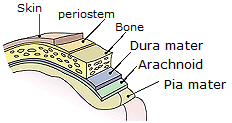
Q.45.
Correct sequence of meninges of brain from outside to inside is ....
-
25%
a) Duramater-Piamater-Arachnoid
-
0%
b) Piamater- Duramater-Arachnoid
-
25%
c) Arachnoid-Duramater-Piamater
-
50%
d) Duramater-Arachnoid –Piamater
Explanation
Q.46.
The correct pair of cervical nerves and cervical vertebrae is … [ Guj CET 2009]
-
25%
a) 7, 7
-
0%
b) 7, 16
-
25%
c) 8, 7
-
50%
d) 16,7
Q.47.
In resting stage of neuron , diffusion due to concentration gradient will drive ...
-
33%
a) K+ into cell
-
0%
b) K+ and Na+ out of cell
-
33%
c) Na+ into cell
-
33%
d) Na+ out of cell
Q.48.
In axon of a neuron, the impulse is generated by exchange of ...
-
0%
a) Sodium and chlorine
-
25%
b) Magnesium and chloride
-
0%
c) Calcium and potassium
-
75%
d) Sodium and potassium
Q.49.
Hypoglossal nerve controls movement of ...
-
33%
a) Tongue
-
0%
b) Heart
-
33%
c) Eye
-
33%
d) Ear
Q.50.
Fish are able to see under water because ... ..
-
33%
a) Both the lens and cornea are special
-
0%
b) Cornea is spherical, lens is flat
-
0%
c) Cornea is flat, lens is spherical
-
67%
d) Both lens and cornea are flat