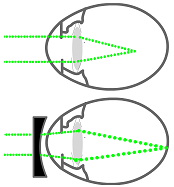
Q.1.
Specific receptors responsible for the balance of the body and posture are
-
38%
a) Organ of corti
-
12%
b) Crista and macula
-
50%
c) Basilar membrane
-
0%
d) Tectorial membrane
Q.2.
Progressive deterioration of nerve cells of brain that control finer muscular movements causes …
-
44%
a) Parkinson’s disease
-
22%
b) Alzheimer’s disease
-
22%
c) Huntigton’s chorea
-
11%
d) Epilepsy
Q.3.
Synaptic fatigue is due to
-
44%
a) Repeated release of acetylcholine
-
11%
b) Repeated release of adrenaline
-
33%
c) Exhaustion of neurotransmitter
-
11%
d) Exhaustion of acetyl cholinesterase
Q.4.
In mammals the brain centre regulating body temperature is found in …. [ BHU 2007]
-
25%
a) Cerebellum
-
0%
b) Cerebral lobe
-
75%
c) Hypothalamus
-
0%
d) Medulla oblongata
Q.5.
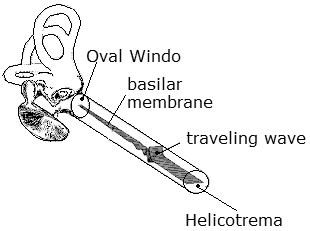
High frequency sound waves vibrate basilar membrane
-
17%
a) Near helicotrema
-
50%
b)In middle of cochlea
-
17%
c) From oval window to helicotrema
-
17%
d) Near oval window
Explanation
Q.6.
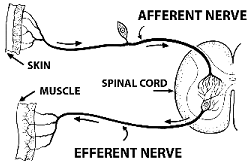
Afferent nerve fibres carry impulse from
-
0%
a) Effector organs to CNS
-
40%
b) Receptors to CNS
-
60%
c) CNS to receptors
-
0%
d) CNS to muscles
Explanation
Q.7.
Mid brain contains
-
20%
a) Corpora quadrigemina
-
20%
b) Diencephalon
-
40%
c) Cerebrum
-
20%
d) None of the above
Q.8.
Brain is dependent on blood supply for
-
25%
a) O2 and ATP
-
25%
b) O2 and electrolytes
-
25%
c) O2 and glucose
-
25%
d) ATP and glucose
Q.9.
Neopallium is found in the brain of
-
20%
a) Amphibian
-
20%
b) Advanced reptiles
-
40%
c) Mammals
-
20%
d) Both b.and c.
Q.10.
Endolymph has good quantity of
-
0%
a) Na
-
25%
b) Ca
-
75%
c) Mg
-
0%
d) Cl
Q.11.
Cerebrospinal fluid occurs
-
0%
a) Beneath arachnoid
-
20%
b) Beneath piamater
-
40%
c) Between arachnoid and piamater
-
40%
d) Between duramater and cranium
Q.12.
Lens In low light intensity, images are formed
-
20%
a) Rods
-
0%
b) Cones
-
60%
c) Both a and b
-
20%
d) Lens
Q.13.
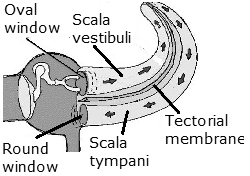
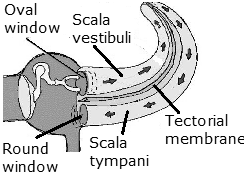
Scala vestibuli is connected with
-
0%
a) Fenestra rotundus
-
50%
b) Fenestra ovalis
-
25%
c) Scala media
-
25%
d) Eustachian tube
Explanation
Q.14.
Neurons producing hormone-like substances are
-
33%
a) Neurosecretory
-
17%
b) Sensory
-
0%
c) Motor
-
50%
d) Both a. and b.
Q.15.
Broca’s area is connected with
-
14%
a) Sensation of smell
-
14%
b) Learning and reasoning
-
43%
c) Speech
-
29%
d) Receiving impulse from eye
Q.16.
Which is thickened to form organ of corti?
-
0%
a) Tectorial membrane
-
25%
b) Ressiner’s membrane
-
25%
c) Basilar membrane
-
50%
d) All the above
Q.17.
Bony labyrinth of ear contains a fluid known as
-
0%
a) Endolymph
-
60%
b) Perilymph
-
20%
c) Humor
-
20%
d) Synovial fluid
Q.18.
Ratio of Na+ and K+ ions across nerve membrane is
-
0%
a) 50:40
-
20%
b) 60: 30
-
60%
c) 30: 10
-
20%
d) 30: 20
Q.19.
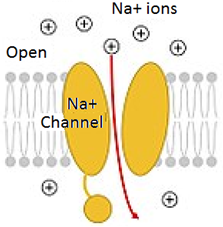
During depolarization/impulse transmission, permeability of neuron increases towards
-
0%
a) H+
-
50%
b) Na+
-
25%
c) Ag+
-
25%
d) Mg2+
Explanation
Q.20.
Route of reflex arc is
-
20%
a) Effectors, grey matter , motor fibres, sensory fibres and receptors
-
40%
b) Receptors, sensory fibres, grey matter and motor fibres
-
40%
c) Receptors, sensory fibres, grey matter, motor fibres and effectors
-
0%
d) Sensory fibres , grey matter , motor fibres , receptors and effectors.
Q.21.
Pons connects Answer : (a)
-
20%
a) Brain with spinal cord
-
0%
b) Cerebrum with cerebellum
-
80%
c) Two lobes of cerebellum
-
0%
d) Two cerebral hemispheres
Q.22.
Corpus callosum is found in
-
0%
a) Medulla oblongata
-
25%
b) Pons
-
50%
c) Cerebrum
-
25%
d) Cerebellum
Q.23.
Movement of nerve impulse across synaptic cleft is primarily
-
0%
a) Physical event
-
20%
b) Electrical event
-
80%
c) Chemical event
-
0%
d) Biological event
Q.24.
Sensory crista of ampulla of mammalian ear is connected with
-
0%
a) Sense of balance
-
33%
b) Sense of low hearing
-
33%
c) Sense of loud hearing
-
33%
d) Secretion of ear wax
Q.25.
Identify the origin of sympathetic nerve fibres and location of their ganglia … …[ WB 2012]
-
0%
a) Thoracicolumbar, close to effector organ
-
0%
b) Craniosacral, close to effector organ
-
100%
c) Thoracicolimbar, beside vertebral column
-
0%
d) Thoracicocervical, beside vertebral column
Q.26.
What are correct about control of Broca area? … [ BHU 2008]Breathing Movement of vocal cordsMovement of teethMovement of tongue
-
33%
a) 1, 2, 3 correct
-
33%
b) 1,2 correct
-
33%
c) 2, 4 correct
-
0%
d) 1, 3 correct
Q.27.
II ,VII, VIII and IX cranial nerves are
-
0%
a) Optic , facial , auditory, glossopharyngeal
-
25%
b) Optic , auditory, facial, hypoglossal
-
0%
c) Oculomotor , auditory, abducens , hypoglossal
-
75%
d) Optic , facial , abducens and glossopharyngeal
Q.28.
In brain lateral ventricle is connected to diocoel by … [ Odisha 2010]
-
0%
a) Foramen of Monro
-
50%
b) Foramen of Magendie
-
50%
c) Foramen of Luschka
-
0%
d) Both a and b
Q.29.
Vibrations of fenestra ovalis are transmitted to
-
0%
a) Endolymph of scala media
-
50%
b) Endolymph of scala vestibule
-
50%
c) Perilymph of scala vestibule
-
0%
d) Perilymph of scala tympani
Explanation
Q.30.
Middle ear contains
-
0%
a) Fluid
-
0%
b) Blood
-
50%
c) Air
-
50%
d) Wax
Q.31.
Sympathetic nervous system increases
-
40%
a) Heart beat
-
0%
b) Secretion of saliva
-
0%
c) Secretion of digestive juices
-
60%
d) All the above
Q.32.
Opacity of eye lens leads to
-
0%
a) Glaucoma
-
50%
b) Cataract
-
0%
c) Presbyopia
-
50%
d) Astigmatism
Q.33.
Match the columns
| a. Bowman’s capsule | p. Spinal cord |
| b. A.V. valves | q. Brain |
| c. Cerebellum | r. Kidney |
| d. Alveoli | s. Heart |
| - - - - | t. Lungs |
-
0%
a) a. –r. , b.- s. , c. – t., d. – q.
-
33%
b) a. –r., b.- t. , c.- s. , d. – q.
-
67%
c) a. – r. , b. – s. , c. – q. , d. – t.
-
0%
d) a. – p. , b. – q. , c. – s. , d. – t.
Q.34.
Reduction in elasticity of eye lens with eye causes
-
50%
a) Myopia
-
0%
b) Presbyopia
-
0%
c) Cataract
-
50%
d) Hypermetropia
Q.35.
Rods and cones of retina are modified
-
0%
a) Bipolar neurons
-
0%
b) Unipolar neurons
-
50%
c) Multipolar neurons
-
50%
d) Hairs
Q.36.
Which of the following nerves innervates the alimentary canal/thoracic region … ..[ Guj CET 2010]
-
0%
a) Oculomotor
-
33%
b) Abducens
-
67%
c) Vagus
-
0%
d) Trigeminal
Q.37.
Cerebrospinal fluid is formed by
-
0%
a) Ependymal cells
-
75%
b) Choroid plexus
-
0%
c) Neurons
-
25%
d) Neuroglial cells
Q.38.
In mammals, the organ of corti occurs in
-
0%
a) Tympanic canal
-
50%
b) Cochlear canal
-
0%
c) Vestibular canal
-
50%
d) Auditory meatus
Q.39.
Nerve fibres in resting stage is …. [ DPMT 2008]
-
0%
a) Less permeable to K+
-
25%
b) Semipermeable
-
75%
c) More permeable to K+
-
0%
d) All the above
Q.40.
Assertion a : In depolarization process there is a positive charge on the outer side of nerve fibres and negative change on its inner side Reason r: During depolarization, permeability of plasma membrane increases for sodium ions, so Na+ ions move to outer side of the membrane and K+ enter the nerve fibre
-
100%
a) Both a and r correct with r being correct reason for a
-
0%
b) Both a and r correct with r is not correct reason for a
-
0%
c) a is correct but r is wrong
-
0%
d) Both a and r are wrong
Q.41.
Cones are concentrated at
-
0%
a) Fovea centralis
-
50%
b) Blind spot
-
0%
c) Edge of retina
-
50%
d) Choroid
Q.42.
Cranial nerves are part of … …
-
33%
a) Sympathetic nervous system
-
0%
b) Parasympathetic nervous system
-
33%
c) Somatic nervous system
-
33%
d) Central nervous system
Q.43.
Ions involved in conduction of nerve impulse are
-
75%
a) Na+ , K+
-
0%
b) Na+ , Ca2+
-
25%
c) Ca2+ , Mg2+
-
0%
d) K+, Mg2+
Q.44.
Lens and cornea do not blood supply. They are supplied with nutrients by
-
50%
a) Vitreous humor
-
50%
b) Aqueous humor
-
0%
c) Blind spot
-
0%
d) Retina
Q.45.
First cranial nerve is
-
0%
a) Auditory
-
0%
b) Optic
-
50%
c) Olfactory
-
50%
d) Oculomotor
Q.46.
The receptors for sound waves are present on
-
0%
a) Organs of corti
-
33%
b) Reissner’s membrane
-
33%
c) Semicircular canals
-
33%
d) Sacculus
Q.47.
Initiation of nerve impulse is due to … ..[ Wardha 2011]
-
0%
a) Release of Ca2+
-
0%
b) Absorption of Ca2+
-
33%
c) Stoppage of Na+ - K+ ATP-ase pump
-
67%
d) Activation of Na+ - K+ ATP-ase pump
Q.48.
Medulla oblongata encloses
-
67%
a) Fourth ventricle
-
0%
b) Third ventricle
-
0%
c) Second ventricle
-
33%
d) Optic lobes
Q.49.
Fovea centralis perceives
-
67%
a) Dim light
-
0%
b) Diffuse light
-
0%
c) Colored light and bright light
-
33%
d) Colored light and dim light
Q.50.
Eye is near-sighted when
-
0%
a) Near object is focused behind retina
-
0%
b) Distant object is focused behind retina
-
100%
c) Distant object is focused in front of retina
-
0%
d) Near object is focused in front of retina
Explanation