Q.1.
The number of unpaired electrons in the complex ion [CoF6]3- is ..[CBSE PMT 2003] [At No Co=27]
-
7%
a) 2
-
29%
b) 3
-
43%
c) 4
-
21%
d) zero
Q.2.
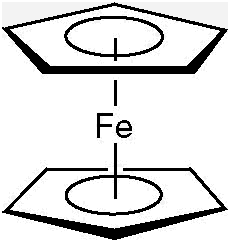
Ferrocene is an example of ..[J And K CEE 2003]
-
36%
a) Sandwich complex
-
18%
b) pi-bonded complex
-
27%
c) A complex in which all the five carbon atoms of cyclopentadine anion are bonded to metal
-
18%
d) All of these
Explanation
Q.3.
The chemical formula for iron(III) hexacyanoferrate(II) is .. [ JIPMER 2001]
-
30%
a) Fe[Fe(CN)6]
-
30%
b) Fe3[Fe(CN)6]
-
0%
c) Fe3[Fe(CN)6]4
-
40%
d) Fe4[Fe(CN)6]3
Q.4.
The colour of CoCl3 . 5NH3 . H2O is [ kerala MEE 2002]
-
44%
a) Orange yellow
-
0%
b) Orange
-
44%
c) pink
-
11%
d) Violet
Q.5.
The type of isomerism present in nitropentaamminechromium(III) chloride is [ AIEEE 2002]
-
0%
a) Optical
-
40%
b) Linkage
-
20%
c) Ionization
-
40%
d) Polymerization
Q.6.
The crystal field splitting energy for octahedral (Δ0) and tetrahedral(Δt) complexes is related to .
-
30%
a) Δt = (4/9) Δ0
-
40%
b) Δt = (1/2)Δ0
-
10%
c) Δ0 = 2Δt
-
20%
d) Δ0 = (4/9)Δt
Q.7.
The number of ions formed on dissolving one molecule of FeSO4(NH4)2SO4 . 6H2O is/are [ AIIMS 2001]
-
29%
a) 6
-
0%
b) 3
-
0%
c) 5
-
71%
d) 4
Q.8.
When AgNO3 is added to a solution of Co(NH3)5Cl3, the precipitate of AgCl shows two ionizable chloride ions. this means..[ Manipal PMT 2002]
-
33%
a) Two chlorine atoms satisfy primary valency and one secondary valency
-
0%
b) one chlorine atom satisfy primary as well as secondary valency
-
50%
c) three chlorine atoms satisfy primary valency
-
17%
d) three chlorine atoms satisfy secondary valency
Q.9.
one mole of complex compound Co(NH3)5Cl3 gives 3 moles of ions on dissolution in water. one mole of the same complex reacts with two moles of AgNO3 solution to yield two moles of AgCl(s). the structure of the complex is ..[AIEEE 2003]
-
50%
a) [Co(NH3)3Cl3] . 2NH3
-
33%
b) [Co(NH3)4Cl2]Cl. NH3
-
0%
c) [Co(NH3)4Cl] Cl2NH3
-
17%
d) [Co(NH3)5Cl]Cl2
Q.10.
Which of the following species represent the example of dsp2 hybridization [ manipal; PMT 2002]
-
20%
a) [fe(CN)6]3-
-
20%
b) [Ni(CN)4]2-
-
40%
c) [Ag(CN)2]-
-
20%
d) [Co(CN)6]3-
Q.11.
Both geometrical and optical isomerisms are shown by ..[ Chd.CET 2002]
-
43%
a) [Co(en)2Cl2]+
-
43%
b) [Co(NH3)5Cl]2+
-
0%
c) [Co(NH3)4Cl2]+
-
14%
d) [Cr(ox)3]3-
Q.12.
What is the coordination number of metal in [Co(en)2Cl2]+ .. [ haryana CEET 2003]
-
20%
a) 4
-
20%
b) 5
-
40%
c) 6
-
20%
d) 3
Q.13.
Which of the following acts as ligand but does not possess any unshared pair of electrons?
-
14%
a) C2H4
-
29%
b) NH3
-
29%
c) en
-
29%
d) CN-
Q.14.
The effective atomic number of iron in [Fe(CN)6]3- is
-
17%
a) 34
-
33%
b) 36
-
33%
c) 37
-
17%
d) 35
Q.15.
Atomic number of Cr and Fe are respectively 25 andWhich of the following is paramagnetic with the spin of the electron [ CBSE PMT 2002]
-
0%
a) [Cr(CO)6]
-
20%
b) [Fe(CO)5]
-
60%
c) [Fe(CN)6]4-
-
20%
d) [Cr(NH3)6]3+
Q.16.
According to IUPAC nomenclature, sodium nitroprusside is named as [ CBSE PMT 2003]
-
20%
a) sodium nitroferricyanide
-
20%
b) sodium nitroferrocyanide
-
40%
c) sodium pentacyanonitrosylferrate(II)
-
20%
d) sodium pentacyanonitrosylferrate(III)
Q.17.
In the spectrochemical series, the magnitude of the crystal field splitting is maximum for which ion? [ Harayana CEET 2003]
-
20%
a) Cl-
-
0%
b) F-
-
60%
c) NO2-
-
20%
d) CN-
Q.18.
The IUPAC name of K3[Ir(C2O4)3] is ..[MPPMT 2001]
-
33%
a) potassium trioxalatoiridium(III)
-
17%
b) potassium trioxalatoiridate(III)
-
33%
c) potassium tris(oxalato)irridium(III)
-
17%
d) potassium tris(oxalato)iridate(III)
Q.19.
In the complexes [Fe(H2O)6]3+, [Fe(CN)6]3- and [FeCl6]3-, more stability is shown by ..[AIEEE 2002]
-
75%
a) [Fe(H2O)6]3+
-
0%
b) [Fe(CN)6]3-
-
25%
c) [Fe(C2O4)3]3-
-
0%
d) [FeCl6]3-
Q.20.
A similarity between optical and geometrical isomerism is that [ AIEEE 2002]
-
0%
a) Each gives equal number of isomers for a given compound
-
20%
b) If in a compound one is present then so is the other
-
40%
c) Both are included in stercoisomerism
-
40%
d) they have no similarity
Q.21.
Which of the following statement is incorrect about Werner's theory?
-
40%
a) Primary valency is the same thing as oxidation state
-
20%
b) Secondary valency is the same thing as coordination number
-
0%
c) Secondary valencies are satisfied by negative ions
-
40%
d) Secondary valencies are directional whereas primary valencies are non directional
Q.22.
In an octahedral crystal field splitting, the number of orbitals pushed down in energy is ..[DEC 2001]
-
0%
a) 3
-
20%
b) 2
-
40%
c) 5
-
40%
d) zero
Q.23.
Which of the following will not show geometrical isomerism? [ MP PMT 2002]
-
20%
a) [Cr(NH3)4Cl2]Cl
-
20%
b) [Co(en)2Cl2]Cl
-
20%
c) [Co(NH3)5NO2]Cl2
-
40%
d) [Pt(NH3)2Cl2]
Q.24.
Correct name of Ce(NH3)6 Cl3 is [ haryana CEET 2003]
-
60%
a) hexaamminechromium(III) chloride
-
0%
b) hexaammine chromium(II) chloride
-
20%
c) hexaammoniachromium(III) chloride
-
20%
d) Chromium(III) hexaammine chloride
Q.25.
Haemoglobin is a complex of ..[CPMT 2003]
-
20%
a) Fe3+
-
40%
b) Fe2+
-
40%
c) Fe4+
-
0%
d) Cu2+
Q.26.
Which of the following cannot show linkage isomerism? [ DEC 2001]
-
0%
a) NO2-
-
25%
b) SCN-
-
50%
c) CN-
-
25%
d) NH3
Q.27.
In the silver plating of copper , K[Ag(CN)2] is used instead of AgNOthe reason is [ CBSE PMT 2002]
-
20%
a) A thin layer of Ag is formed on Cu
-
0%
b) More voltage is required
-
40%
c) Ag+ ions are completely removed from solution
-
40%
d) Less availability of Ag+ ions, as Cu cannot displace Ag from [Ag(CN)2]- ion
Q.28.
Which one of the following octahedral complexs does not show geometric isomerism? [ And B are monodentate ligands] [ CBSE PMT 2003]
-
20%
a) [MA2B4]
-
0%
b) [MA3B3]
-
40%
c) [MA4B2]
-
40%
d) [MA5B]
Q.29.
The volume (in mL) of 0.1 M AgNO3 required for complex precipitation of chloride ions present in 30 mL of 0.01 M solution of [Cr(H2O)5Cl]Cl2, as silver chloride is close to Answer: (d)
-
20%
a) 3
-
0%
b) 4
-
40%
c) 5
-
40%
d) 6