Q.1.
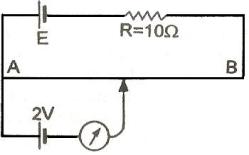
In figure, AB is potentiometer wire of length 10 m and resistance 1Ω. The balancing length for 2 volt p.d. is 8m. The emf of the battery E is
-
25%
a) 2.75 V
-
25%
b) 13.75 V
-
38%
c) 27.5 V
-
12%
d) 5.5 V
Q.2.
64 cells, each of emf 2volt and internal resistance 2Ω are connected to supply a maximum current through an external resistance of 8×10⁻³ Ω. Then the cells must be connected in
-
38%
a)series only
-
0%
b) parallel only
-
50%
c)mixed series and parallel arrangement
-
12%
d)any of the above three combination
Q.3.
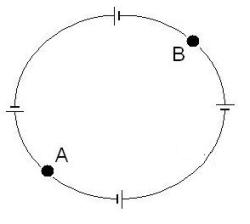
Four identical cells each having emf E, internal resistance zero are connected as shown in figure. The potential difference between A and B is :
-
11%
a) 4E
-
22%
b) 2E
-
22%
c)E
-
44%
d)zero
Q.4.
In a potentiometer experiment, it is found that no current flows through the galvanometer when the terminals of the cells are connected across 52 cm of the potentiometer wire. If cell is shunted by a resistance of 5Ω a balance is found when the cell is connected across 40 cms of the wire. the internal resistance of the cell is
-
0%
a) 5 Ω
-
50%
b) (200/52) Ω
-
17%
c) (52/8) Ω
-
33%
d) 1.5 Ω
Q.5.
A short piece of iron wire glows red hot when placed across the terminals of a2 volts accumulator ( storage battery), but the same piece of wire does not get worm when connected across the terminals of 9 volt 'dry' battery. This is because
-
0%
a) the dry battery is smaller
-
50%
b) the dry battery does not contain enough electric charges
-
33%
c) the wire makes better contact with accumulator
-
17%
d) the dry battery has a high internal resistance
Q.6.
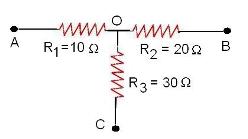
In the circuit show below R1=10Ω, R2=20Ω, R3=30Ω and the potentials of points A, B and C are 10V, 6V and 5V respectively. The current through resistance R1 is :
-
17%
a)0.1 A
-
50%
b) 0.2 A
-
0%
c)0.3 A
-
33%
d)0.4 A
Q.7.
In an electrolyte 3.2×10¹⁸ bivalent positive ions drift to the right per second while 3.6×10¹⁸ monovalent negative ions drift to left per second. Then the current is
-
0%
a) 1.6 amp. to the left
-
80%
b) 1.6 amp to the right
-
0%
c)0.45 amp. to the left
-
20%
d)0.45 amp to the right
Q.8.
A cell of emf E and internal resistance r is connected in series with an external resistance nr. Then the ratio of the terminal potential difference to emf is
-
0%
a) 1/n
-
20%
b) 1 (n+1)
-
60%
c)n/(n+1)
-
20%
d)(n+1)/ n
Q.9.
In comparing emf's of two cells with the help of a potentiometer, at the balance point the current flowing through the wire is taken from
-
0%
a) one of these cells
-
0%
b) both of these cells
-
80%
c) the battery in the main circuit
-
20%
d) none of above
Q.10.
A number of cells are to be grouped so as to obtain maximum current. The internal resistance of each cell is r and the total external resistance is R. Which of the following is wrong?
-
40%
a)Series combination for R >r and parallel for R < r
-
20%
b) Series combination for R
r -
20%
c)Mixed combination for R=r
-
20%
d)None of the above
Q.11.
Two dry cells P and Q have same emf. The dimensions of cells P are more than that of Q. r1 and r2 denotes internal resistance of P and Q respectively. Then
-
0%
a) r1 and r 2
-
40%
b) r1 > r 2
-
0%
c)r1 < r 2
-
60%
d)r1 and r 2 are unrelated to one another
Q.12.
A battery is connected in series with an external resistance. The current in the circuit is 1A and 0.7 A when external resistance equals 5Ω and 8Ω respectively. The internal resistance of battery is
-
0%
a) 0.2Ω
-
60%
b) 0.5Ω
-
20%
c)2Ω
-
20%
d)0.6Ω
Q.13.
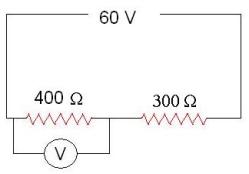
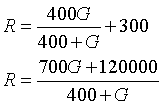
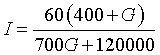
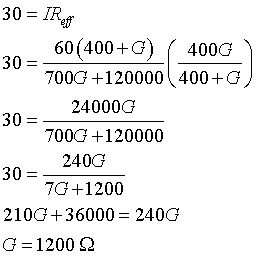
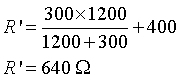
In the circuit shown in the figure a voltmeter reads 30V when it is connected across 400Ω resistance. Calculate what the same voltmeter will read if it is connected across 300Ω resistance
-
20%
a) 30 V
-
40%
b) 60 V
-
40%
c) 22.5 V
-
0%
d) zero
Explanation
Q.14.
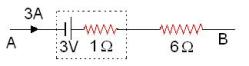
Figure represents a part of closed circuit. The potential difference between A and B i.e. VA - VB
-
0%
a)24 V
-
17%
b) 0 V
-
67%
c)6 V
-
17%
d)18 V
Q.15.
A conductor contains 8×10²² free electrons per cubic metre. The conductor carries a current of 1A and has a length of 10cm. the are of cross section of the conductor is 7.81×the time taken by an electron to move from one end of the conductor to the other end is
-
40%
a) 10-2s
-
0%
b) 10-4 s
-
40%
c)105 s
-
20%
d)106
Q.16.
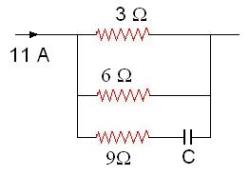
In figure current in 3Ω and 6Ω resistance is
-
33%
a)7.33A ; 3.67A
-
33%
b) 3.67A; 7.33A
-
0%
c)10.0A ; 15.0A
-
33%
d)3.37A ; 6.74A
Q.17.
In a potentiometer experiment, the balancing length is 8m when two cells E1 and E2 are joined in series. When the two cells connected in opposite the balancing length is 4 m. The ratio of the emf of two cells ( E1 / E2=is
-
0%
a)1:2
-
20%
b) 2:1
-
20%
c)1:3
-
60%
d)3:1
Q.18.
The resistance in the left and right gap of a meter bridge are 3 Ω and 5Ω respectively. When resistance in the left gap increases by 10 percent, the balance point shifts by
-
40%
a) 2.2 cm left
-
40%
b) 22 cm left
-
0%
c) 22 cm right
-
20%
d) 2.2 cm right
Q.19.
When resistance P and Q are kept in the left gap of a metre bridge the balance point is obtained at 40cm and 60 cm. respectively.When P and Q are connected in series in the same gap the balance point will be nearly at
-
0%
a) 68.4 cm from left
-
20%
b) 64.4 cm from right
-
40%
c) 64.6 cm from left
-
40%
d) 64.6 cm from right
Q.20.
Potential gradient is defined as:
-
60%
a) Fall of potential per unit length of the wire
-
20%
b) Fall of potential per unit area of the wire
-
20%
c) Fall of potential between two ends of the wire
-
0%
d) Potential at any one ends of the wire
Q.21.
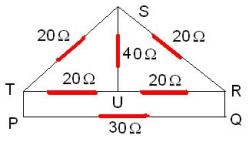
Calculate the resistance between points P and Q in the circuit shown in the figure
-
17%
a)7.5 Ω
-
67%
b) 12 Ω
-
0%
c)50 Ω
-
17%
d)20 Ω
Q.22.
Amperes hour is the unit of
-
33%
a) quantity of charge
-
50%
b) strength of current
-
0%
c)power
-
17%
d)energy
Q.23.
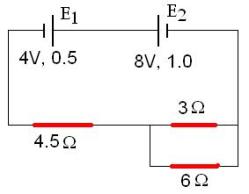
In circuit shown, the cell E1 and E2 have emf of 4V and 8V. Internal resistance of 0.5Ω and 1Ω respectively. Then the potential difference across E1 and E2 will be
-
20%
a) 4.25 V; 4.25V
-
60%
b) 3.75V; 3.75V
-
20%
c)4.25V; 7.5V
-
0%
d)3.75V; 7.5V
Q.24.
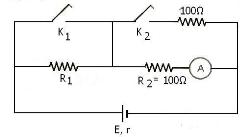
In the circuit, when key K1 is closed, the ammeter reads Io whether K2 is open or closed. But when K1 is open, the ammeter reads Io/2 when K2 closed. Assuming that the ammeter resistance is much less than R2, find value of r and R1( in ohms)
-
0%
a) 100, 50
-
25%
b) 50, 100
-
42%
c) 0, 100
-
33%
d) 0, 50
Q.25.
The terminal potential difference of a battery exceeds its emf when it is connected ( Pb.C.E.T. 1997)
-
40%
a)in parallel with battery of higher emf
-
0%
b) in series with a battery of higher emf
-
40%
c)in series with battery of lower emf
-
20%
d)in parallel with a battery of lower emf
Q.26.
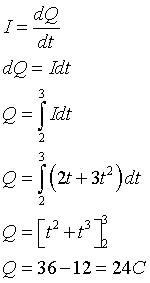
The current I in a conductor varies with time t as I=2t + 3t2, where I is in ampere and t in seconds. Electric charge flowing through a section of the conductor during t=2s to t=3s is ( Orissa JEE 2003]
-
20%
a) 10 C
-
40%
b) 24C
-
40%
c)33C
-
0%
d)44C
Explanation
Q.27.
According to Joule's law if potential difference across a conductor having a material of specific resistance ρ, remains constant, then heat produced in the conductor is directly proportional to
-
60%
a) 1 / √ρ
-
40%
b) 1/ρ
-
0%
c)ρ
-
0%
d)ρ2
Q.28.
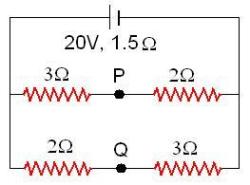
If in the circuit. The internal resistance of the battery is 1.5Ω and VP and VQ are potentials at P and Q respectively. What is the potential difference between the points P and Q?
-
0%
a) Zero
-
20%
b) 4 volts ( Vp > VQ)
-
60%
c) 4 volts (VQ > VP)
-
20%
d) 2.5 volts (VQ > VP)
Q.29.
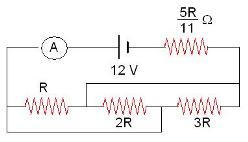
In the circuit shown, the ammeter reads 2A. The resistance of ammeter is negligible. The value of R is
-
40%
a)2 Ω
-
20%
b) 4 Ω
-
20%
c)6 Ω
-
20%
d)8 Ω
Q.30.
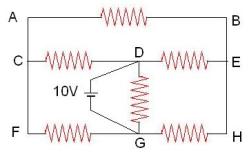
All resistance shown un circuit are 2Ω each. The current in the resistance between D and E is
-
17%
a) 5 A
-
33%
b) 2.5 A
-
33%
c)1 A
-
17%
d)7.5 A