Q.1.
A battery is used to charge a parallel plate capacitor till the potential difference between the plates becomes equal to the electromotive force of the battery. The ratio of the energy stored in the capacitor and the work done by the battery will be [ AIEEE 2007]
-
62%
a)1/2
-
8%
b) 1
-
15%
c)2
-
15%
d)1/4
Q.2.
The resistance of wire is 5 Ω at 50° and 6Ω at 100°C. The resistance of the wire at 0° will be [ AIEEE 2007]
-
0%
a) 3 Ω
-
23%
b) 2 Ω
-
54%
c)1 Ω
-
23%
d)4 Ω
Q.3.
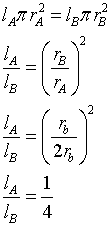
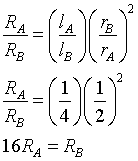
Two uniform wires A and B are of same metal have equal masses. The radius of wire A is twice that of wire B. The total resistance of A and B when connected in parallel is [ MNR 1994]
-
60%
a)4Ω when the resistance of wire A is 4.25Ω
-
10%
b) 5Ω when the resistance of wire A is 4Ω
-
10%
c)4Ω when the resistance of wire B is 4.25Ω
-
20%
d)5Ω when the resistance of wire B is 4Ω
Explanation
Q.4.
In Bohr's model of hydrogen atom the electron moves around the nucleus in a circular orbit of radius 5×10-11 metres. Its time period is 1.5×10⁻¹⁶ second. The current associated with the electron motion is [ MNR 1992]
-
0%
a) zero
-
10%
b) 1.6×10⁻¹⁹ A
-
40%
c) 0.17 A
-
50%
d) 1.07×10⁻³ A
Q.5.
In a neon gas discharge tube 2.9×10¹⁸ Ne+ ions are move to the right through a cross section of tube each second, while 1.2×10¹⁸ electrons move to the left in this time. The electronic charge is 1.6×10⁻¹⁹ coulomb. Then the net electric current in the tube is [ MPPMT 1999]
-
9%
a)1 amp to the right
-
73%
b) 0.66 amp to the right
-
9%
c)0.66 amp to the left
-
9%
d)zero
Q.6.
At 0 K Germanium behaves as a [ EAMCET 1989]
-
9%
a) conductor
-
36%
b) insulator
-
36%
c)super conductor
-
18%
d)ferromagnetic substance
Q.7.
Two non-idel batteries are connected in parallel. Consider the following statements(i) The equivalent e.m.f. is smaller than either of the two e.m.f.'s(ii) The equivalent internal resistance is smaller than either of the two internal resistance's [MPPMT 1999]
-
36%
a)Both (i) and (ii) are correct
-
18%
b) (i) is correct but (ii) is incorrect
-
36%
c)(ii) is correct but (i) is incorrect
-
9%
d)Both (i) and (ii) are incorrect
Q.8.
The specific resistance and cross section area of potentiometer wire is ρ and A respectively. If a current I is passed through the wire, the potential gradient of wire will be [ Raj.PMT 1996]
-
36%
a) (Iρ) /A
-
18%
b) I/(Aρ)
-
27%
c) (IA) / ρ
-
18%
d) IAρ
Q.9.
A box with two terminals is connected in series with a 2V battery, an ammeter and a switch. When a switch is closed the needle of ammeter moves quickly across the scale and then drop back to zero. The box contains
-
50%
a)a 20 Ω resistor
-
20%
b) a strip of copper
-
10%
c)a diode
-
20%
d)a fuse wire
Q.10.
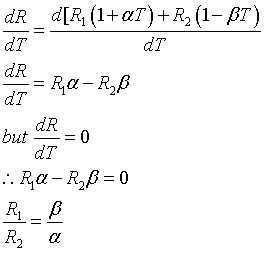
Two resistance's R1 and R2 are made of different materials. The temperature coefficient of the material of R1 is α and of the material of R2 is -β. The resistance of the series combination of R1 and R2 will not change with temperature, if R1 / R2 equals [ MPPMT 1997]
-
17%
a) α / β
-
42%
b) ( α+ β) /( α- β)
-
8%
c)( α2 + β2 ) / αβ
-
33%
d)β / α
Explanation
Q.11.
Drift velocity is equal to [ BHU 1995]
-
8%
a) 1 / ne
-
58%
b) I / neA
-
33%
c)I/ne
-
0%
d)i/A
Q.12.
If n, e, τ and m represent electron density, charge, relaxation time and mass of an electron respectively, then the resistance of a wire of length l and cross-sectional area A is
-
55%
a)

-
0%
b)

-
27%
c)

-
18%
d)

Q.13.
A copper wire and aluminum wire of same length have same resistance. Specific resistance of aluminum is more than that of copper. Which of the following statement is correct?
-
42%
a)Mass of copper and aluminum wire same
-
8%
b) Mass of copper wire is more than that of aluminum wire
-
8%
c)MAss of copper wire is less than that of aluminum wire
-
42%
d)Nothing can be said as information given is incomplete
Q.14.
Constanton wire is used for making standard resistance because it has [ MPPMT 1999]
-
8%
a) low specific resistance
-
17%
b) high specific resistance
-
58%
c)negligible temperature coefficient of resistance
-
17%
d)high melting point
Q.15.
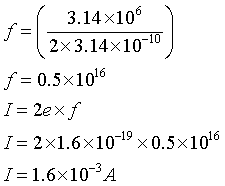
An α particle ( mass=4mp, charge 2e) is revolving in a circular orbit of radius 1Å, with speed 3.14×10⁶m/s. The equivalent current is
-
45%
a) 1.6 mA
-
27%
b) 3.2mA
-
27%
c)6.4 mA
-
0%
d)0.8mA
Explanation
Q.16.
The resistance of certain piece of wire is 9Ω, the resistance of second piece, identical to first, except that its diameter is 3 times as large will be [ BIT 1989]
-
31%
a) 1 Ω
-
23%
b) 3Ω
-
31%
c) 9Ω
-
15%
d) 27Ω
Q.17.
Two wires of same material have lengths L and 2L and cross-sectional area 4A and A respectively. The ratio of their specific resistance's would be [ CPMT 1993]
-
46%
a)1 : 1
-
23%
b) 1 : 8
-
8%
c)8 : 1
-
23%
d)1 : 2
Q.18.
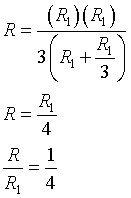
Two wires of same length and material have their cross-sections in the ratio of 1:3 The two wires are joined so that their ends fuse into one another without any other change. The ratio of the resistance of the fused wire and the wire of small cross-section is
-
55%
a) 1:3
-
18%
b) 1:4
-
18%
c)1:2
-
9%
d)4:1
Explanation
Q.19.
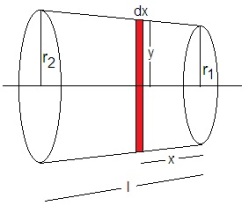
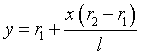
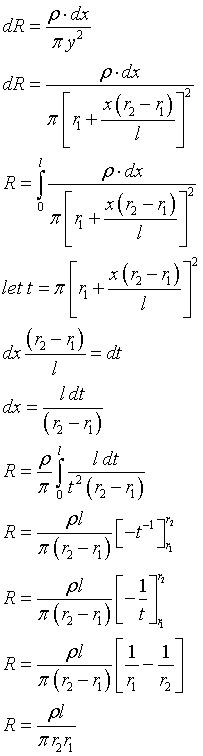
A resistor is in the shape of truncated right circular cone. The end radii are r1 and r2 ( r1 < r2) and altitude is l. If the taper is small, then the resistance between the plane faces of this resistor is
-
22%
a)

-
22%
b)

-
56%
c)

-
0%
d)

Explanation
Q.20.
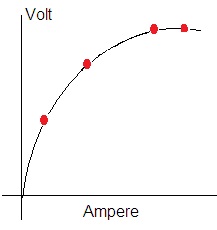
Variation of current passing through a conductor as the voltage applied across its ends is varied as shown in the adjoining diagram. If the resistance is determined at the point A, B, C and D. We find that resistance at [CPMT 1989]
-
45%
a) C and D are equal
-
18%
b) B is higher than at A
-
27%
c) C is higher than at B
-
9%
d) A is lower than at B
Q.21.
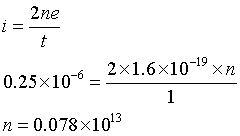
A steady beam of α- particles ( q=2e) traveling with constant kinetic energy of 20MeV carries a current 0.25µA. If the beam is directed perpendicular to a plane surface, how many α- particles strike the surface in 3 secs?
-
50%
a)2.3×10¹²
-
10%
b) 2.3×10¹⁹
-
10%
c)2.3×10⁸
-
30%
d)2.3×10⁶
Explanation
Q.22.
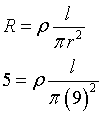
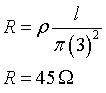
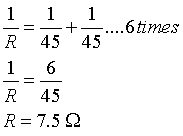
An electric cable of copper has just one wire of radius 9mm. Its resistance is 5Ω. This single copper wire of the cable is replaced by 6 different well insulated copper wires each of radius 3mm. The total resistance of the cable will now be equal to [ CPMT 1989]
-
45%
a) 7.5Ω
-
9%
b) 45Ω
-
36%
c)90Ω
-
9%
d)270Ω
Explanation
Q.23.
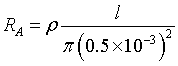
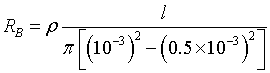
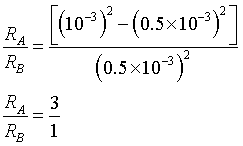
Two conductors are made of the same material and have the same length. Conductor A is solid wire of diameter 1mm. Conductor B is hollow tube of outer diameter 2mm and inner diameter 1mm. The ratio of resistance RA to RB is :
-
33%
a) 3:1
-
33%
b) 1:3
-
22%
c)1:1
-
11%
d)2:1
Explanation
Q.24.
The temperature of a metal wire rises when an electric current passes through it because
-
9%
a) collision of conduction electrons with each other releases heat energy
-
55%
b) collision of conduction electrons with the atoms of the metal gives them energy which appears as heat
-
27%
c) When the conduction electrons fall from higher energy level to lower energy level heat energy is released
-
9%
d) Heat energy is released when the conduction electrons are separated from their parent atoms
Q.25.
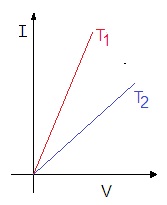
The current I and voltage V graph for a given metallic wire at to different temperatures T1 and T2 are shown in the figure. It is concluded that
-
9%
a) T1 > T2
-
64%
b) T1 < T2
-
27%
c) T1 = T2
-
0%
d) T1 = 2T2
Q.26.
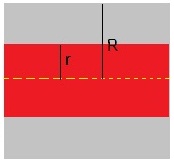
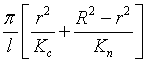
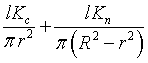
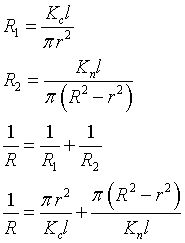
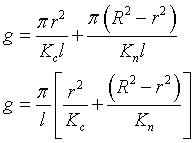
A copper wire of length l and radius r is nickel plated till its final radius is R and length l. If the specific resistance of nickel and copper ne Kn and Kc then the conductance of nickeled wire is
-
12%
a)

-
25%
b)

-
62%
c)
-
0%
d)
Explanation
Q.27.
A steady current i passes through a linear conductor of uniform cross-section. Any given segment of the conductor has
-
9%
a) a net negative charge
-
27%
b) a net positive charge
-
55%
c)a zero net charge of any kind
-
9%
d)a net charge proportional to the volume of the segment
Q.28.
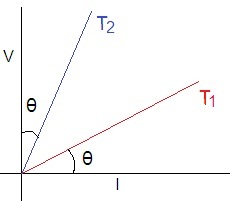
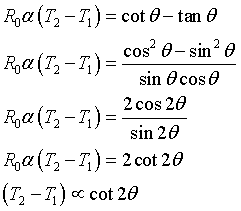
The V-I graph for conductor at temperatures Ti and T2 are shown in the figure. (T2 - T1) is proportional to :
-
50%
a) cos2θ
-
12%
b) sin2θ
-
38%
c) cot2θ
-
0%
d) tan2θ
Explanation
Q.29.
The resistivity of a material is inversely proportional to
-
11%
a)number density of electrons as well as relaxation time
-
44%
b) number density of electrons and directly proportional ro relaxation time
-
11%
c)relaxation time and directly proportional to the number density of electrons
-
33%
d)neither relaxation time nor number density of electrons
Q.30.
A steady current is passing through a linear conductor of non-uniform cross-section. The net quantity of charge crossing any cross-section per second is
-
33%
a) directly proportional to the area of cross-section
-
11%
b) inversely proportional to the area of cross-section
-
33%
c)independent of the area of cross-section
-
22%
d)directly proportional to the length of conductor